
درباره سایت
آخرین مطالب
- راهنمای ثبت سفارش آنلاین و استعلام قیمت کائولن
- چگونه بهترین اکسید آهن قرمز (اخرا) را برای پروژه انتخاب کنیم؟
- بررسی جامع خواص اکوستیک و وزن مخصوص باریت سفید صنعتی
- نقش کائولن در کاهش هزینههای تولید در صنایع معدنی
- نقش سیلیس در افزایش مقاومت حرارتی مواد نسوز
- چرا اکسید آهن قرمز (اخرا) قدرت پوشانندگی بالایی دارد؟
- The role of industrial barite in the papermaking and specialty coatings industries
- How to find the best kaolin supplier in the country?
- How to properly examine feldspar analysis?
- ما هي استخدامات التالك الصناعي في صناعة البلاستيك والمطاط؟
امکانات وب
What is Kaolin? A Comprehensive Introduction to This Widely-Used Mineral
Kaolin, also known in Persian as "china clay," is one of the most valuable industrial minerals, used across a wide range of industries. It forms as a soft, white, earthy rock, and its main constituent is the mineral "kaolinite." The chemical formula of kaolinite is Al2Si2O5(OH)4; meaning this mineral is composed of hydrated aluminum silicate, whose crystal structure binds layers of aluminum oxide and silicon oxide together.
The name kaolin is derived from the "Gaoling" region in China, where this material was first extracted and high-quality porcelain tiles and vessels were made from it. Today, kaolin is extracted in many countries around the world, including China, the United States, Brazil, England, India, and Iran, and its global market has been constantly growing due to the sustained demand from the tile, ceramic, paper, paint, plastic, rubber, and pharmaceutical industries.
One of the most important properties of kaolin is its natural white color. This exceptional whiteness makes kaolin an ideal choice as a filler and coating material in industries where the brightness and luster of the final product matter. Beyond whiteness, kaolin possesses other physical and chemical characteristics that distinguish it: high heat resistance, chemical neutrality, adequate adhesion and plasticity when mixed with water, the ability to suspend particles in water, and a very fine particle size.
In nature, kaolin is formed as a weathering product of feldspar-bearing rocks (such as granite) over millions of years. In this process, water, organic acids, and carbon dioxide react with feldspar and break it down; the result is the formation of kaolinite clay, which accumulates in mines as thick layers. The quality of the extracted kaolin depends on the level of impurities such as iron, titanium, and other unwanted minerals, which are removed during processing.
From an industrial application standpoint, kaolin is supplied in two general forms: raw and processed. Raw kaolin is extracted directly from the mine and offered after crushing, while processed kaolin reaches higher purity and whiteness through more complex operations such as magnetic separation, acid washing, and particle classification. In industries such as tile, ceramic, glaze, paper, and paint—each requiring a specific degree of whiteness, particle size distribution, and chemical purity—choosing the right type of kaolin plays a vital role in the quality of the final product.
Kaolin Production Methods and Process; From Mine to Final Product
The kaolin production process begins with exploration and extraction. Geologists, by conducting exploratory drilling and analyzing samples, identify kaolin deposits and evaluate their quality based on parameters such as whiteness, alumina percentage, iron and titanium impurity levels, and particle size distribution. After a deposit is proven economically viable, extraction is usually done by open-pit method; in this method, the topsoil and overlying layers are removed and then the mineral is extracted with heavy machinery.
After extraction, the raw kaolin enters the processing circuit. In the dry processing method, kaolin is directly classified and packaged after primary crushing, drying, and grinding. This method is suitable for kaolins with relatively high purity that require less whiteness in their applications. But in the wet processing method, which is more complete, kaolin is mixed with water and a suspension of clay particles is formed. At this stage, coarse particles and rocky impurities are separated using hydrocyclones and screens.
One of the key stages in producing high-quality kaolin is magnetic separation. Since iron oxide and other magnetic minerals reduce the whiteness of kaolin, these unwanted particles are removed as much as possible using powerful magnetic separators. In some cases, acid washing or oxidation processes are used to increase the whiteness degree. The output of this stage is kaolin with a high brightness degree, tailored to the needs of industries sensitive to this characteristic.
The next stage is dewatering and drying. Kaolin is dewatered through filter presses or centrifuges and then reaches the desired moisture level in kilns or industrial dryers. After drying, kaolin is ground and classified by particle size. One of the most important indicators at this stage is the "mesh" number; the 450 to 1500 mesh range indicates the extremely fine particles of processed kaolin. For example, 1500-mesh kaolin has particles much thier than 450-mesh kaolin and is more suitable for applications requiring a high contact surface and greater uniformity (such as paints, coatings, and fine paper).
Finally, after final quality control—including whiteness, particle size distribution, moisture, pH, and chemical purity tests—kaolin is packaged in bags or large bundles and supplied to the market. The diversity of production processes means products with different quality grades exist in the market, and each industry can choose the suitable kaolin based on its needs. Professional producers such as Amiran Kani Sang Project, by applying strict quality control at all stages, offer uniform products matching the needs of industrial customers.
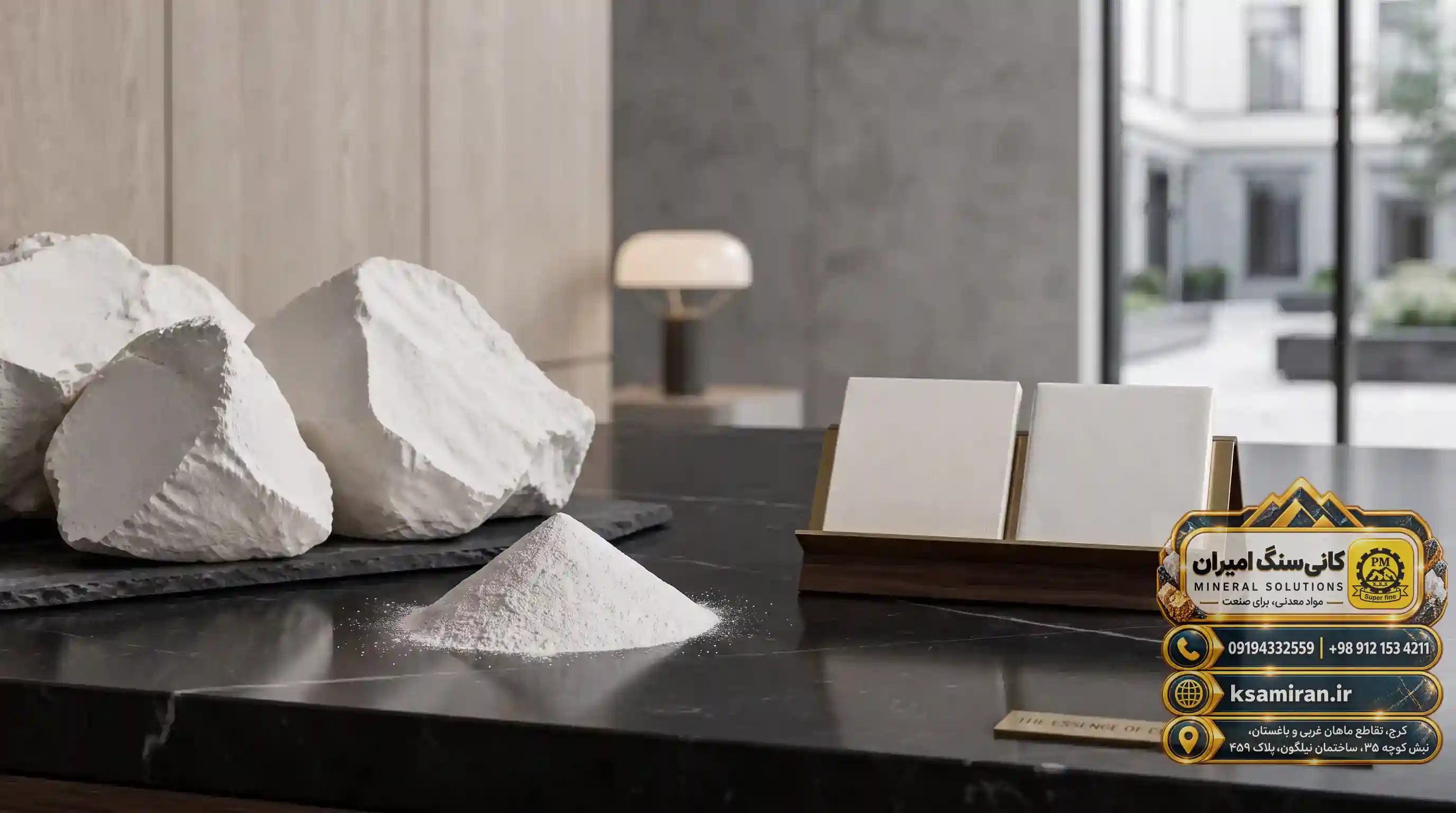
Application of Kaolin in the Tile and Ceramic Products Industry
The tile and ceramic industry is one of the largest consumers of kaolin in the world. In the body of tiles and ceramic products, kaolin plays multiple and vital roles: as the main body-forming material, as a plasticity and bonding agent, and ultimately as a whitening agent.
In tile body formulation, kaolin is combined with other minerals such as feldspar, quartz, and other clays. By creating plasticity, kaolin allows the mixture to be shaped easily; whether in the dry pressing method for wall and floor tile production, or in extrusion and casting methods for producing more complex ceramic products. Without kaolin or similar clays, the tile slip and powder would lack the necessary formability, and the final product would suffer from cracks and defects.
Another important role of kaolin in the ceramic industry is creating mechanical strength in the unfired product (green strength). After pressing or shaping, the unfired tile must maintain its integrity until firing; kaolin, due to its layered structure and bonding property, provides this strength. Also during the firing process in the kiln, which takes place at high temperatures, kaolin decomposes and forms new phases such as mullite. Mullite is a crystalline aluminum silicate with high thermal and mechanical resistance that greatly increases the strength of the fired ceramic product.
The whiteness of kaolin is also very important in the tile and ceramic industry. In white wall tiles, light ceramic tiles, and decorative ceramic products, the whiteness of the body directly affects the transparency and beauty of the glaze. The whiter and purer the kaolin used, the more beautiful the color and luster of the final product. For this reason, kaolin with a high whiteness degree and low iron impurity is used in higher-value ceramic industries.
In the production of ceramic products such as porcelain vessels, sanitary ware (basins, toilets), ceramic insulators, and technical ceramics, kaolin is an essential material. Porcelain vessels (bone china and porcelain) require high-quality kaolin to achieve their special translucency and luster after firing. In the production of ceramic sanitary ware, kaolin forms a major part of the body and guarantees the product's strength, formability, and uniform appearance.
Choosing the right kaolin for the tile and ceramic industry depends on factors such as alumina percentage, particle size distribution, whiteness, impurity levels, and behavior at firing temperature. Kaolin with finer particles (higher meshes) usually shows better reactivity in the kiln and produces more mullite phases, while coarser kaolin is useful for its own specific applications.
The Role of Kaolin in Glaze Production; From Particle Suspension to Final Transparency
Glaze is a glass-like, semi-transparent coating applied to the surface of tiles and ceramic products to create a glossy, smooth, hygienic surface resistant to moisture, abrasion, and chemicals. In glaze composition, kaolin is considered one of the essential and indispensable materials and constitutes a significant share of its formulation.
One of the most important functions of kaolin in glaze is its role as a suspending agent. Glaze is prepared as an aqueous suspension, and all its constituents must remain suspended and stable in water until applied to the tile. With its layered structure and colloidal property, kaolin prevents the settling of heavier particles such as frits, quartz, and feldspar, keeping the glaze slip uniform. This property is critical for avoiding quality variations on the tile surface.
Kaolin is also the source of alumina (Al2O3) and silica (SiO2) in glaze. Alumina increases the chemical resistance, hardness, and toughness of the glaze, and silica forms the glaze's glass network. During firing in the kiln, kaolin melts with feldspar and frits and creates a continuous glass phase that covers the tile surface. The thermal behavior of kaolin and its thermal expansion coefficient must be coordinated with the tile body to prevent defects such as crazing or shivering.
In producing white and light glazes, the whiteness of kaolin plays a decisive role. The whiter the kaolin and the freer it is of iron and titanium impurities, the lighter and more transparent the glaze will be. Also, kaolin's particle size directly affects glaze quality; kaolin with higher meshes (finer particles) disperses better in water and creates a smoother and more uniform final surface. This characteristic is very important for high-quality tiles and luxury ceramic products.
Kaolin is used in all types of glazes, including glossy, matte, transparent, and colored. In matte glazes, kaolin produces a light-scattering surface with microscopic particles. In glossy glazes, kaolin helps form a smooth and shiny surface. In colored glaze production, kaolin acts as a base for uniform dispersion of pigments. Also in the tile industry, kaolin is used to produce engobe—the intermediate layer between the body and glaze—to provide whiteness and better glaze-to-body bonding.
An important point for glaze producers is controlling kaolin purity. The presence of iron impurities causes yellow or brown spots on the fired glaze surface and makes the product unacceptable in the market. For this reason, choosing processed kaolin with high purity and high whiteness is a quality requirement in the glaze industry.
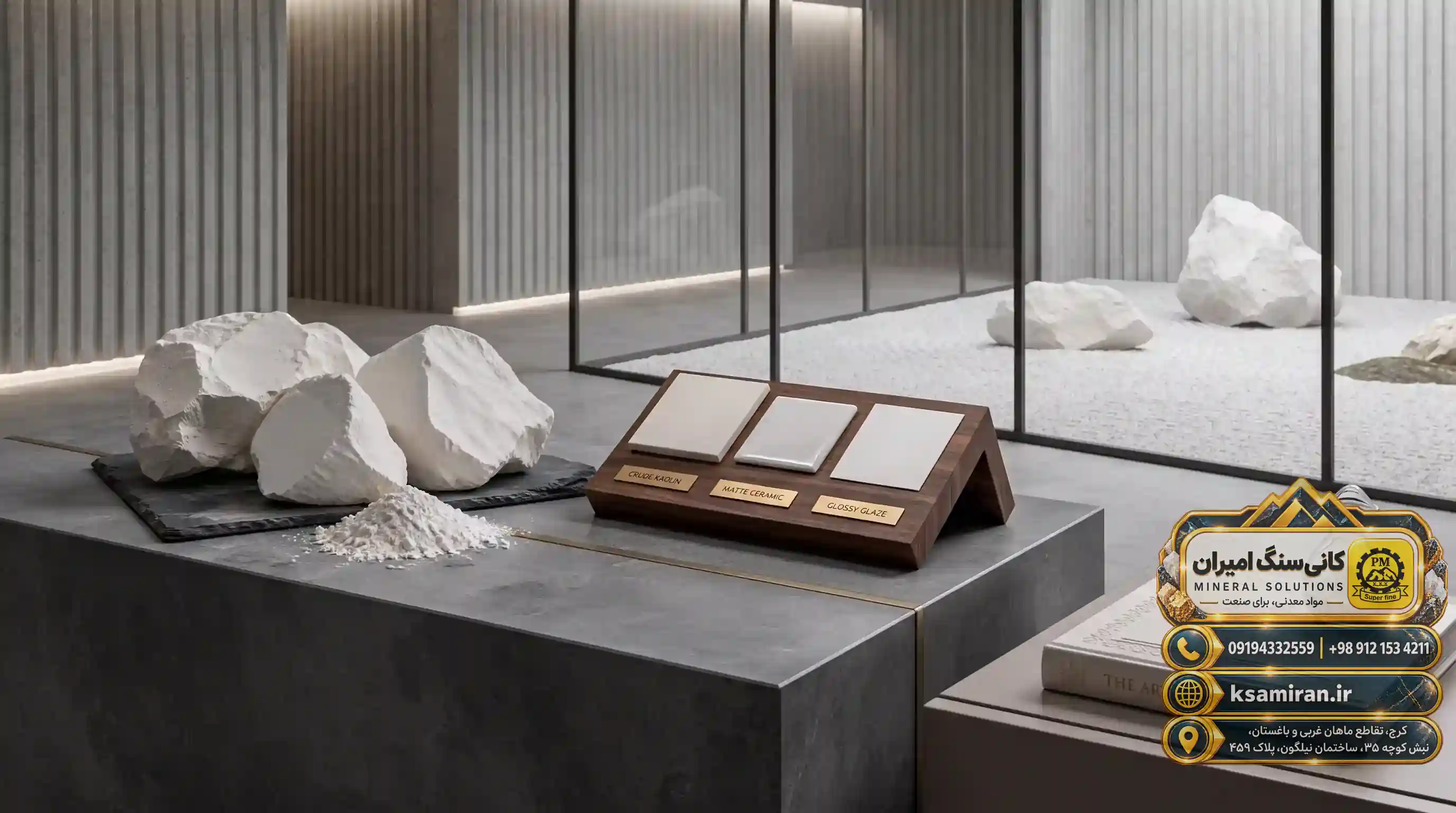
Application of Kaolin in the Paper Industry; Filler and Coating Pigment
The paper-making industry is one of the most important consumers of kaolin in the world. In this industry, kaolin is used in two main forms: as a filler and as a coating pigment. Both applications play a vital role in determining the quality, appearance, and cost of the final paper.
As a filler, kaolin is placed in the pores between cellulose fibers. This makes the paper smoother, denser, and brighter. Kaolin also increases the opacity of the paper; that is, it prevents light from passing through the paper so that writing on one side does not show on the other. This property is vital for printing paper, book paper, and magazines. In addition, kaolin significantly increases the whiteness of the paper and replaces part of the cellulose fibers, which are more expensive.
In the coating process, the paper is covered with a thin layer of kaolin and other pigments. Coating kaolin must have very fine particles and a polygonal (hexagonal) shape to create an extremely smooth and dense surface. Coated papers—such as art paper, luxury magazine paper, and catalog paper—have outstanding printability due to this coating; ink spreads evenly on the smooth surface, and images are printed with high resolution and color quality.
The quality of kaolin in the paper industry is measured by indicators such as brightness degree, coatability, particle size distribution, suspension viscosity, and impurity percentage. High-brightness kaolin is used for high-quality papers, and lower-grade kaolin is used for paperboard, structural papers, and recycled products. Higher-mesh kaolins (such as 800 to 1500 mesh) are used in producing fine paper and luxury printing due to their smoother surface and better coating capability.
Another advantage of using kaolin in paper-making is the reduced consumption of wood fibers. By replacing part of the fibers with kaolin, in addition to reducing production costs, pressure on forests and cellulose resources is decreased. This is important from both environmental and production-economy perspectives. Also, kaolin is inert and does not react with paper-making process chemicals, which ensures the stability of the production process.
The paper market has undergone significant changes with digital transformation, but demand for packaging paper, paperboard, and hygienic papers continues to grow. Paper manufacturers still need high-quality kaolin and have set stringent standards for its quality. Choosing a reliable supplier that can provide uniform kaolin with consistent indicators is a competitive advantage for paper mills.
Application of Kaolin in the Paint Industry; Extender Pigment with High Economic Benefit
In the paint manufacturing industry, kaolin is known as an extender pigment. Water- and solvent-based paints typically consist of primary pigments such as titanium dioxide (TiO2) and organic and inorganic pigments, which are expensive. Kaolin, at a much lower price, replaces part of these expensive pigments and reduces the final cost of the paint without compromising product quality.
One of the most important roles of kaolin in paint is increasing hiding power and opacity. Kaolin particles, with their polygonal shape and high specific surface area, scatter light within the paint layer and enable the paint to cover the underlying surface better. This property allows the paint to have the necessary covering power with a smaller volume of the primary pigment. Also, by dispersing TiO2 particles and preventing them from agglomerating, kaolin increases the efficiency of this expensive material.
Kaolin also affects the gloss and durability of industrial coatings. Fine kaolin particles make the paint surface smoother and more even after drying, resulting in higher gloss. In matte paints, kaolin helps control the gloss level and creates a uniform coating without excessive reflection. To read more on this topic, see the article Examining the Effect of Kaolin on the Gloss and Durability of Industrial Coatings, which covers this subject in a specialized way.
In architectural, industrial, and marine paints, kaolin plays an important role in improving paint durability and resistance. Kaolin increases abrasion resistance, wash resistance, and the paint's stability against weather conditions. Also, kaolin's suspension property prevents pigments from settling in the paint can and improves the paint's spreadability on the surface. These properties are vital for paints used in harsh environmental conditions.
Kaolin's particle size plays a decisive role in its application in paint. Lower-mesh (coarser) kaolin is used for economical paints and primers, while higher-mesh kaolin (such as 1250 and 1500 mesh) is used for high-quality paints, automotive paints, and delicate industrial coatings. Refined kaolins with a high whiteness degree are used for light and white paints, while lower-whiteness kaolins can be used in dark paints.
Ultimately, due to its chemical neutrality, kaolin is stable in combination with all kinds of pigments and resins and is fully compatible with paint-making processes. This mineral plays a key role in producing economical, high-quality, and durable paints, and without it, the price of paints would increase dramatically.

Technical Specifications of Kaolin and the Importance of the 450 to 1500 Mesh Range
One of the most important technical indicators of kaolin is its particle size, expressed in "mesh" units. The mesh number indicates the number of holes in the screen per unit area; the higher the mesh number, the finer the particles. The kaolin offered by Amiran Kani Sang Project is provided in the 450 to 1500 mesh range, indicating extremely fine particles and the capability for use in sensitive industries.
450-mesh kaolin: Has relatively fine particles and is suitable for applications requiring high thermal reactivity. This grade of kaolin is mainly used in the tile, ceramic, and building ceramic products industries, where kaolin must react in the kiln and form new phases such as mullite. It is also used in producing industrial glazes and engobe.
800 to 1000-mesh kaolin: Has finer particles. This grade is suitable for applications requiring a balance between price and quality; such as filler papers, architectural paints, industrial paints, and high-quality glazes. In the paper industry, these meshes are used for filler papers and medium coated papers.
1250 to 1500-mesh kaolin: Has very fine particles. These kaolins are used for professional and high-quality applications such as automotive paints, industrial coatings, fine printing papers, luxury glazes, and delicate ceramic products. The high specific surface area of these particles creates outstanding light scattering and reactivity.
In addition to particle size, other indicators are important in kaolin's technical specifications. The whiteness degree, often varying between 80 and 95 percent, is vital for paper, paint, and glaze applications. The alumina (Al2O3) percentage, which in kaolin constitutes a significant portion of the chemical composition, determines its thermal behavior and resistance in ceramics and glaze. The iron oxide (Fe2O3) content must be very low to prevent unwanted coloration.
Other technical parameters include moisture percentage, suspension pH (neutral), oil absorption level—which is important in the paint industry—and the levels of titanium, calcium, and potassium impurities. Each industry determines the acceptable range of these parameters based on its needs, and the supplier must provide a product within that range.
Particle size distribution is also important relative to the average particle size. A good kaolin has a uniform distribution; meaning most of its particles fall within a defined range, with very few very coarse or very fine particles. This uniformity ensures stability in the production process and final product quality. Reputable manufacturers supply kaolin with precise particle size control and accurate classification so each industry receives a product suited to its needs.
Guide to Purchasing and Supplying Industrial Kaolin
Buying industrial kaolin for factories is a strategic decision that directly affects the quality of the final product and production costs. The first step in a successful purchase is precisely determining technical requirements: your industry (tile, ceramic, glaze, paper, or paint), the required whiteness degree, the appropriate mesh, alumina percentage, and maximum permissible impurities. Without specifying these parameters, choosing the right kaolin among the market's diverse products will be difficult.
The second factor is selecting a supplier. A reliable supplier must be able to provide a uniform and high-quality product, present valid technical test results, have stable supply capacity, and advise the customer on kaolin applications. Amiran Kani Sang Project, as a mineral materials producer, covers diverse industrial needs by offering kaolin in the 450 to 1500 mesh range.
The third point is understanding the market and prices. Kaolin prices change based on factors such as whiteness degree, mesh, purchase volume, packaging method, and mineral market fluctuations. To better understand market trends, reading the article Analysis of Kaolin Price Trends in the Mineral Market helps you buy at the right time and negotiate knowledgeably with the supplier.
The fourth point is shipment quality control. Even if the supplier is well-known, receiving a Certificate of Analysis (COA) for each shipment and conducting incoming tests are recommended. Parameters such as whiteness, particle size distribution, moisture, and alumina percentage must match the agreed values. Uniformity between different shipments is the key to your production process stability.
The fifth point is packaging and transportation. Kaolin must be transported in packaging that protects against moisture and contamination. Plastic bags, one-ton bundles, and strapping are each suitable for specific purchase volumes. Also, having a nearby warehouse and proper logistics services reduces your transportation costs.
The sixth point is the variety of complementary products. Mineral projects that offer multiple products can meet your various needs and avoid duplicated costs. For example, if your industry also needs other minerals, the Guide to Submitting an Online Purchase Request for Industrial Barite can show the path to collaborating with a multi-product supplier.
Ultimately, buying kaolin is a long-term business partnership, not a one-time deal. Choosing a supplier that can deliver high-quality products and technical support alongside the growth of your business is worth far more than a few percent of short-term discount. By considering the above points, you can purchase the kaolin suitable for your industry with confidence.
| Question | Answer |
|---|---|
| What is kaolin? | Kaolin, or china clay, is a white mineral mainly composed of the kaolinite mineral (hydrated aluminum silicate), widely used in the tile, ceramic, glaze, paper, and paint industries. |
| What are the main applications of kaolin? | The most important applications of kaolin include producing tiles and ceramic products, glaze, paper (as a filler and coating pigment), and paint (as an extender pigment). |
| What does kaolin mesh mean, and what does the 450 to 1500 mesh range signify? | The mesh number indicates particle size; the higher the mesh, the finer the particles. The 450 to 1500 mesh range means very fine kaolin particles, suitable for sensitive industrial applications. |
| Why is kaolin used in the tile and ceramic industry? | Kaolin has plasticity and bonding properties, increases the strength of the unfired product, forms mullite in the kiln, and boosts the strength and whiteness of the final product. |
| What is the role of kaolin in paper production? | As a filler and coating pigment, kaolin increases the whiteness, opacity, smoothness, and printability of paper and saves on cellulose fiber consumption. |
| How is kaolin used in the paint industry? | As an extender pigment, kaolin replaces part of the titanium dioxide, raises opacity and hiding power, reduces paint costs, and improves coating durability and gloss. |
| What is the difference between raw and processed kaolin? | Raw kaolin is offered directly after extraction and crushing, while processed kaolin attains higher purity and whiteness through processes such as magnetic separation and classification. |
| What properties make kaolin so widely used? | High whiteness, chemical neutrality, thermal resistance, plasticity, suspension capability in water, and adjustable particle size are key properties of kaolin. |
| How is kaolin produced? | After extraction from the mine, kaolin is produced through crushing, dry or wet processing, magnetic separation, drying, grinding, and classification based on particle size. |
| What points should be considered when buying industrial kaolin? | Determining technical requirements (mesh, whiteness, purity), choosing a reliable supplier, receiving a certificate of analysis, paying attention to packaging, and tracking market price trends are the most important purchasing considerations. |
The technical data and product specifications in this article were prepared using information provided by Amiran Kani Sang Project (mineral materials production).
برچسب: Kaolin,What is Kaolin? A Complete Review of the Industrial Applications of This Widely,Used Mineral,
نویسنده: رساوب آفرین