
درباره سایت
آخرین مطالب
- بررسی استانداردهای ایمنی کار با اکسید لیمونیت (گل ماش)
- Comprehensive Guide to Technical Analysis of Limonite Oxide (Gol Mash)
- الدليل الشامل للتحليل الفني لأكسيد الليمونيت (جول ماش)
- مراجعة معايير السلامة للعمل مع أكسيد الليمونيت (جول ماش)
- چگونه از تقلب در خرید اکسید لیمونیت (گل ماش) جلوگیری کنیم؟
- How to Prevent Fraud When Purchasing Limonite Oxide (Gol Mash)?
- کاربرد تخصصی اکسید لیمونیت (گل ماش) در تولید بتن
- Specialized Application of Limonite Oxide (Yellow Ochre) in Concrete Production
- راهنمای جامع آنالیز فنی اکسید لیمونیت (گل ماش)
- التطبيق التخصصي لأكسيد الليمونيت (غل ماش) في إنتاج الخرسانة
امکانات وب
What is Feldspar? Structure, Types, and Its Role in Industry
Feldspar is the name of one of the most important and abundant groups of minerals in the Earth's crust. These minerals make up a large part of igneous rocks such as granite, syenite, and rhyolite, and geologically belong to the tectosilicate category. It is estimated that the feldspar family accounts for more than half of the volume of the Earth's crust, and therefore they are considered one of the most accessible mineral resources for various industries.
Chemically, feldspars are aluminum silicates in whose crystal structure potassium, sodium, or calcium ions are located. The general formula of this group is defined based on the combination of alumina (Al₂O₃) and silica (SiO₂) along with alkali oxides. In fact, the three-dimensional crystal lattice of feldspar is formed from SiO₄ and AlO₄ tetrahedra, in the empty space between which cations such as K⁺, Na⁺, and Ca²⁺ are placed, giving the lattice stability.
Feldspars are divided into three major groups: potassium feldspar (orthoclase and microcline with the composition KAlSi₃O₈), sodium feldspar (albite with the composition NaAlSi₃O₈), and calcium feldspar (anorthite with the composition CaAl₂Si₂O₈). The plagioclase series includes a continuous range between albite and anorthite. This very variety of composition allows feldspar to be used in very different industries.
In terms of physical properties, feldspar is usually seen in white, cream, pink, or gray colors, and its hardness on the Mohs scale is around 6. This mineral has two perfect cleavage directions at an angle close to 90 degrees, and its specific gravity is about 2.5 to 2.8. These properties make grinding and dispersing its particles in various systems easy.
In industrial texts, feldspar is known as a versatile mineral that is introduced for glass, tiles, ceramics, and glaze. In the glass industry, this material is a source of alumina and alkali and helps reduce the melting temperature and increase the strength of glass. In the tile and ceramic industries, its role as a flux in the body and one of the main components of glazes is prominent; where, by melting at the right temperature, it creates a transparent and resistant network on the tile surface.
But beyond these traditional applications, ground feldspar has found a special place today in the formulation of paints and industrial coatings. Particles of this mineral are used as a functional mineral filler in paint and bring properties such as hardness, chemical stability, brightness, and economic advantage to the paint formulation. This is exactly the topic we will discuss in detail in this article.
In the following, we review seven key reasons for using feldspar in the paint and industrial coatings industries: from its chemical composition and its role as a functional filler to hardness, chemical stability, its effect on drying and surface roughness, the importance of particle size, and finally the main applications of this mineral. If you are familiar with kaolin, barite, or other mineral fillers, you will see that feldspar has a distinct position among them.
Chemical Composition of Feldspar and Its Role in Paint Performance
The chemical composition of feldspar is the main determining factor of this mineral's behavior in paint formulation. As mentioned, feldspar basically consists of silica (SiO₂) and alumina (Al₂O₃) along with alkali oxides such as K₂O, Na₂O, and in some types CaO. This composition makes a hard, chemically inert, and bright material that is ideal for industrial coatings.
The presence of alumina in the feldspar structure is one of its most important advantages in the paint industry. Alumina contributes to the hardness, durability, and scratch resistance of the dried paint film. In coatings exposed to mechanical wear — such as floor paints, traffic paints, and industrial machinery coatings — this feature means increased lifespan and preservation of the coating's appearance over time.
Silica, which makes up the largest part of the feldspar structure, is one of the most stable mineral compounds. This material has high resistance against acids and bases, is not decomposed by ultraviolet light, and is compatible with most paint resins. This stability causes feldspar particles not to change color over time and to retain their dispersibility in the film layer.
The alkali oxides present in feldspar, although they act as fluxes in glass and ceramic applications, mainly remain as part of a stable chemical structure in paint systems. The important point is that these compounds do not have significant reactivity under normal environmental conditions and do not negatively affect the stability of the paint film. This distinguishes feldspar from many impure minerals.
Another important feature of feldspar's composition is its low iron content in high-quality grades. Iron compounds in many minerals are the main cause of yellowing or dulling of light-colored paints. The inherent brightness and low coloration of high-quality feldspar allow it to be used in white, gray, and pastel paints without causing significant color change over time.
This chemical behavior is somewhat similar to kaolin; except that kaolin has a clay-like layered structure and shows different oil absorption and adhesion. To lea about the role of kaolin in this industry, you can read the article Application of Kaolin in Paint Manufacturing and Industrial Coatings. The chemical composition of feldspar makes it a complementary option alongside kaolin and other fillers.
Also, the difference in feldspar's behavior in water-based and solvent-based systems should be mentioned. In water-based paints (acrylic and polyvinyl acetate), feldspar particles remain stable in the presence of water and dispersing agents and do not release ions, which is compatible with most emulsions. In industrial solvent-based paints, this mineral maintains the chemical stability of the formula during long-term storage due to its non-reactivity with organic resins.
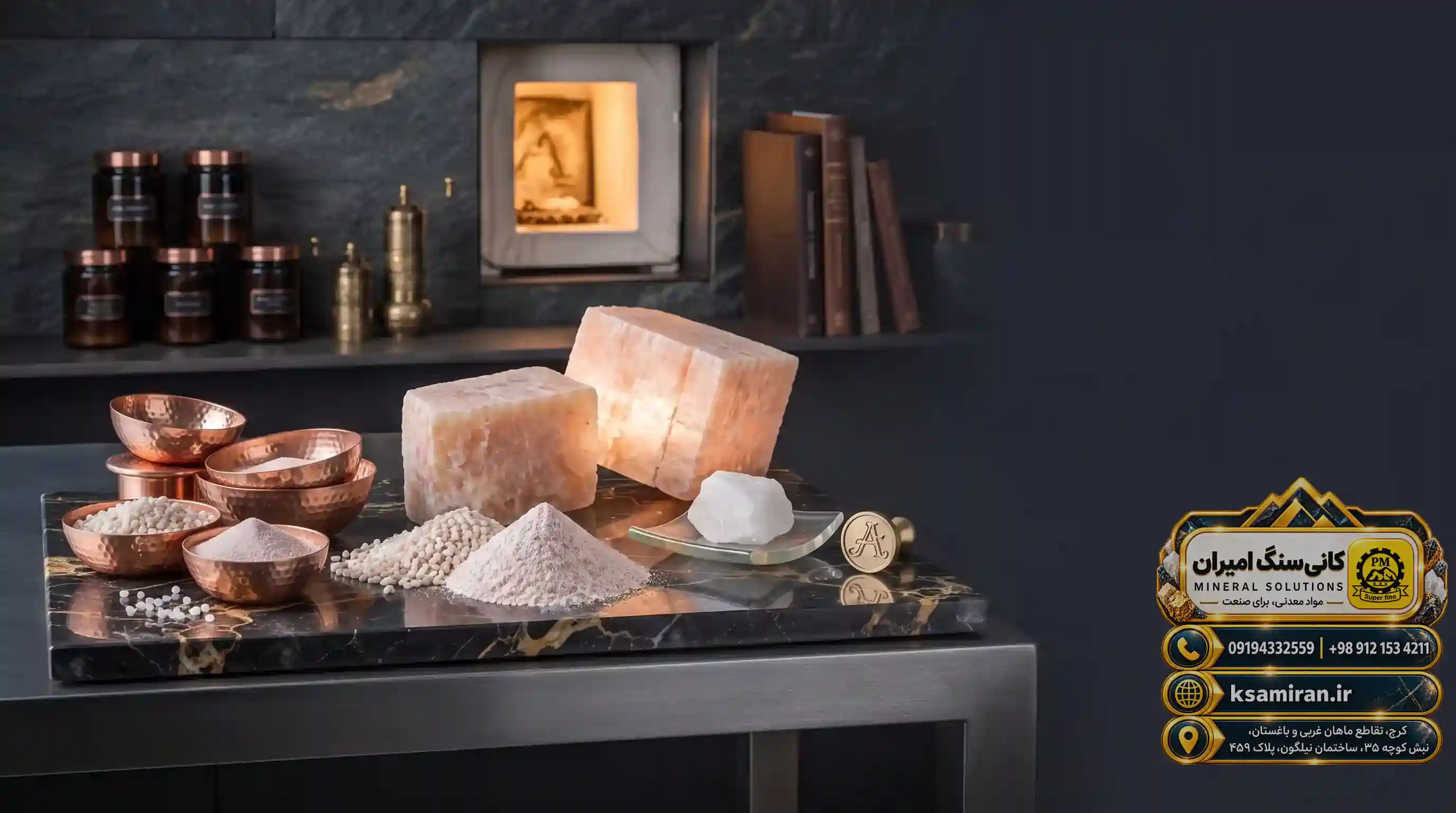
Feldspar as a Functional Filler in Paint Formulation
In the paint industry, fillers or extenders are mineral materials added to the formula to help control the cost of the formulation while improving the physical properties of the paint film. Feldspar is considered a functional filler; meaning it does not merely fill the volume of the film but adds specific properties such as hardness, stability, and brightness to it.
One of the most important roles of feldspar in paint is acting as a "spacer" for titanium dioxide (TiO₂). By placing between the white pigment particles, this filler prevents their agglomeration and creates better distribution in the film. The result is an increase in the covering power per unit of TiO₂ and the possibility of reducing the amount of this expensive pigment in the formula.
Reducing titanium dioxide consumption is one of the main ways to control costs in paint production. Due to its more economic advantage compared to white pigments, feldspar helps economic formulations without a significant drop in covering power or appearance. This issue is especially important in building and industrial paints that are produced in high volumes.
The concept of "pigment volume concentration" (PVC) plays a key role in paint formula design. Adding feldspar to the formula allows for an increase in PVC and better filling of the film space. Because feldspar particles are non-porous, they do not create a need for extra resin to saturate their surface, meaning a formula with higher solids can be made without losing mechanical properties.
Feldspar differs from barite in terms of specific gravity (around 2.6 g/cm³). White barite, with a higher specific gravity, is preferred in formulations that require high weight, durability, and water resistance (such as primers). To understand this difference, you can read the article Why is Using White Barite Essential in Paint Production?. Choosing between these two minerals depends on the formula's goal and the type of coating.
Alongside the type of filler, a paint chemist must pay attention to particle size distribution, particle shape, and oil absorption. Feldspar has roughly cubic and non-porous particles; meaning it offers a low specific surface area and consequently does not increase binder demand. This property is very valuable for systems with high pigment volume.
Also, due to its inherent brightness, feldspar can replace part of the white pigment while remaining a stable filler in the formula. This combination of efficiency and economic advantage has made this mineral one of the widely used mineral materials in paint factories.
Hardness and Abrasion Resistance: Why Does Feldspar Increase Coating Durability?
Hardness is one of the vital factors in industrial coatings. Many painted surfaces in factories, parking lots, ship decks, industrial floors, and equipment are exposed to continuous mechanical wear. In such conditions, the resistance of the paint film to abrasion directly affects its lifespan, and choosing the right filler is decisive in this regard.
Feldspar has a hardness of around 6 on the Mohs scale; its hardness is higher than minerals such as calcite (3) or talc (1). The hard particles of feldspar in the paint film act like a mineral skeleton and increase the overall resistance of the surface to wear, scratching, and erosion. This feature demonstrates the superiority of the coating's durability compared to soft fillers.
The mechanism of this effect is simple but effective: when a foreign object is dragged on the paint surface, contact with the hard feldspar particles causes the frictional force to be distributed, reducing concentrated damage to the resin film. This means coatings containing feldspar perform better in scrub resistance tests and retain their initial appearance for a longer time.
In traffic paints and road line striping, abrasion resistance is extremely important, because vehicle tires and machinery constantly pass over them. The presence of feldspar in these formulas helps the lines last longer and reduces periodic repair costs. Similarly, in industrial epoxy and polyurethane floor paints, this mineral acts as a mechanical reinforcer.
Another important application is industrial coatings of pipelines, tanks, and equipment exposed to friction, impact, and harsh environments. In these coatings, the combination of feldspar's hardness with resin adhesion creates a more stable protective layer. Also in wood and fuiture paints, this mineral helps resistance to stains and scratches caused by daily use.
The noteworthy point is that the hardness of feldspar is not lost through mechanical processing (grinding); because this property is embedded in its crystal structure. For this reason, even after processing into different meshes, feldspar particles retain their hardness and uniformly enhance the abrasive performance of the coating.
Compared to softer fillers, feldspar is a more logical choice for coatings whose priority is mechanical durability. At the same time, combining it with other fillers allows the paint chemist to achieve an accurate balance between hardness, gloss, and cost.

Chemical Stability and Resistance to Environmental Conditions
Industrial coatings are usually located in harsh environments: humidity, sunlight, temperature changes, acidic and alkaline vapors, and industrial chemicals. In such conditions, every component of the formula must be chemically stable so that premature quality loss does not occur. Among these, feldspar is one of the most stable mineral options.
The tectosilicate structure of feldspar is a continuous network of silicon and aluminum with strong oxygen bonds. This network is not dissolved in water and in most weak acids and bases. For this reason, feldspar particles maintain their stability in water-based and solvent-based systems, in alkaline environments, and in the presence of salts.
One of the important differences between feldspar and iron-bearing or impure minerals is its behavior against ultraviolet light. Aluminate-silicate particles do not absorb UV light and do not contribute to the photodegradation of the resin. This means paints containing feldspar show less yellowing in open spaces and retain their gloss for a longer time.
In exterior building and facade coatings, this stability means resistance to weathering, humidity, and freeze-thaw cycles. Since feldspar particles are not porous, they do not absorb moisture and do not facilitate the growth of fungi and algae on the paint surface. This property is important for exterior facade paints and masonry protective coatings.
Feldspar is used in corrosion-resistant industrial coating systems as a chemically inert component. Since it does not react with resins, corrosion inhibitors, or other additives, it guarantees the chemical stability of the formula and prevents quality loss over time.
On concrete and cement surfaces, there is a problem called "efflorescence" and high alkalinity. Feldspar particles resist these alkaline environments and help maintain the coating's adhesion to concrete. This makes its use in industrial floor coatings and mineral substrates logical.
In terms of color, the chemical stability of feldspar means color stability over time; the particles of this mineral do not become dull, do not blacken, and do not change color. For applications where aesthetics and long-term appearance stability are important, this feature is considered a competitive advantage.
The Effect of Feldspar on Drying, Adhesion, and Surface Roughness of Paint
Although feldspar is a hard and chemically inert filler, it has significant effects on the physics of the paint film, including drying, adhesion, and surface texture. These effects directly influence the final quality of the coating and its performance on various surfaces.
The drying of the paint film depends on the reaction of the resin and solvent, but filler particles also play a role in this process. Feldspar has low oil absorption; meaning it absorbs a small amount of resin or solvent on its surface. As a result, the movement of the resin in the film is not limited and the drying of the film is not delayed. This property is especially valuable in high-solids paints and thick industrial coatings.
The adhesion of the film to the substrate is one of the most important factors in the durability of the coating. Feldspar particles, by creating micro-roughness at the contact surface, increase the mechanical interlocking of the film with the substrate. This effect is prominent in sanded metals and concrete surfaces; where industrial coatings must withstand impact and pressure.
Gloss control is another important application of feldspar in paint. Fine feldspar particles, by creating micro-roughness on the film surface, increase light scattering and create a matte or satin surface. In mode architectural paints where a matte appearance and simultaneously high durability are desired, feldspar is a suitable option. For comparison, you can read the article Investigating the Benefits of Using Kaolin in Architectural Paints; kaolin is also a strong matting agent but with higher oil absorption.
In addition, feldspar affects the rheology of the paint. Cubic-shaped feldspar particles, compared to platy kaolin particles or needle-shaped particles, change viscosity differently and give the formula good flowability. This means paint containing feldspar has good pumpability, sprayability, and rollability.
Intercoat adhesion is also important in multi-layer industrial coatings. The mild roughness that feldspar creates on the surface provides a better base for the next layer and reduces the risk of topcoat peeling. This issue is widely used in industrial epoxy and polyurethane systems.
Finally, the balance between roughness and surface smoothness is controlled by the particle size of feldspar. Fine particles create a smoother surface and more uniform light reflection; coarser particles create natural texture and surface defect hiding. This flexibility allows the paint chemist to design the final appearance of the coating exactly according to the project's needs.

Particle Size and the Importance of Mesh in Feldspar Application
One of the most important characteristics of any mineral filler is its particle size. In mineral materials trade, this characteristic is expressed with a unit called "mesh". The mesh number indicates the number of holes per inch of the sieve; the higher the mesh number, the finer the particles. Feldspar is offered in the 10 to 450 mesh range, which covers a very wide spectrum.
This wide range allows feldspar to be used in completely different applications. Coarse meshes (such as 10 to 100) are suitable for formulations that want rough texture and high hiding power; for example, plasters, stone coatings, and textured decorative paints. Fine meshes (such as 325 and higher) are used for thin industrial paints, gloss paints, and formulations that require a smooth surface.
Particle size directly affects several key properties: surface gloss, covering power, viscosity, sedimentation, and dispersibility. Finer particles scatter light more and create better covering power, but at the same time require more energy to disperse in the resin. Coarser particles come with easier dispersion and faster sedimentation in dilute systems.
The uniformity of particle size distribution is as important as its average size. Feldspar that has a uniform distribution creates stable viscosity, reproducible gloss, and less sedimentation in the paint formula. This issue is vital for factories that have continuous production lines; because any change in particles can cause a drop in the quality of the product batch.
In the paint production process, the appropriate mesh of feldspar must be chosen based on the type of coating. A traffic paint might use coarser feldspar for more durability, while a delicate industrial paint requires very fine particles for a uniform surface. Choosing the right mesh, while delivering the desired appearance, prevents problems such as sedimentation in the paint can or disruption in the spray process.
In the production process, feldspar is classified into different meshes after extraction, crushing, and grinding. The 10 450 mesh range mentioned for this product shows the ability to process this mineral in a wide range of industries and covers both suitability for traditional industries (glass, tile, ceramic, glaze) and for finer applications such as paint.
Also, it should be noted that the mesh number is only an average, and there is always a percentage of finer and coarser particles in the product. A supplier with precise quality control provides the full specifications of the particle distribution so that the paint formulation is designed accurately.
Main Applications of Feldspar and a Guide to Choosing It
Feldspar is a versatile mineral used in various industries. According to the specifications of this product, the main applications of feldspar include glass, tiles, ceramic products, and glaze. In the glass industry, this mineral acts as a source of alumina and alkali and helps reduce the melting temperature, increase transparency, and improve the strength of glass.
In the tile and ceramic industries, feldspar acts as a flux; meaning it melts at the kiln temperature and creates a glassy phase that bonds quartz and clay particles. This material is widely used in tile bodies, sanitaryware, porcelain dishes, and pottery. In glaze production, feldspar is one of the main components and provides the transparency, gloss, and thermal resistance of the glaze.
In addition to these traditional applications, as examined in this article, feldspar has found an important place in the paint and industrial coatings industries. The seven main reasons for using this mineral in paint are: chemical composition rich in alumina and silica, performance as a functional filler and savings in TiO₂ consumption, high hardness and abrasion resistance, chemical stability and resistance to environmental conditions, positive effect on drying and adhesion, gloss and surface roughness control, and finally the variety of the mesh range (10 450 mesh) which allows precise selection based on the formula's needs.
In choosing feldspar for the paint industry, several points should be considered: uniformity of particle size distribution, brightness and low iron content, absence of reactive impurities, and quality stability in different shipments. Also, choosing the appropriate mesh depends on the type of coating, film thickness, desired surface effect, and application system (spray, roller, or brush).
For factories producing glass, tiles, and ceramics, these points are also important; especially the amount of iron and alkali metals that affect the color and melting temperature of the final product. The 10 450 mesh range allows the appropriate mesh to be selected for each industry: finer meshes for glaze and glass, and coarser meshes for ceramic and tile bodies.
Finally, if you are looking to supply high-quality feldspar for the paint and industrial coatings industries, glass, tiles, ceramics, or glaze, you can view the complete specifications of the feldspar product in the Kani Sang Amiran Project. This group is active in the field of production and supply of mineral materials and covers the 10 450 mesh range needed by various industries.
As a conclusion, it can be said that feldspar is not merely a simple mineral, but a multi-purpose mineral material whose combination of hardness, chemical stability, brightness, and particle size variety has made it a valuable option for the formulation of paints and industrial coatings.
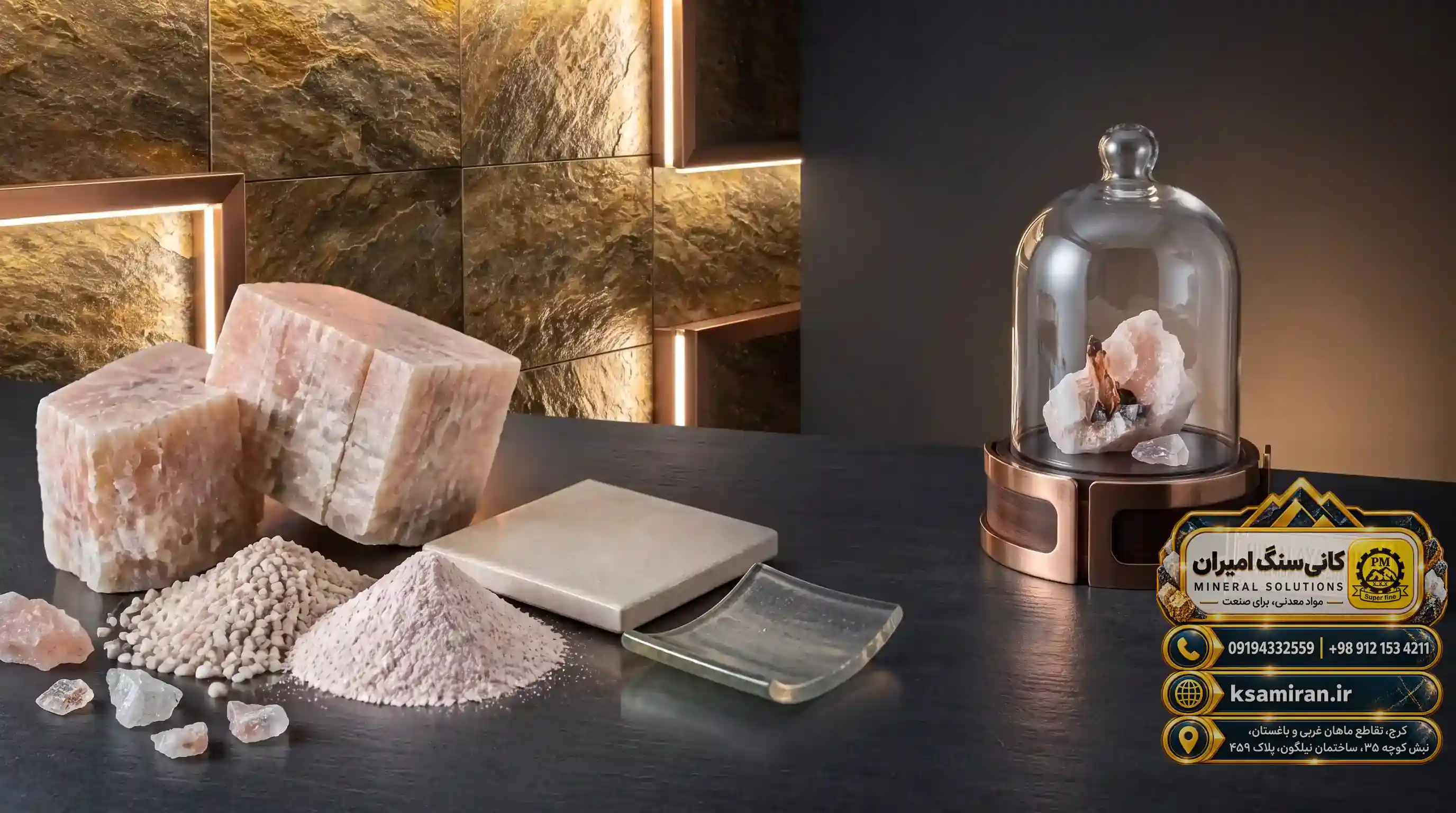
| Question | Answer |
|---|---|
| 1. What is feldspar and what is its application in the paint industry? | Feldspar is an aluminum silicate mineral containing potassium, sodium, or calcium that is used as a functional filler in paint and industrial coatings, as well as in glass, tiles, ceramics, and glaze. |
| 2. What is the difference between feldspar and kaolin in paint making? | Feldspar has cubic particles with low oil absorption and higher hardness, while kaolin shows a layered structure, higher oil absorption, and a stronger matting effect. |
| 3. What effect does feldspar have on the abrasion resistance of paint? | A hardness of about 6 on the Mohs scale causes feldspar particles to act like a mineral skeleton and increase the paint film's resistance to wear, scratching, and scrubbing. |
| 4. Why is feldspar used in white and light-colored paints? | High-quality feldspar is bright and low in iron, does not change its color over time, and does not cause color change in white and pastel paints. |
| 5. What effect does the particle size (mesh) of feldspar have on the final paint? | Finer particles create a smoother surface and uniform gloss, and coarser particles create a rougher texture and higher hiding power. |
| 6. Can feldspar replace part of titanium dioxide? | Yes; feldspar acts as a spacer for TiO₂ particles and creates better distribution, which allows reducing the amount of this expensive pigment. |
| 7. In what other industries besides paint is feldspar used? | The main applications of this product include glass, tiles, ceramic products, and glaze, where it is used as a source of alumina and flux. |
| 8. Is feldspar chemically stable in paint? | Yes; its tectosilicate structure is stable against weak acids and bases, water, salts, and UV light, and does not react with resins. |
| 9. Which mesh of feldspar is suitable for paint? | It depends on the type of coating; for delicate and gloss paints, fine meshes (such as 325 and higher) and for rough textures, coarser meshes are used. |
| 10. Where can suitable feldspar for the paint and coatings industry be obtained? | Kani Sang Amiran Project is active in the field of mineral material production and supplies feldspar in the 10 450 mesh range for various industries. |
Specifications and applications of feldspar, Kani Sang Amiran Project: https://ksamiran.ir/products/feldspar/
برچسب: Feldspar,7 Reasons to Use Feldspar in Paint and Industrial Coatings Industries,
نویسنده: رساوب آفرین