
درباره سایت
آخرین مطالب
- استخدام الباريت الصناعي في الصناعات التحويلية وتجهيز الأقمشة
- دراسة التأثيرات الحرارية لأكسيد الليمونيت (جل ماش)
- The Impact of Color and Whiteness of Industrial Talc Powder in the Paint Industry
- نقش اکسید آهن قرمز (اخرا) در صنایع تولید شیشه
- A Review of Modern Applications of Calcium Carbonate in Industry
- Review of the Application of Industrial Barite in the Pharmaceutical and Cosmetic Industries
- Bentonite and its Wide Application in the Ceramic and Glaze-Making Industries
- كيفية تحديد جودة الباريت الصناعي في المختبر؟
- الاستخدام المتخصص لأكسيد الحديد الأحمر (المغرة) في إنتاج البلاستيك
- استعراض التطبيقات الحديثة لكربونات الكالسيوم في الصناعة
امکانات وب
Introduction to Identifying the Appearance Characteristics of High-Quality Calcium Carbonate
Precise identification of minerals and their industrial products requires a thorough examination of physical and appearance parameters. Among widely used industrial materials, calcium carbonate is recognized as one of the most consumed fillers in various industries, where quality assessment begins with visual inspections. The appearance characteristics of this material include color, whiteness level, particle condition, and powder uniformity, which play a decisive role in its final selection for specialized applications.
Industrial producers and consumers examine its physical specifications to ensure the purity and efficiency of the raw material. Due to its unique properties, this mineral powder finds extensive application in industries such as the production of PVC/UPVC profiles and pipes. The appearance quality of this material directly affects the mechanical properties and appearance of the final product, which is why its quality control is of high importance.
In this specialized article, we intend to comprehensively examine the appearance characteristics of this mineral and analyze its various dimensions from the perspective of mining and polymer experts. Understanding these characteristics helps various industries select the best raw material for their production lines and noticeably improve the quality of their final products.
The Importance of Particle Size and Mesh Range in Powder Appearance and Quality
One of the most important factors in the visual inspection of mineral powders is particle size and its distribution range. The standard mesh range of this industrial material varies between 100 and 3500 mesh, each considered for a specific application. Powders with lower mesh have coarser particles, whereas high meshes indicate micronization and extraordinary fineness of particles, appearing under a microscope as uniform structures.
To better understand classification methods and the importance of particle dimensions, studying mesh grading standards in various types of coated calcium carbonate provides very useful information for specialists and activists in this field. The proportionality between particle size and the type of industrial application will guarantee a high-quality output in production processes.
When mineral powder is produced with high meshes, its appearance closely resembles smoke or very soft dust, lacking any roughness or pellet-shaped grains. This appearance feature indicates an advanced crushing and pulverization process in manufacturing plants, which directly affects the final quality of polymer products and paints.

The Role of Processing and Surface Coating on the Appearance of Mineral Powder
Improving the physical and appearance properties of mineral powders is usually achieved through surface coating processes. These processes improve particle aggregation and increase the powder's compatibility with polymer and oil matrices. For more specialized information in this field, reviewing the article the impact of stearic acid in coated calcium carbonate coating well elucidates the chemical and appearance dimensions of these changes.
Proper coating causes the powder particles to lie more freely next to each other and prevents them from agglomerating. Visually, after the coating process, these materials take on a more fluid and silky state, which has a noticeable difference from raw and unprocessed samples.
These appearance and structural changes help manufacturing industries experience homogeneous distribution when mixing with other raw materials. As a result, the final product lacks structural weak points and will be very smooth, glossy, and flawless in appearance, which is of vital importance for industries such as masterbatch and paint production.
Examining the Whiteness Index and Color in Evaluating Mineral Purity
The whiteness index is one of the most prominent appearance features that quality control engineers notice at first glance. A bright and uniform white color indicates the high purity of the initial ore and the absence of metallic or carbon impurities in its structure. The higher the degree of powder whiteness, the greater its commercial and practical value in more sensitive industries.
The presence of dark spots or yellow pigments in the mineral powder indicates the presence of impurities such as iron or magnesium oxides, which reduce the final product quality. In the paint, paper, and engineering coatings industries, the absolute whiteness of the powder is of key importance because it prevents undesirable color changes in the final product.
Using advanced optical equipment, manufacturers measure the amount of light reflection from the particle surface to ensure that the produced powder meets the highest appearance standard. This precise control over color and whiteness guarantees quality stability throughout various production cycles.
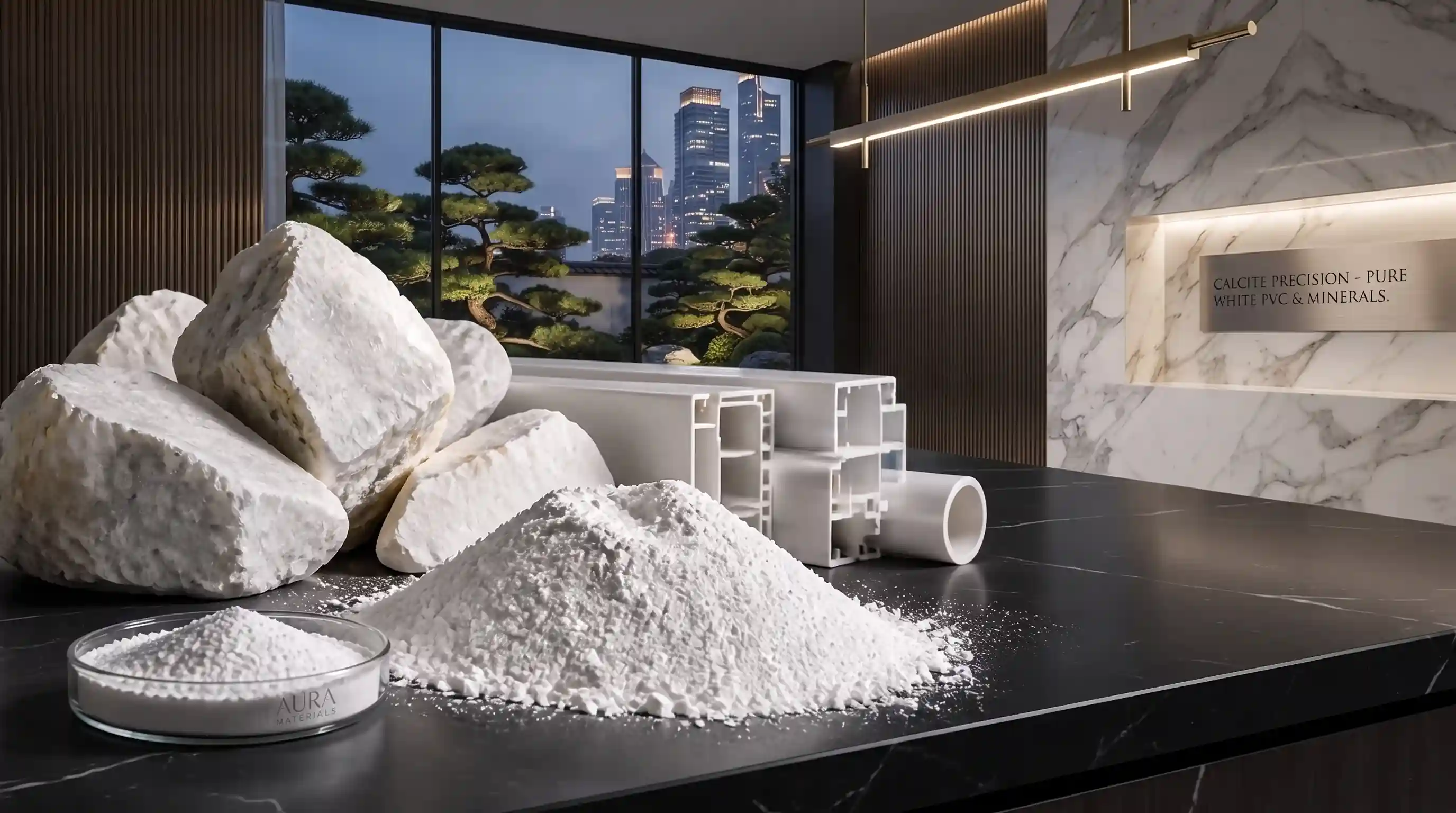
Examining Industrial Applications Based on Physical and Appearance Characteristics
The appearance and physical characteristics of minerals are the main determinants of their application scope in various industries. Due to its favorable powder properties, high whiteness, and diversity in mesh dimensions, this valuable material is utilized in a wide spectrum of industries. A thorough understanding of these features helps industries make the most efficient use of raw materials.
The main applications of this product include items such as PVC/UPVC profiles and pipes, masterbatch, cables, artificial leather, paints, paper, adhesives, and engineered stone. For instance, in the masterbatch and polymer composites manufacturing industry, there is a need for powders with high mesh and a completely uniform particle size distribution to prevent clogging in processing equipment.
To supply this high-quality material for use in the mentioned industries, visiting calcium carbonate by Kani Sang Amiran company is a reliable option to access standard technical specifications. The diversity in the mesh grading of these products allows for complete adaptation to the technical needs of various production lines.
The Effect of Particle Size Distribution on Material Viscosity and Flowability
The flow behavior of mineral powders when combined with resins, polymers, and solvents has a direct relationship with their appearance characteristics and particle dimensions. Powders that have an optimal particle size distribution show the least resistance to flowability during mixing and maintain the mixture's viscosity at an optimal level.
In industries such as paint, adhesive, and sealant production, if the powder particles are too coarse or agglomerated, the appearance of the final product will suffer from roughness and scratches. Micronized powders with high mesh, due to their vast specific surface area, disperse well within the liquid matrix and create a completely smooth and polished surface.
Controlling the visual condition of particles in terms of the absence of hard agglomerates plays an important role in reducing the wear and tear of industrial equipment and extruders. This improves production efficiency and reduces maintenance costs of machinery in manufacturing plants.

Examining Texture and Apparent Porosity in Paper and Engineered Stone Applications
In the paper and engineered stone manufacturing industries, the visual texture and microscopic structure of the mineral powder are of special importance. The powder consumed in the paper industry must be such that it fills the empty space between cellulose fibers in the best possible way to create a smooth, matte surface suitable for printing.
In the production of engineered stones and solid surfaces, the homogeneity of the powder with polyester or acrylic resins is also vital. If the mineral powder does not have a uniform appearance structure, air bubbles or heterogeneous spots will be created on the stone surface after curing and molding, which reduces its beauty and strength.
Therefore, careful examination of the visual texture and the absence of impure particles in the mineral powder is the key to achieving high-standard final products in advanced industries. Careful selection of the appropriate mesh will guarantee this structural harmony.
Conclusion and Guide to Selecting the Best Mineral Powder for Industries
In this article, we comprehensively reviewed the appearance characteristics of high-quality calcium carbonate, and it became clear that parameters such as the degree of whiteness, mesh range, particle size distribution, and surface coating quality play a decisive role in the industrial efficiency of this material. Precise knowledge of these specifications helps industries make a more informed choice.
The Kani Sang Amiran project, focusing on the production of high-quality and standard minerals, best covers the needs of various industries, including producers of pipes and profiles, masterbatch, paints, paper, and engineered stone. Compliance with manufacturing standards guarantees the purity and uniformity of this valuable powder.
Ultimately, the correct selection of raw materials tailored to the technical needs of each industry will improve final product quality, increase equipment lifespan, and optimize production costs. Continuous review of appearance and physical specifications is always recognized as the first step in successful quality control.

| Question | Answer |
|---|---|
| What is the mesh range of the produced calcium carbonate? | This product is produced and supplied in a mesh range of 100 to 3500. |
| What are the main applications of this mineral? | PVC/UPVC profiles and pipes, masterbatch, cable, artificial leather, paint, paper, adhesive, and engineered stone are among its main applications. |
| What effect does the whiteness index have on powder quality? | High whiteness indicates higher purity and the absence of colored impurities in the powder structure. |
| Does the mineral powder have a surface coating? | Based on customer requirements, samples coated with stearic acid can also be supplied. |
| How can this product be purchased? | Action can be taken through the dedicated product page on the Kani Sang Amiran website. |
| What is the role of powder in the PVC pipe industry? | It is used as a filler and improver of mechanical and dimensional properties. |
| Does particle size affect paint viscosity? | Yes, higher meshes and finer particles result in better leveling and viscosity control. |
| Why is particle size distribution important? | Uniform distribution prevents agglomeration and improves flowability in the production process. |
| Is this material used in engineered stone production? | Yes, it is used as the primary filler in the manufacturing of engineered stones and solid surfaces. |
| How can we find out about the quality of the powder? | Through reviewing the technical data sheet and laboratory tests of whiteness and mesh grading. |
Specialized references in materials engineering and mineral processing by Kani Sang Amiran Company.

برچسب: Calcium Carbonate,Review of the Appearance Characteristics of High,Quality Calcium Carbonate,
نویسنده: رساوب آفرین