
درباره سایت
آخرین مطالب
- راهنمای ثبت سفارش آنلاین و استعلام قیمت کائولن
- چگونه بهترین اکسید آهن قرمز (اخرا) را برای پروژه انتخاب کنیم؟
- بررسی جامع خواص اکوستیک و وزن مخصوص باریت سفید صنعتی
- نقش کائولن در کاهش هزینههای تولید در صنایع معدنی
- نقش سیلیس در افزایش مقاومت حرارتی مواد نسوز
- چرا اکسید آهن قرمز (اخرا) قدرت پوشانندگی بالایی دارد؟
- The role of industrial barite in the papermaking and specialty coatings industries
- How to find the best kaolin supplier in the country?
- How to properly examine feldspar analysis?
- ما هي استخدامات التالك الصناعي في صناعة البلاستيك والمطاط؟
امکانات وب
Introduction to Kaolin and Its Place in Mining Industries
Kaolin is one of the most important and widely used industrial minerals, belonging to the hydrated aluminum silicate group. Often referred to as "China clay," this material is used in dozens of industries—ranging from tiles and ceramics to papermaking and paint—due to its bright color, softness, low plasticity, insulating properties, and controlled chemical reactivity. In fact, after being mined, kaolin undergoes a complex transformation process to evolve from raw mineral soil into a uniform, pure, and ready-to-use industrial powder.
At the Kani Sang Amiran project, which specializes in mineral production, kaolin is offered in a range of 450 to 1500 mesh for key applications, including tiles, ceramic products, glaze, paper, and paint. This wide range demonstrates that the final product can meet diverse requirements for fineness and particle size, as every industry requires a specific degree of powder fineness tailored to its own processes. This is why understanding the kaolin production process is not merely a technical matter, but a criterion for buyers and industrial consumers to make informed product selections.
The goal of this article is to provide a complete and detailed examination of the kaolin production process from the mine to the final industrial powder. Below, we explore the stages of exploration, extraction, processing, grinding, quality control, and applications from a scientific and practical perspective. This guide assists production line engineers, purchasing managers at tile and ceramic factories, paint and paper manufacturers, and all active participants in the mineral sector to select and evaluate kaolin suitable for their specific needs with greater insight. Indeed, successful kaolin procurement begins with a correct understanding of this production chain.
From Mountain to Mine: Exploration and Extraction of Kaolin
The kaolin production process begins, above all, with exploration. Kaolin is typically found in near-surface deposits and is mostly formed through sedimentary basins or hydrothermal alteration zones. In Iran, kaolin reserves are scattered across various provinces, and the quality of the deposit varies based on factors such as alumina percentage, iron content, whiteness, particle size distribution, and the type of impurities. For this reason, the exploration stage involves mapping, surface sampling, exploratory drilling, and laboratory analysis to precisely determine the boundary between waste and mineral material. The more accurate the initial assessments are, the less cost and energy will be spent on purification in subsequent processing stages.
After confirming the economic viability of the deposit, the extraction phase begins. The common method for kaolin extraction is open-pit mining; this involves surface excavation, the removal of topsoil, and then the extraction of the kaolin-bearing layer using machinery such as loaders, excavators, and mining trucks. In some mines, kaolin is extracted as hard, rock-like material, while in others, it is soft and earthy; this directly influences the design of the processing line. Selective mining is crucial at this stage to ensure low-quality reserves are not mixed with high-quality ones.
One of the key points at this stage is the management of impurities. Extracted kaolin is usually accompanied by impurities such as quartz, mica, hematite, limonite, titanium, and organic residues, which must be separated in later stages. Additionally, natural mine moisture, reserve uniformity, and fine particle loss are factors considered when designing conveyors, sizing equipment, and hydrocyclones. In fact, the extraction stage can be considered the foundation of the final kaolin quality; an improper extraction plan can cause severe fluctuations in the alumina percentage and whiteness of the final product, leading to issues in tile and ceramic production lines.

Primary Processing: Crushing, Beneficiation, and Impurity Removal
After extraction, raw kaolin enters the processing plant. Here, the first operations involve crushing and the removal of coarse materials; large chunks and coarse impurities are separated using crushers or grizzlies so that the feed entering sizing and fine processing is uniform. The kaolin then enters the beneficiation circuit, which is typically based on a Wet Process or Dry Process. In the wet process, kaolin is mixed with water to form a slurry, and through hydrocyclones, coarse particles like quartz and mica are removed as underflow, while fine, high-quality kaolin particles emerge as overflow. This method is more advantageous for producing high-quality, white kaolin.
In the dry process, after crushing, the kaolin reaches the desired mesh using mills and sizers. This method is typically used when the raw material is relatively pure from the start and has low moisture content. In many factories, the processing is hybrid; the dry section is used for coarser products and the wet section for ultra-fine products. Magnetic separation is also performed to reduce iron content and decolorizing agents to maintain product whiteness. High iron content has a direct negative impact on the firing color of tiles and ceramics.
Washing and dechlorination or complete impurity removal are essential in high-quality kaolins. After beneficiation, kaolin particles are diluted in a solution, and chemical processing, such as acid leaching or oxidation, is performed to remove iron, sulfide compounds, and organic materials. Finally, the kaolin slurry is thickened and enters a filter press to produce a cake with controlled moisture. This cake is the primary feedstock for the final drying and grinding process. The quality of execution at this stage determines the alumina level, iron percentage, and whiteness of the final product, which are considered critical in the glaze and ceramic industries.
Drying, Calcination, and Production of Final Kaolin Powder
Drying is one of the most critical stages in the kaolin production process. After filtration, the kaolin slurry or cake has a moisture content of about 30% to 40%, which must be reduced. In industrial methods, rotary dryers, spray dryers, or large laboratory kilns are used. The choice of dryer depends on the initial moisture, particle fineness, size distribution, and final application. In tiles and ceramics, the final moisture of the powder must reach a specific amount to optimize pressing and firing behavior. In papermaking, lower moisture and powder uniformity are of greater importance.
Calcination, or thermal firing, is a stage where kaolin is heated at high temperatures (typically between 500 to 1500 degrees Celsius), and its crystalline structure changes from kaolinite to metakaolinite and, at higher temperatures, to mullite. This process changes the chemical and mechanical properties of kaolin; its thermal resistance, whiteness, porosity, and binding properties are controlled. Calcined kaolins are widely used in the ceramics, casting, and refractories industries. In contrast, non-calcined (hydrated) kaolins are more suitable for papermaking, paint, and fillers because they have a layered structure and higher coating properties.
After drying, the kaolin enters the grinding circuit. Hammer mills, planetary mills, rod mills, or base mills and classifiers are used here so that the powder reaches the desired mesh degree. In the Kani Sang Amiran project, kaolin is produced with a range of 450 to 1500 mesh, which demonstrates the processing line's ability to produce both medium and ultra-fine powders. Dynamic classifiers and sizers control particles based on size distribution, and the product is categorized and packaged in different meshes. The quality of this stage directly impacts the performance of the kaolin in customers' production lines.
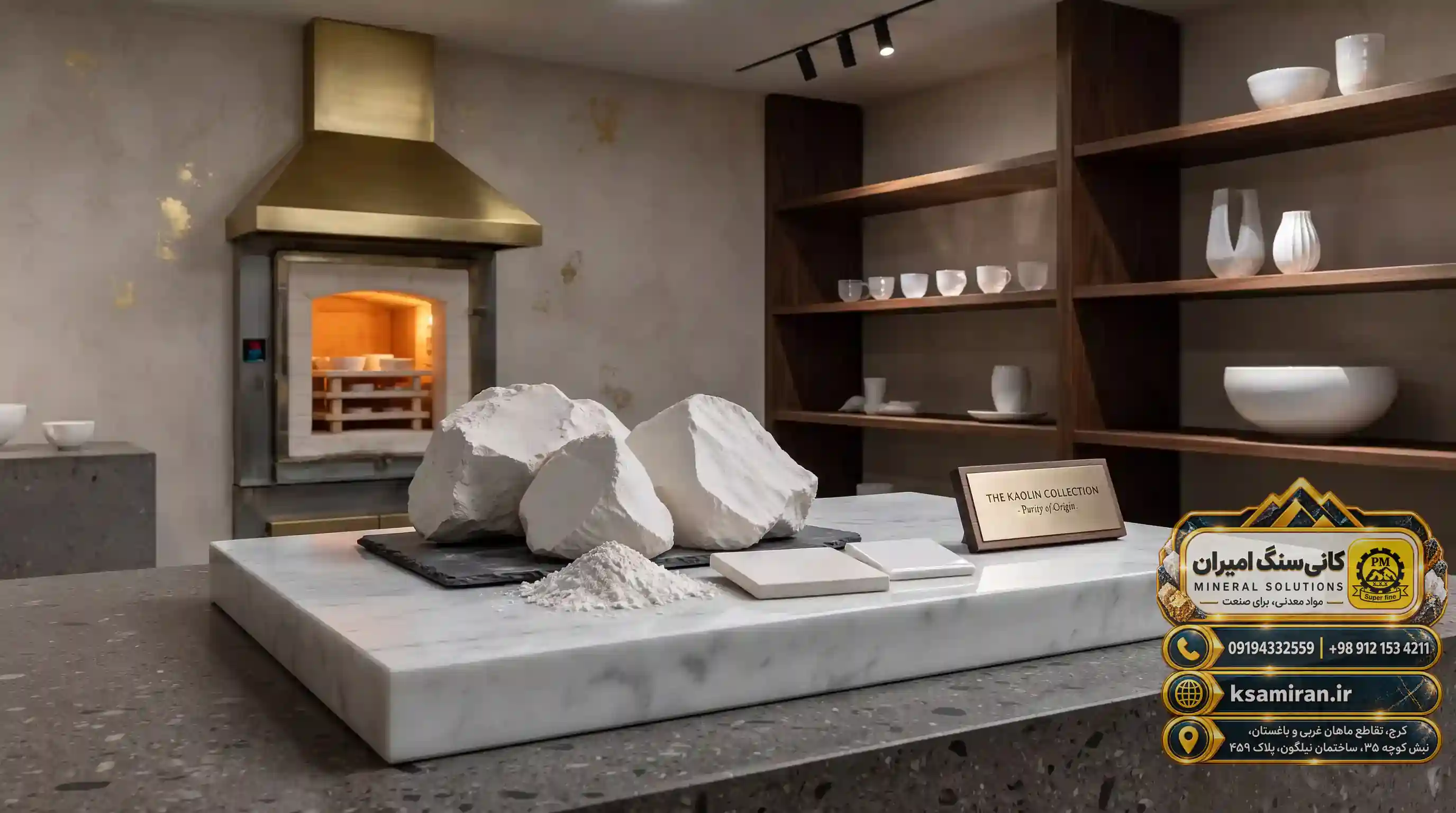
Mesh and Grading: The Common Language of Kaolin Quality
One of the most important technical indicators in presenting industrial kaolin is its mesh grade. The term "mesh" refers to the number of openings per square inch of a standard sieve, and the higher the mesh number, the finer the powder particles are. Kaolin produced in the Kani Sang Amiran project is offered in a range of 450 to 1500 mesh; this means particles ranging from a few microns down to sub-micron size. This variety allows for the use of a single source of supply for various industries with different requirements, representing an important competitive advantage for buyers.
In the tile and ceramic industry, medium meshes are usually used to maintain a balance between plasticity, water absorption, and firing behavior. In glaze, particles must be much finer to ensure glaze uniformity, no settling, and transparency after firing. In the papermaking industry, the powder must be very soft and uniform to spread well on the paper surface and increase brightness and printability. In the paint industry, particle size distribution determines the covering power, viscosity, and stability of the pigment suspension. Therefore, a single product can be used in completely different industries just by changing the mesh.
Particle Size Distribution (PSD) is not limited only to the average mesh. In evaluating kaolin quality, the percentage of particles under 2 microns, under 10 microns, and the amount of coarse particles (over-size) must be examined. Coarse particles cause scratches, mechanical weak points, or tool wear. For this reason, precise control of PSD is performed using laser devices (Laser Diffraction) and is included in technical reports (Data Sheets). Professional buyers usually use these data to fine-tune their formulations. To better understand how to measure quality, read the article How to Evaluate the Quality of Kaolin Used in the Production Line?
Key Applications of Kaolin in Tiles, Ceramics, Glaze, Paper, and Paint
The applications of kaolin are very broad, but in the Kani Sang Amiran project, this product is mainly introduced for the tile, ceramic, glaze, paper, and paint industries. In the tile industry, kaolin acts as a main raw material in the tile body, providing plasticity, moldability in pressing, and strength after firing. The combination of kaolin with feldspar, quartz, and calcium carbonate forms the main framework of the ceramic body. The alumina percentage of kaolin is directly related to the mechanical resistance and firing temperature of the tile, and impurities can seriously affect the quality of the final product.
In the ceramic industry, kaolin is widely used in the production of tableware, sanitary ware, technical ceramics, and refractories. In the production of sanitary ware and pottery, whiteness, purity, and the property of forming the mullite phase at high temperatures are key features. In glaze, kaolin is used as an opacifier, viscosity regulator, and to improve the adhesion of raw glaze to the body; its fine particles (high mesh) are essential for glaze uniformity. For a comparison of industrial mineral properties, you can also read the article Examination of Physical and Mechanical Properties of Industrial Talc Powder.
In papermaking, kaolin is used as a filler and coating pigment, which increases brightness, surface smoothness, reduces cellulose fiber consumption, and improves printability. In the paint industry, kaolin is used as an extender pigment, optimizing the covering power, stability, and pricing of the paint formulation. If you are looking for a sustainable supply of this product, you can check and order Kaolin with 450 to 1500 mesh for the aforementioned applications. In addition to these applications, kaolin can be used in plastic industries, antibacterial tiles, catalysts, adhesives, fertilizers, agriculture, and water supply, which indicates the strategic importance of this mineral.

Quality Control, Analysis, and Standards for Assessing Kaolin
Quality control in kaolin production is a multi-layered and continuous process that begins at the mine and continues until final packaging. Key parameters include the percentage of Al2O3, SiO2, iron content (Fe2O3), titanium, calcium, sodium, and potassium, which are measured using methods such as XRF (X-ray fluorescence). Additionally, particle size is measured with laser equipment, whiteness with a colorimeter, moisture with a moisture meter, and pH, viscosity, and plasticity are measured using standard laboratory methods. Each of these indices is important for a specific industry, and the buyer should request the appropriate index based on their needs.
In the tile and ceramic industry, kaolin with high alumina and low iron is required. In papermaking, whiteness and particle size distribution play the main role. In the paint industry, viscosity and the specific surface area of the particles are important. Also, practical tests, including Test Firing, abrasion, flexural strength, and slurry behavior in vacuum and agitation, help the tile and ceramic factory to confirm the product's compliance with the production line. Having sufficient knowledge of these parameters is, in fact, the common language between the producer and consumer of kaolin.
One of the important points in quality control is consistency across different production batches. Severe changes in kaolin quality cause changes in pressing parameters, firing temperature, porosity, and even the color of the final product, resulting in multiple production line stoppages. For this reason, reputable factories retain periodic samples from every production batch and provide analysis results along with the product. It is recommended to receive a trial sample and test it on your production line before purchasing in large volumes. This approach significantly reduces the risk of purchase and quality fluctuations.
Kaolin Trade: Price, Supplier Selection, and Ordering
The kaolin market, as an industrial mineral commodity, is influenced by numerous factors, including the quality of the mineral reserve, mesh degree, amount of processing (wet or dry), packaging method, order volume, domestic transportation costs, and the status of consumer markets such as tiles, ceramics, and paper. Consequently, the price of kaolin can fluctuate over different time periods, and buyers should prioritize sustainable quality and product uniformity instead of focusing solely on the spot price. For a more precise analysis of this topic, read the article Analysis of Kaolin Price Trends in the Mining Market.
One of the common mistakes in buying kaolin is comparing products based solely on the mesh label. While two products with the same mesh can have completely different particle size distributions, whiteness, alumina, and firing behavior. For example, a 1200 mesh from one mine might have high iron content and cause yellowing in light-colored tiles, while a product from another mine with the same mesh might be completely suitable. For this reason, requesting a technical Data Sheet, a trial sample, and visiting the production line are important steps before signing long-term contracts.
The Kani Sang Amiran project, as a producer of mineral materials, offers kaolin in the 450 to 1500 mesh range for tile, ceramic, glaze, paper, and paint applications. Buyers can select the appropriate option by precisely defining their needs (alumina percentage, mesh degree, moisture, packaging type, and monthly volume). Constant communication with the producer to improve quality and reduce fluctuations will ultimately lead to the optimization of your production line. We hope this article has provided you with a complete perspective from the mine to the ready-to-use industrial powder, enabling you to make decisions with full awareness.
| Question | Answer |
|---|---|
| What is kaolin? | Kaolin is a hydrated aluminum silicate (China clay) that is widely used in tile, ceramic, glaze, paper, and paint industries due to its whiteness, softness, and low plasticity. |
| What is the mesh range of the Kani Sang Amiran project's kaolin? | The kaolin from this project is produced and supplied in the range of 450 to 1500 mesh, which includes medium to ultra-fine powders. |
| What role does kaolin play in the paper industry? | As a filler and surface coating pigment, kaolin increases the brightness, smoothness, and printability of paper and reduces cellulose fiber consumption. |
| What is the difference between calcined and non-calcined kaolin? | Calcined kaolin is fired at high temperatures, and its structure changes to metakaolinite/mullite, making it more suitable for thermal applications; non-calcined (hydrated) kaolin is more suitable for paper and paint. |
| What should the kaolin mesh be for glaze? | For glaze, higher meshes and finer particles (around 1200 to 1500 mesh) are usually suitable to ensure uniformity and prevent glaze settling. |
| Why is the amount of iron in kaolin important? | Higher iron content reduces whiteness and creates yellowing in fired tiles and ceramics; therefore, iron control is critical during processing. |
| What is the difference between the wet and dry kaolin processing methods? | The wet method separates fine, high-quality particles using slurry and hydrocyclones, while the dry method reaches the desired mesh using grinding and sizing. |
| How can we measure the quality of the kaolin being used? | It can be evaluated by measuring the percentage of alumina, iron, particle size distribution (PSD), whiteness, and by conducting test firing samples on the production line. |
| What is the application of kaolin in the paint industry? | Kaolin, as an extender pigment, adjusts the covering power, suspension stability, and viscosity of paint and optimizes formulation costs. |
| Can we receive a kaolin sample before purchasing? | Yes; it is recommended to receive a trial sample and test it on your production line before purchasing in large volumes to confirm the product's compliance with your process. |
This article is based on technical information provided by the Kani Sang Amiran project (mineral production) and the kaolin product page on the website https://ksamiran.ir/products/kaolin/
برچسب: Kaolin,Kaolin Production Process, From Mine to Ready,to,Use Industrial Powder,
نویسنده: رساوب آفرین