
درباره سایت
آخرین مطالب
- دور أكسيد الليمونيت (گل ماش) في صناعة السيراميك والبلاط
- The Role of Limonite Oxide (Gole Mash) in the Ceramic and Tile Industry
- Online Order and Price Inquiry Guide for Kaolin
- راهنمای ثبت سفارش آنلاین و استعلام قیمت کائولن
- How to choose the best red iron oxide (ochre) for the project?
- دور أكسيد الليمونيت (گل ماش) في إنتاج الطلاءات الواقية
- كيف تشترين أفضل ماركة أكسيد الليمونيت (جول ماش)؟
- Examining the Environmental Impacts of Limonite Oxide (Gole Mash)
- دراسة التأثيرات البيئية لأكسيد الليمونيت (گل ماش)
- How to buy the best Limonite Oxide (Gol Mash)?
امکانات وب
Introduction and the Importance of Understanding Industrial Talc in Mode Industries
Precise knowledge of minerals and their applications in various industries guarantees the foundation of optimal production processes. Among widely consumed minerals, industrial talc is recognized as one of the most practical raw materials, playing a key role in improving the physical and mechanical properties of final products. This mineral, with its layered structure and unique characteristics, has found a special place in industrial formulations.
The principled selection of minerals requires a careful examination of technical specifications and their alignment with production line needs. In mode industrial processes, the quality of raw materials directly affects product performance. For a better understanding of the importance of minerals in industries, studying the comprehensive review of the production and processing trend of industrial silica provides useful information about processing standards. Understanding the behavior of materials helps design engineers select the best option for product optimization.
The Kani Sang Amir project, focusing on the supply of high-quality minerals, has provided a suitable platform for industries to access standard raw materials. Awareness of technical features and the particle size range is the main key to correct selection, which will be examined in detail in the following sections.
Familiarity with the Nature, Structure, and Physical Properties of Industrial Talc
Industrial talc is a hydrated magnesium silicate that holds the lowest rating on the Mohs scale (hardness 1). This characteristic gives its powder a special softness. The crystalline structure of this material consists of thin sheets that slide over each other, which is why it feels greasy or slippery to the touch. Its color usually varies from white to light gray, depending on the amount of impurities.
One of the most important properties of this mineral is its chemical neutrality; meaning it does not react with most weak acids and bases and exhibits high stability. In addition, this material is hydrophobic and insoluble in water. These properties make it widely used as a filler and performance enhancer in various industries.
Understanding the physical structure of this material helps engineers accurately predict oil absorption, dispersion in various matrices, and its effect on viscosity. Alongside this material, other minerals are also used in industries, and familiarizing with them is worthwhile; for example, reviewing the Limonite Oxide (Gol Mash) Buying Guide with the Best Quality sheds light on other aspects of supplying industrial pigments.

Examining the Mesh Range and the Importance of Particle Sizing in Industrial Talc Quality
The particle size distribution of mineral powders plays a decisive role in their behavior in industrial formulations. For industrial talc, the standard mesh range is set between 450 and 1000 mesh. This sizing range ensures that the particles are milled and graded with appropriate precision to exhibit the best performance in various applications.
Choosing the right mesh depends entirely on the consuming industry. Finer particles (close to 1000 mesh) usually create a larger contact surface and are more widely used in industries that require high surface coverage and delicacy. In contrast, lower meshes (close to 450 mesh) are used in cases where it acts as a bulk filler.
Precise control of particle size prevents agglomeration and ensures uniform distribution of the material throughout the product volume. This leads to improved mechanical properties, reduced shrinkage, and increased durability of the final product. In the purchasing consultation process, carefully examining the mesh range and its compatibility with the factory's mixing equipment is one of the most important steps.
Application of Industrial Talc in Polymer and Rubber Industries
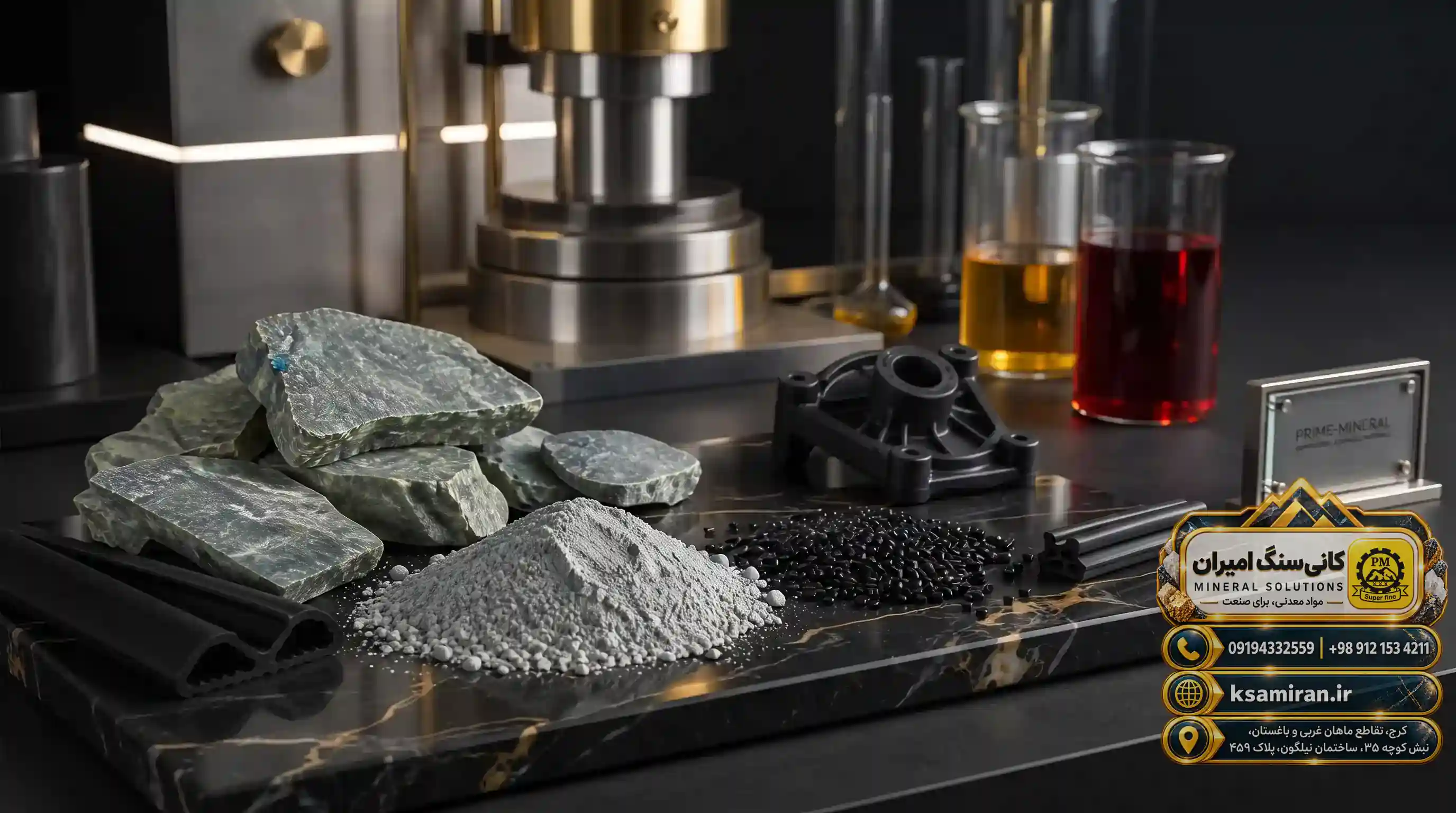
The plastics and rubber industries are among the largest consumers of industrial talc. In the polymer industry, adding this material as a filler increases the elastic modulus, improves dimensional stability, and reduces the shrinkage of injected parts. The microcavity sheets of this material greatly help improve heat resistance and deformation of polymer parts.
In the rubber industry, this material acts as an activator and filler. Due to its layered structure, talc powder reduces gas permeability in rubber products and improves resistance to wear and tearing. It also prevents layers from sticking to equipment during the rubber production and vulcanization process.
The Kani Sang Amir project, by supplying this mineral with desired quality for polymer and rubber products, meets the needs of manufacturers in this sector. Precisely selecting the weight percentage of this material in a polymer or rubber compound requires precise laboratory tests and technical consultation before purchase.

The Key Role of Industrial Talc in the Paint and Industrial Coatings Industry
The paint manufacturing and coatings production industry always needs raw materials that, in addition to filling properties, improve the optical characteristics and durability of the paint film. Industrial talc is one of the most popular extenders in paint formulations due to its suitable refractive index and matting properties.
The use of this material in paints helps improve dry coverage, increase resistance to atmospheric conditions, moisture, and corrosion. Parallel talc sheets inside the paint film create a barrier against the penetration of moisture and oxygen, which significantly increases the lifespan of the coating. It also plays a role in improving viscosity and preventing paint settling during storage.
Ensuring the powder's compatibility with various resins, including acrylic, alkyd, and epoxy, is a technically important point in this industry. To receive further guidance regarding purchasing standards for consumed minerals, studying the Comprehensive Guide to Expert Consultation Before Buying Silica can provide valuable insights to stakeholders in the paint and coatings industry.
Diverse Applications of Industrial Talc in Other Industrial Products
In addition to its well-known applications in polymers, rubber, and paint, industrial talc is used as a key raw material in a wide range of other industrial products. Features such as thermal stability, chemical neutrality, and lubricating properties have made this material an indispensable option in production processes.
In many industrial products, this material is used as a powder flow improver, friction modifier, and cost-effective filler. The variety in the mesh range of 450 to 1000 mesh allows different industries to select the appropriate grade according to their mechanical and physical needs.
Manufacturers of industrial products are always looking for a reliable supplier that guarantees the purity and quality consistency of minerals. The Kani Sang Amir project, by providing a suitable platform, has facilitated access to this high-quality mineral for various production lines.
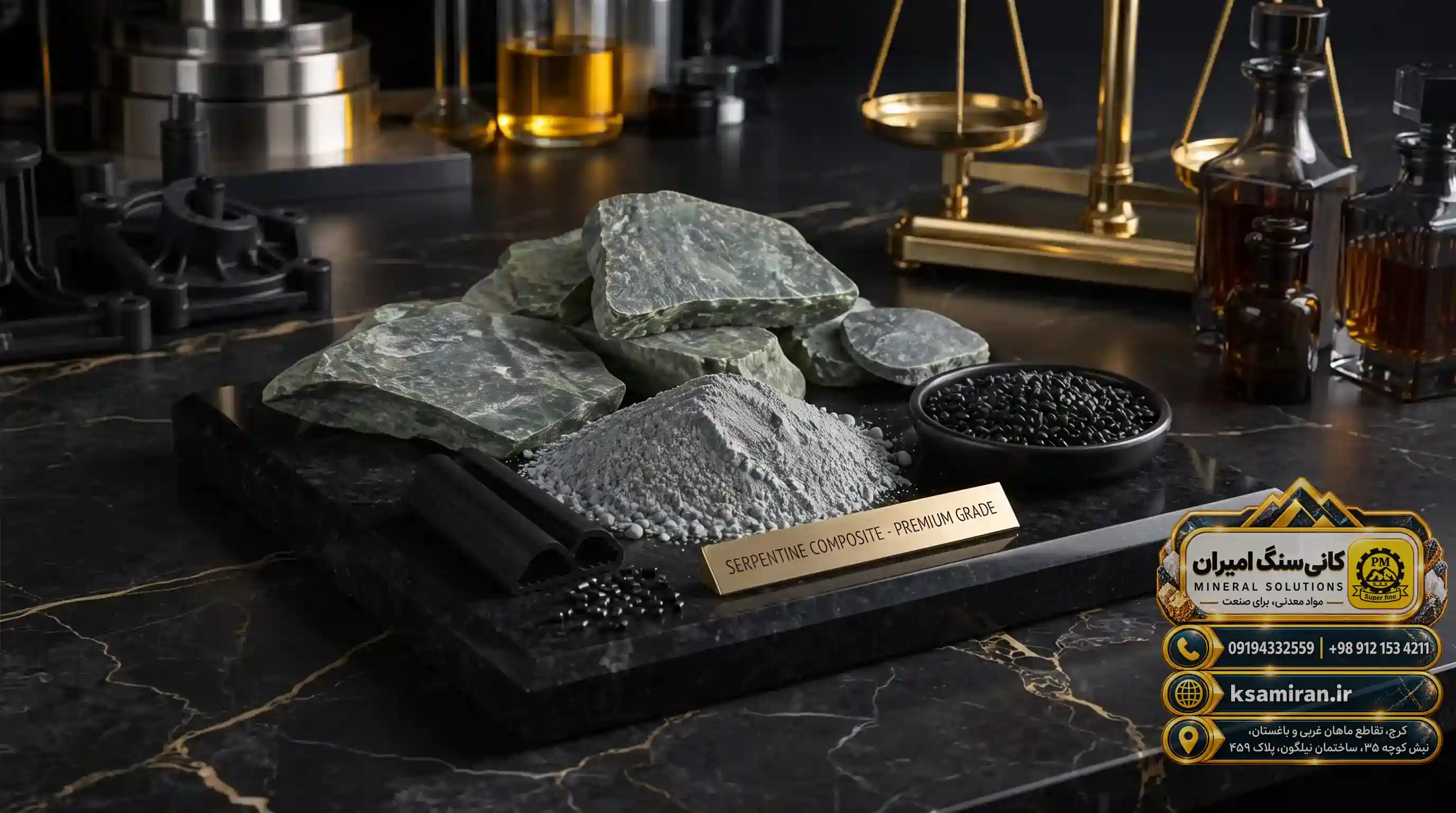
Specialized Guide to Purchasing Consultation and Supply of Industrial Talc
The process of supplying mineral raw materials requires meticulous attention and precise technical evaluation. When deciding to procure industrial talc, examining factors such as purity percentage, the level of accompanying mineral impurities, surface moisture, and particle size consistency in consecutive shipments is of high importance.
Specialized purchasing consultation helps buyers choose the most appropriate technical specifications based on the final application (whether polymer products, rubber products, paint, or industrial products). Choosing the wrong mesh or inappropriate grade can compromise the quality of the final product and increase production costs.
Manufacturers can visit the dedicated Industrial Talc product page for a closer examination of their production line needs and to view full technical specifications, gaining comprehensive information for informed decision-making. Establishing contact with Kani Sang Amir's technical experts also smooths the path of supply.
Vision for Sustainable Supply and Quality Control of Amiran Minerals
Sustainable supply of raw materials is one of the main conces of supply chain managers in manufacturing industries. Quality fluctuations or gaps in the supply chain can cause heavy damages to production lines. Therefore, collaborating with reputable and committed manufacturers who have strict quality control standards is essential.
The Kani Sang Amir project, utilizing rich mineral resources and advanced processing equipment, strives to guarantee the continuous supply of industrial talc with uniform technical specifications for the country's industries. Monitoring the extraction process, precise grading in the 450 1000 mesh range, and standard packaging are the main pillars of this complex's commitment to its customers.
Ultimately, looking at the future of the mining industry shows that focusing on quality, precisely responding to customer needs, and providing specialized technical consultations are the key to creating sustainable added value in the industrial raw material supply chain.
| Question | Answer |
|---|---|
| What is industrial talc? | It is a hydrated magnesium silicate with a layered structure and high softness, used in industries as a filler and property enhancer. |
| What is the mesh range of the supplied industrial talc? | This product is produced and supplied in the mesh range of 450 to 1000 mesh. |
| What are the main applications of industrial talc? | It is used in polymer products, rubber products, paint, and various industrial products. |
| Why is talc's structure beneficial for the polymer industry? | Its layered structure increases dimensional stability, improves modulus, and reduces polymer shrinkage. |
| What is the role of talc in the paint industry? | It acts as an extender and increases resistance to moisture, coverage, and the durability of the paint film. |
| Is this material soluble in water? | No, this mineral is insoluble in water and has hydrophobic properties. |
| How can the appropriate grade be selected for a production line? | By considering the type of final application and consulting with technical experts based on the required mesh and purity. |
| What is the hardness limit of talc? | This material has a hardness of 1 on the Mohs scale and is very soft. |
| How can this product be purchased? | It is possible by visiting the industrial talc product page on the Kani Sang Amir website. |
| Does talc's particle sizing affect the final quality? | Yes, particle size distribution and mesh range directly affect the dispersion and mechanical properties of the final product. |
Specialized reference for mineral data and industrial standards of Kani Sang Amir.
برچسب: Industrial Talc,Specialized Guide to Purchasing Consultation and Supply of Industrial Talc,
نویسنده: رساوب آفرین