
درباره سایت
آخرین مطالب
- دور أكسيد الليمونيت (گل ماش) في صناعة السيراميك والبلاط
- The Role of Limonite Oxide (Gole Mash) in the Ceramic and Tile Industry
- Online Order and Price Inquiry Guide for Kaolin
- راهنمای ثبت سفارش آنلاین و استعلام قیمت کائولن
- How to choose the best red iron oxide (ochre) for the project?
- دور أكسيد الليمونيت (گل ماش) في إنتاج الطلاءات الواقية
- كيف تشترين أفضل ماركة أكسيد الليمونيت (جول ماش)؟
- Examining the Environmental Impacts of Limonite Oxide (Gole Mash)
- دراسة التأثيرات البيئية لأكسيد الليمونيت (گل ماش)
- How to buy the best Limonite Oxide (Gol Mash)?
امکانات وب
Limonite Oxide (Gole Mash); Introducing a Mineral Pigment with a Direct Impact on Product Quality
Among the mineral pigments that the paint, coating, and building materials industries rely on, limonite oxide (gole mash) holds a special place. Known in the Iranian market as “gole mash,” this material is a natural pigment based on iron oxide-hydroxide, and due to its warm yellow to brown color, high stability, and versatile applications, it is used in a wide range of formulations. But what distinguishes this material from a simple filler is its direct impact on the quality of the final product: from color intensity and surface uniformity to resistance against environmental conditions and long-term durability.
The limonite oxide (gole mash) product offered by Kani Sang Amiran Project — Mineral Materials Production is officially introduced for three key areas: mineral pigments, coatings, and building products. Although these three areas may seem different from one another, they share a fundamental commonality; they all tie their final quality to particle grading, color purity, and pigment behavior within the formulation. This is why a limonite with inappropriate granulation or high impurity can reduce the overall value of a building product or a batch of paint.
The mesh range of this product is aounced as 450 to 1500 mesh; meaning its particles can be much finer than ordinary market particles. This feature forms the mechanical basis of limonite oxide's impact on product quality; because particle size directly affects coloring power, dispersibility within the binder, and final surface smoothness. In the following chapters, we will examine how this wide range allows for precise selection for each application.
To view product specifications and full explanations, you can visit the official page for Limonite Oxide (Gole Mash) on the Kani Sang Amiran Project website. In the rest of this article, we will examine the role of this mineral pigment in product quality; from its structure and color chemistry to its application in mineral pigments, coatings, and building products, and finally quality control considerations for buyers and formulators.
Structure, Chemistry, and Color Nature of Limonite Oxide (Gole Mash)
Limonite in mineralogical literature is a name applied to a group of hydrous iron oxides, consisting mainly of goethite (FeO(OH)) with varying amounts of water of crystallization. This hydrous structure is the main reason for the yellow to light brown color of limonite oxide (gole mash). The iron element in this lattice absorbs blue-green wavelengths of light and creates a warm reflection of yellow to orange-brown. This is why limonite has been used for centuries as a natural ochre pigment in painting and construction.
An important chemical feature of limonite oxide (gole mash) is its stability in alkaline and neutral environments. This pigment resists the high pH of cement and mortars and does not lose its color upon prolonged contact with moisture. This behavior makes limonite oxide a suitable choice for building products and colored concrete. In contrast, organic pigments that produce a similar yellow color are often susceptible to the alkalinity of cement and the sun's ultraviolet rays.
In terms of optical properties, limonite particles have an acceptable hiding power. The refractive index of the iron oxide-hydroxide lattice allows a thin layer of pigment to largely cover the underlying surface. This property directly affects product quality: the higher the hiding power, the less pigment needed to achieve the desired color, resulting in lower formulation costs and a reduced risk of quality degradation due to resin saturation.
Another point is the thermal stability of limonite oxide. This material maintains its stability at the typical temperatures of building processes and powder coatings, although at very high temperatures and severe calcination processes, it may lose its hydrous structure and tend toward other phases of iron oxide and color change. Therefore, for applications involving high-temperature curing, choosing the right product type and appropriate mesh range plays a decisive role in final quality. Overall, the chemical structure of limonite is the foundation upon which all its technological advantages in pigments, coatings, and building materials rest.
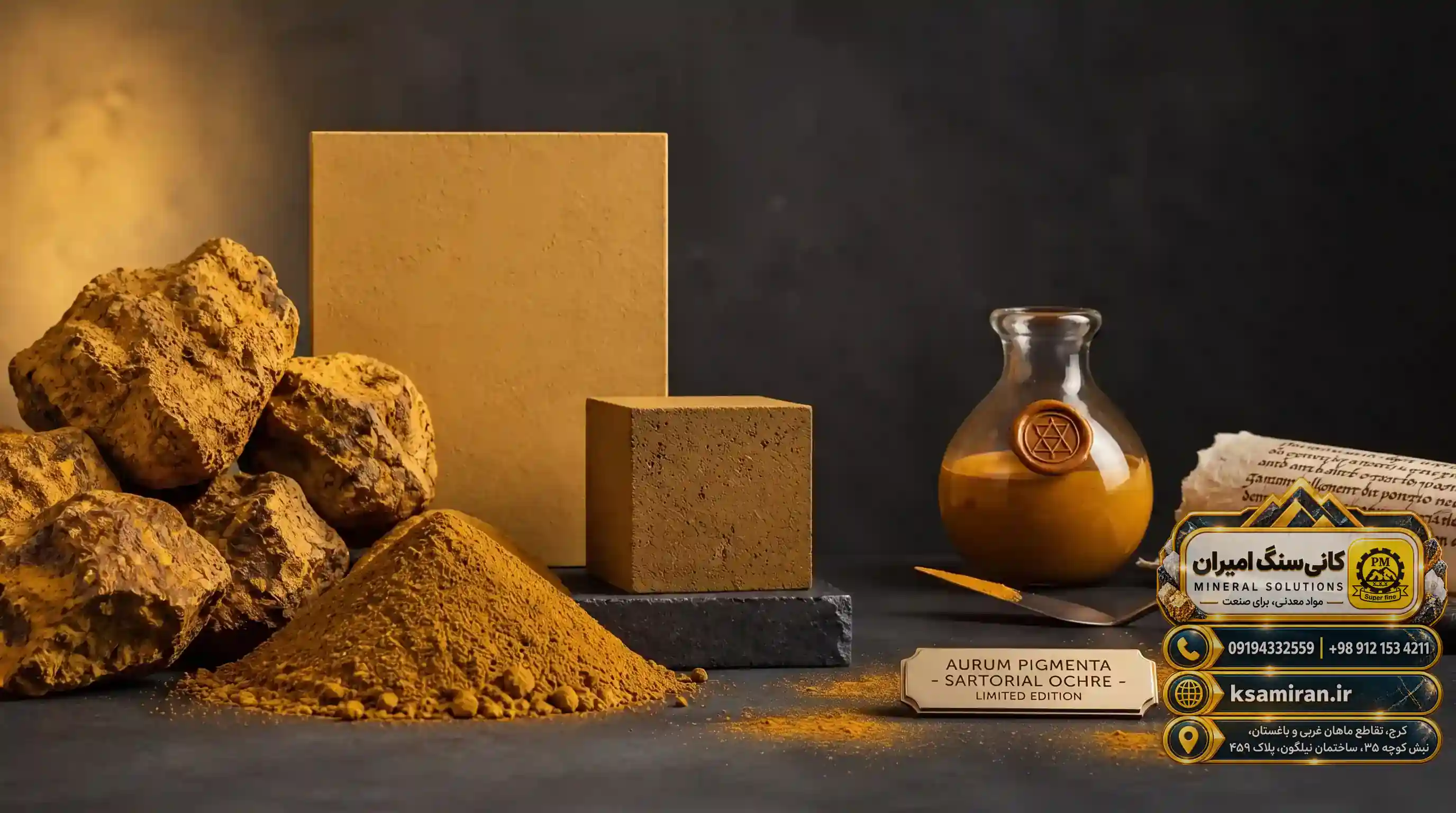
The Impact of Limonite Oxide (Gole Mash) on the Quality of Mineral Pigments
Mineral pigments are a spectrum of mineral colorants used in the paint, plastics, tile, ceramic, and colored materials industries. In these industries, limonite oxide (gole mash) plays the role of a natural yellow to ochre color, and the quality of the final product depends on three main factors: color intensity, color uniformity, and dispersibility. Color intensity depends on the amount of light absorption and the concentration of the color phase in the particles; color uniformity depends on the particle size distribution and the absence of colored impurities; and dispersibility relates to the specific surface area of the particles and their behavior in a resinous or aqueous system.
One of the most important effects of limonite oxide (gole mash) on the quality of mineral pigments is the fineness of its particles in the 450 1500 mesh range. Finer particles create a higher specific surface area, resulting in better contact with the binder. This allows us to achieve the desired color with a smaller amount of pigment while forming a smoother and more even final surface. In contrast, coarser particles can cause a rough texture, reduced gloss, and even faster settling in the paint tank.
The second factor is loading uniformity. A pigment composed of particles with a uniform distribution produces a consistent color on a large production scale. This is vital for manufacturers who paint multiple times and must match the color of each batch to the previous one. Otherwise, color variation between production batches is considered a form of quality degradation that directly lowers the product's value.
For buyers and quality control experts who want to evaluate the quality of this product professionally, the Limonite Oxide (Gole Mash) Quality Detection Guide offers useful practical tips. Overall, improving the quality of mineral pigments with limonite has a direct relationship: the more precise the particle grading and the higher the color purity, the more color-stable, smoother, and more economical the final product will be.
The Role of Limonite Oxide (Gole Mash) in the Quality of Coatings and Powder Coatings
Protective and decorative coatings are layers that simultaneously provide the beauty and durability of a product. In these layers, limonite oxide (gole mash) acts in two ways: first, as a colored pigment creating a warm yellow to brown color, and second, as a mineral pigment that, due to its particle shape and chemical behavior, helps form a denser layer and better adhesion. Both of these roles play a part in the final quality of the coating, including resistance to abrasion, moisture, and UV radiation.
In powder coatings, which require a thermal curing process, the particle size of the pigment is of special importance. Very fine particles in the 450 1500 mesh range can disperse uniformly within the powder and, after curing, create a smooth surface without heterogeneous color spots. Heterogeneous or coarse particles can cause “color defects,” reduced gloss, and even the formation of pinholes in the coating layer. For this reason, choosing the right product and coordinating it with the curing oven has a direct impact on coating quality.
Another advantage of limonite oxide in coatings is its color stability against sunlight. Mineral iron oxides generally have high resistance to UV radiation and retain their color upon prolonged contact with light. This feature is important for exterior coatings, facades, machinery, and urban equipment; where organic paints fade or dull after a few years. For specialized information in this field, you can read the article The Application of Limonite Oxide (Gole Mash) in Powder Coatings.
Finally, formulators should know that limonite oxide (gole mash) can be used with various organic, acrylic, epoxy, and polyester resins. However, to achieve the best quality, the pigment amount, dispersion time, and mixer speed must be adjusted according to the selected mesh range. For coarser formulations, longer dispersion time is needed, and for finer paints, viscosity control and preventing agglomeration become important. These settings determine the boundary between a high-quality coating and a problematic one.

Application of Limonite Oxide (Gole Mash) in Building Products and Concrete
In the construction industry, color is usually not merely a decorative aspect; it is a sign of durability, architectural identity, and execution quality. Limonite oxide (gole mash) is used in building products such as colored concrete, colored mortars, bricks, tiles, stone mosaics, and colored plasters. The advantage that makes it stand out in these products is its resistance to the alkaline environment of cement and the durability of the color against weather conditions; a feature that organic colors simply caot provide.
In colored concrete, limonite oxide particles must disperse uniformly in the cement paste so that the final color looks even and spotless. The fineness of the particles in the 450 1500 mesh range facilitates this uniform dispersion while preventing structural weakness. Coarse particles can cause heterogeneous color spots and even reduce surface resistance. Therefore, controlling the granulation is important both for aesthetics and for concrete performance.
An important technical point in coloring concrete is the water-to-cement ratio and the moisture of the paste. Mineral pigments like limonite absorb water, and consequently, the amount of water in the formulation must be adjusted according to the amount and mesh grade of the pigment. This adjustment has a direct impact on final quality: more water reduces strength and results in a paler color, and less water prevents pigment dispersion and causes surface spotting. For a deeper look into this topic, the article The Specialized Application of Limonite Oxide (Gole Mash) in Concrete is a good resource.
In building facades, colored bricks and tiles, limonite oxide creates a warm and natural color that, over time, instead of fading, only develops a slight “beautiful patina.” This behavior is highly valued, especially in historic buildings and classic architecture. Also, in widely used building products such as plaster and colored mortars, this material plays an effective role in final product quality due to its good adhesion and surface stability. Overall, the impact of limonite oxide on building products is a combination of natural beauty and technical durability.
The 450 1500 Mesh Range; The Key to Limonite Oxide's Impact on Product Quality
One of the most important technical specifications of limonite oxide (gole mash) is its particle grading range, i.e., 450 to 1500 mesh. The “mesh” unit indicates the number of openings in the screen per inch, and the larger the number, the finer the particles. For example, 450 mesh particles will be around 32 microns, and 1500 mesh particles will be around 10 microns and smaller. This wide range allows the producer and consumer to choose the product exactly according to their application needs.
The impact of particle size on product quality is multifaceted. First, color intensity: finer particles create a higher color surface density per unit volume, and thus we reach a saturated color with less pigment. Second, surface smoothness: in coatings and paints, finer particles produce a smoother and glossier surface because light scattering on the surface decreases. Third, dispersibility: finer particles stay suspended better in liquid or paste environments and do not agglomerate.
But being finer is not always better. In some applications, such as thick building mortars or formulations requiring high viscosity, very fine particles can cause increased water absorption, increased viscosity, and reduced workability. In these cases, coarser particles in the 450 mesh range might be more suitable. Conversely, in high-quality powder coatings and precision tiling, the finer side of the range (1000 to 1500 mesh) performs better. Therefore, the right choice should be based on matching the application, rather than searching for the “finest” product.
Economically, a high-quality mesh range also has a direct impact on cost and quality. Particles with inappropriate granulation cause more pigment to be used, or make the dispersion process longer and more energy-intensive, or in the worst case, cause the final product to be reworked. For this reason, suppliers who have precise granulation control provide their customers not just a product, but a quality guarantee. Overall, the 450 1500 mesh range is a technical tool that, if used correctly, creates a significant improvement in the quality of pigments, coatings, and building products.
Quality Control and Evaluation of Limonite Oxide (Gole Mash) Before Use
The impact of limonite oxide (gole mash) on product quality depends not only on the material itself but also on how it is controlled and evaluated before entering the production line. A proper quality control program includes several key stages: visual inspection, granulation measurement, color intensity assessment, and formulation behavior testing. In visual inspection, uniform color, absence of foreign particles, and absence of excess moisture are initial signs of a high-quality product.
Granulation can be checked with laboratory methods such as dry sieving or particle size analysis. Although these tests are not feasible in all factories, even a simple “water sedimentation test” can provide useful information: a good product should disperse quickly and without forming large clumps. In more professional cases, a comparative coloring test (alongside a reference sample) is a good way to ensure color intensity and stability.
In bulk purchases, besides technical specifications, attention must be paid to uniformity across different batches. A reliable supplier provides a product with color and granulation consistency that does not change from one batch to another. For more precise guidance in this area, reading the Limonite Oxide (Gole Mash) Quality Detection Guide helps buyers evaluate product quality with simple yet practical methods before use and prevent an unsuitable material from entering the production line.
Finally, proper storage is also part of maintaining quality. Limonite oxide should be stored in a dry environment, away from moisture, and in sealed packaging to prevent agglomeration and moisture absorption. Excess moisture can damage both the color and dispersibility, consequently affecting the final product quality. Combining a high-quality product, precise evaluation, and proper storage is the best way to fully leverage the capabilities of limonite oxide in various industries.
Conclusion; Why Limonite Oxide (Gole Mash) is Worth Investing in for Quality
Throughout this article, we examined the impact of limonite oxide (gole mash) on product quality from several angles. This mineral pigment, offered in the 450 1500 mesh range, plays an important role in the quality of mineral pigments, coatings, and building products; from color intensity and surface uniformity to durability against light, moisture, and the alkaline environment of cement. This set of features has made it a sustainable and economical option for formulators.
The key advantage of this product is the combination of “being natural” with “technical control.” On one hand, its mineral origin provides a warm and stable color that does not fade over time; on the other hand, precise particle grading enables its use in advanced formulations such as powder coatings, tiles, colored concrete, and industrial coatings. This combination means a simple material that, through proper processing, becomes a quality control tool.
For manufacturers looking to improve the quality of their products, the practical recommendation is this: before choosing, define your application needs (desired final surface, production method, process temperature, and binder type); then select the appropriate mesh range; and finally, evaluate the product with a comparative test. These three simple steps drastically reduce the risk of quality degradation. Also, using specialized resources such as the article The Application of Limonite Oxide in Powder Coatings and The Specialized Application of Limonite Oxide in Concrete can guide the way.
In conclusion, it must be emphasized that the quality of the final product is the result of a chain of correct decisions: choosing the right mineral material, controlling granulation, precise evaluation, and principled use in formulation. Limonite oxide (gole mash), with its inherent characteristics, can play an effective role in all four links of this chain, and therefore its impact on product quality is regarded as a strategic value-creating factor rather than a simple coloring agent.
| Question | Answer |
|---|---|
| What is limonite oxide (gole mash) and what impact does it have on product quality? | It is a mineral pigment based on iron oxide-hydroxide with a yellow to brown color, which improves the color intensity, uniformity, and durability of final products through precise particle grading. |
| Why does limonite oxide create a yellow to brown color? | The hydrous structure of iron oxide-hydroxide absorbs blue-green wavelengths of light and produces a warm reflection from yellow to brown. |
| What does the 450 1500 mesh range mean and how is it chosen? | This range indicates the fineness of the particles; selection is based on application: finer particles for a smooth surface and higher color intensity, and coarser particles for mortars and high-viscosity formulations. |
| What is the impact of limonite oxide on the quality of mineral pigments? | It enhances the quality and stability of the final color by increasing color intensity, improving dispersibility, and ensuring uniform particle distribution. |
| What is the application of this product in coatings and powder coatings? | Creating light-stable yellow to brown color, helping form a dense layer and smooth surface after curing, and increasing the coating's durability against environmental conditions. |
| How does limonite oxide affect building products and concrete? | It is stable in the alkaline environment of cement, creates a natural and durable color, and by dispersing uniformly in the cement paste, it improves the visual quality of colored concrete. |
| Is limonite oxide stable against light and moisture? | Yes; mineral iron oxides have high resistance to UV radiation and moisture, and retain their color upon prolonged contact with weather conditions. |
| How can we evaluate the quality of limonite oxide before purchasing? | By checking color uniformity and absence of impurities, testing dispersibility in water, comparing color intensity with a reference sample, and ensuring granulation consistency across different batches. |
| What factors affect the color uniformity of limonite oxide? | Uniform particle size distribution, absence of colored impurities, product moisture, and the method of dispersion in the formulation. |
| What is the advantage of limonite oxide over synthetic yellow pigments? | Higher stability against light and cement alkalinity, long-term color durability, and lower cost, especially in building and outdoor applications. |
Reference: Technical specifications of the limonite oxide (gole mash) product, Kani Sang Amiran Project — Mineral Materials Production.
برچسب: Limonite Oxide (Gole Mash),The Impact of Limonite Oxide (Gole Mash) on Product Quality,
نویسنده: رساوب آفرین