
درباره سایت
آخرین مطالب
- Applications of White Talc in Plastic Production and Industrial Polymer Industries
- Applications of Coated Calcium Carbonate in Chemical and Plastic Industries
- What is Coated Calcium Carbonate? A Guide to Its Application in the Construction Industry
- كيفية اختيار كربونات الكالسيوم المطلي بناءً على التدرج الحبيبي
- How to Choose High-Quality White Barite: Key Purchasing Tips
- استانداردهای دانهبندی تالک سفید برای مصارف گوناگون در صنایع
- White Talc in the Construction Industry: Its Applications and Key Features
- Industrial Barite or Calcium Carbonate? A Complete Comparison of Applications and Benefits
- استانداردهای کیفیت باریت صنعتی و روشهای آزمایش و کنترل آن
- Application of White Barite in Producing Paint and Durable Industrial Coatings
امکانات وب
What is White Talc? A Comprehensive Introduction to This Industrial Mineral
White talc is one of the most well-known and widely used industrial minerals in the world, recognized by the chemical formula Mg₃Si₄O₁₀(OH)₂. This mineral belongs to the group of layered silicates (phyllosilicates) and is mainly composed of hydrated magnesium silicate. Talc is formed during hydrothermal and thermal alteration processes of dolomitic and clay-bearing rocks, and is extracted from various mines in countries including Iran, China, the United States, Brazil, and India.
The crystal structure of white talc consists of thin stacked sheets. These sheets are coected to each other through weak interlayer bonds (van der Waals), which is the main reason for this mineral's extreme softness. On the Mohs hardness scale, talc is known as the softest mineral with a rating of 1; so much so that it can be scratched with a fingeail. This exceptional softness makes grinding and processing talc easy, and its low abrasiveness reduces the wear and tear of industrial equipment.
In addition to softness, white talc has other outstanding properties: it is chemically nearly inert, resistant to acids and bases, remains stable at high temperatures, and has low thermal and electrical conductivity. Talc is also hydrophobic and lipophilic; meaning it has a natural tendency to combine with organic materials, polymers, and oils.
After extraction, talc rock is converted into a uniform powder through crushing, grinding, and classification processes. The particle size of the final product is offered in the range of 450 to 2500 mesh (from about 32 microns to less than 6 microns), and each industry chooses the appropriate mesh based on its needs. For example, the ceramics and paper industries usually prefer medium meshes, while masterbatch, compound, and paint manufacturers lean towards higher meshes and finer particles.
The main applications of white talc include masterbatch, compounds, paint, paper, and ceramic products. In the construction industry, this mineral is used in the formulation of adhesives, sealants, mastics, plaster, and coatings, helping to improve their strength, adhesion, and durability. This versatility makes white talc one of the most strategic mineral materials in the market.
In the rest of this article, we will fully examine the key features of white talc, its applications in the construction industry and other industries, and a guide to choosing a high-quality product.
To understand why white talc is so widely used across various industries, we must carefully examine the physical and chemical properties of this mineral. Each of these characteristics plays a decisive role in one or more industries.
1. Whiteness and Brightness
After processing and removing impurities such as iron oxide, white talc tus into a white, bright powder. The high degree of whiteness of this mineral makes it a suitable filler and secondary pigment in the paint, paper, and plastics industries. The higher the whiteness, the brighter and higher-quality the final product appears, reducing the need for expensive pigments.
2. Low Hardness and Non-Abrasiveness
Talc is the softest mineral on the Mohs scale. Grinding it requires less energy, and its particles have low abrasiveness. This characteristic allows talc to minimize machinery wear in polymer and paint production processes, extending the life of extruders and mixers.
3. Sheet-Like (Layered) Structure
The layered structure of talc gives this mineral high covering and surface-coating properties. Sheet-like particles spread over surfaces, level out, and form a protective matrix. This feature is highly valued in architectural paints, coatings, and coated papers.
4. Thermal Stability
White talc maintains its structure at high temperatures and does not degrade. This thermal stability makes talc ideal for ceramic applications fired in kilns and polymeric products exposed to extruder heat.
5. Chemical Inertness
Talc does not react with most chemicals and is resistant to acids and bases. This property allows talc to guarantee the chemical stability of the entire formulation in different product formulations without interfering with other additives.
6. Hydrophobicity and Lipophilicity
Talc has a hydrophobic and lipophilic nature and combines well with oils, resins, and polymers. This property is very important in masterbatches, compounds, and the paper industry.
7. Various Particle Sizes (450 to 2500 mesh)
Manufacturers can supply talc in different meshes. Coarser particles are suitable for applications requiring high filling capacity and lower cost, while finer particles (higher meshes) are used for products with high surface quality and better dispersion.
8. Low Electrical Conductivity
Talc is a good electrical insulator and is used as an insulating filler in the production of plastic parts and cables.
The combination of these properties makes white talc a versatile material that, despite its simplicity, plays a very important role in the quality of industrial products.
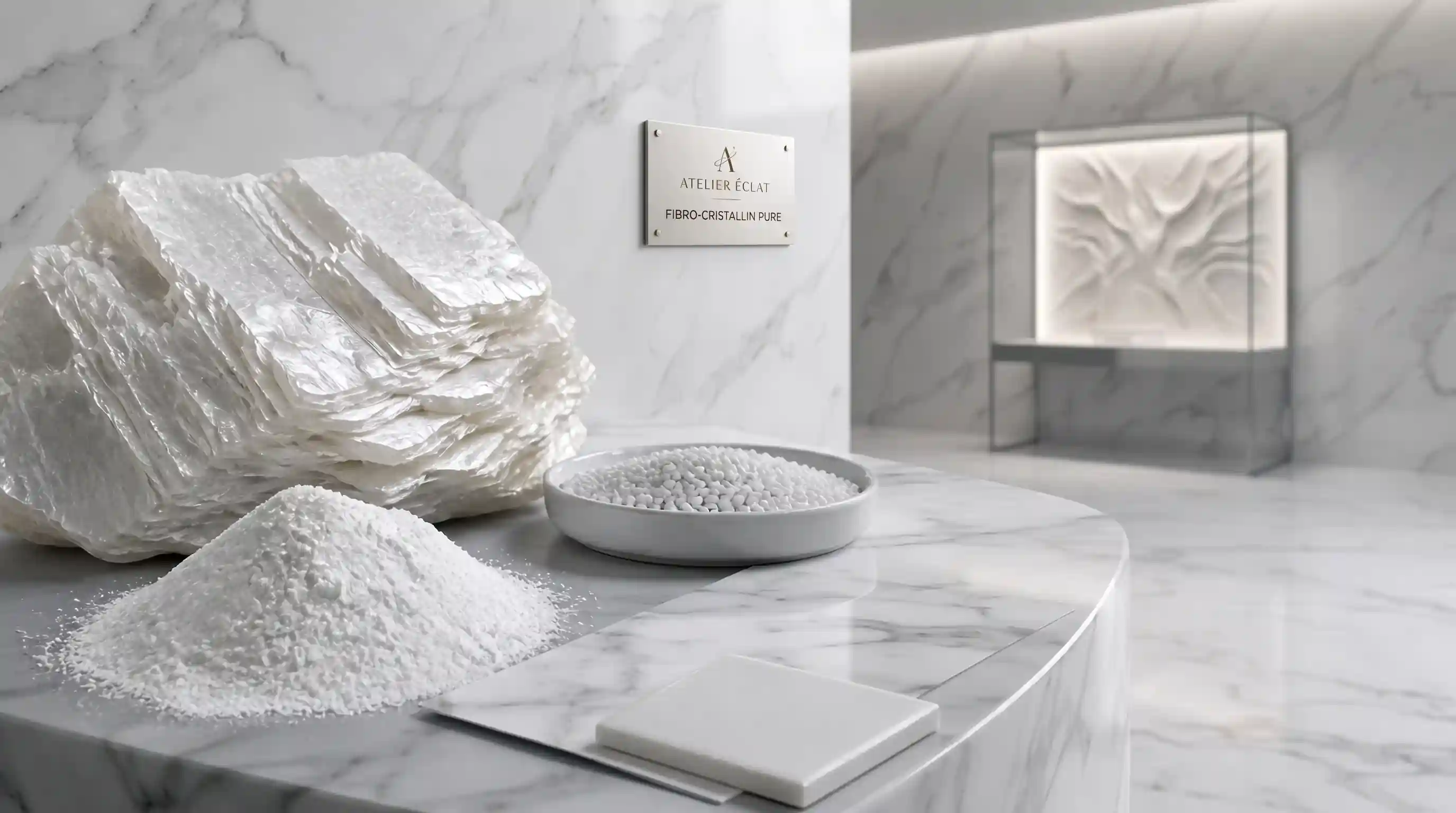
The construction industry is one of the largest consumers of minerals, and white talc holds a special place among these materials. Although talc is mostly associated with the plastics and paper industries, it also plays vital roles in building materials.
1. Construction Adhesives
White talc is used as a filling and viscosity-regulating agent in polymer-based adhesives, tile and ceramic adhesives, and industrial glues. The sheet-like structure of this mineral helps the adhesive cover surfaces better, increases adhesion, and prevents the mixture from separating. Also, the hydrophobicity of talc increases the adhesive's resistance to moisture.
2. Sealants and Mastics
In the production of polymeric sealants, mastics, and silicones, white talc is an ideal filler. By reducing product shrinkage during drying, this mineral prevents cracking and increases the sealant's durability against weather conditions. The high whiteness of talc also gives the final product a clean appearance.
3. Plaster, Stucco, and Interior Coatings
Industrial talc plays an important role in the gypsum and building materials industries. Adding talc to gypsum and plasters can regulate setting speed, reduce product density, and increase its durability. Also, in interior and decorative coatings, the softness of talc creates a smooth, frictionless surface. To read more on this topic, you can study the article The Role of Industrial Talc in the Gypsum and Building Materials Industries.
4. Architectural Paints and Coatings
White talc is used in architectural paints as a filling and matting agent, increasing the paint's resistance to abrasion, washing, and weather conditions. The sheet-like particles of talc form a protective layer on the paint surface, preventing moisture penetration.
5. Thermal and Acoustic Insulation
Due to its thermal stability and low thermal conductivity, talc is used in the composition of building insulations, panels, and polymeric foams, helping to reduce heat transfer.
6. Polymeric Mortars and Concrete
In polymer-based mortars and specialty concretes, talc acts as an active filler, improving mechanical properties, adhesion, and durability.
Overall, white talc is recognized not only as a cost-effective filler but also as an active agent that enhances the quality and durability of building products.
The plastics industry is one of the largest markets for white talc in the world. To understand the role of talc in this industry, we must first understand two concepts: "masterbatch" and "compound".
A masterbatch is a concentration of pigments or additives in a polymeric carrier that is added to raw plastic in small quantities to color it or modify its properties. A compound is a ready-to-use blend of polymer, mineral filler, and additives used directly in shaping machines.
Why is White Talc Used in Masterbatches?
- Lipophilicity: easy combination with polymeric carriers and uniform dispersion in the matrix
- High whiteness: replaces a portion of expensive pigments like titanium dioxide
- Good dispersion: uniform distribution of particles and prevention of clumping
- Thermal stability: resistance to high extruder temperatures
- Very fine particles: meshes above 1250, to prevent loss of surface quality
The Role of White Talc in Compounds
- Mechanical reinforcement: talc's sheet-like particles act as reinforcements in the polymer matrix
- Reduced coefficient of thermal expansion: the dimensions of the final part remain more stable against temperature changes
- Improved dimensional stability
- Reduced overall product cost
- Improved surface properties and scratch resistance
- Anti-blocking property: prevents the sticking of polymeric film layers
- Nucleating: accelerates polymer crystallization and increases production cycle speed
In the production of polyolefin films, pipes, injected parts, profiles, and cables, white talc acts as a multi-functional mineral filler. Choosing the right mesh (usually 1250 to 2500 mesh) has a direct impact on the transparency, surface quality, and mechanical properties of the final product.
The important point is that talc is not just a cheap filler; it is an active material that, by interacting with the polymer matrix, improves the physical and thermal properties of the product. For this reason, many plastics manufacturers consider white talc an inseparable part of their formulations.
The paint industry is one of the oldest and most important consumers of white talc. This mineral is used in architectural paints, industrial coatings, automotive paints, and powder coatings, playing diverse roles in the quality of the final product.
The Role of White Talc in Paint
- Filling agent: talc increases the volume of paint and reduces the finished cost without dropping quality
- Increased coverage: talc's sheet-like particles cover the surface better
- Matting agent: reduces undesirable gloss in architectural paints
- Suspension stability: prevents paint particles from settling in the can
- Increased moisture resistance: talc's natural hydrophobicity
- Improved abrasion and durability: a surface more resistant to washing and abrasion
Application in Acrylic and Latex Paints
In acrylic and latex paints, which are the most widely used architectural paints, white talc helps the paint cover surfaces uniformly, become more wash-resistant, and extend the coating's lifespan. The natural hydrophobicity of talc raises the paint's moisture resistance and prevents the growth of fungi and mold on the surface.
Application in Primers and Anti-Corrosion Paints
Due to its chemical inertness, talc does not react with other formulation components and maintains the mixture's stability. In primers, talc provides a smooth surface for subsequent paint layers and improves the adhesion of the final paint.
Mesh Selection for the Paint Industry
For regular architectural paints, medium meshes (around 600 to 800 mesh) are suitable, but for higher-quality paints, automotive paints, and powder coatings, higher meshes (1250 to 2500 mesh) are used to improve surface quality and clarity.
Overall, white talc, as a versatile mineral, helps paint manufacturers produce higher-quality, more durable, and at the same time more cost-effective products.
The paper industry is one of the largest consumers of talc in the world. White talc is used in two main areas in this industry: as a filler in the paper pulp and as a coating color.
1. Talc as a Paper Filler
In paper production, a portion of the cellulose fibers is replaced with minerals. White talc is an ideal choice for the following reasons:
- High whiteness: increases paper brightness
- Affordable price: reduces production costs
- Softness: softer paper and a more pleasant touch
- Better printability: better ink absorption and higher print quality
- Pitch control: talc's hydrophobicity absorbs natural wood pitch particles, preventing them from depositing on machinery
2. Talc in Paper Coating Colors
In high-quality papers such as magazine paper, catalog paper, and photographic printing paper, the paper surface is covered with a coating color. White talc is used in these colors for the following reasons:
- Creating a smooth and glossy surface for high-quality printing
- Increasing brightness and whiteness
- Improving ink absorption
- Reducing the consumption of expensive pigments
3. Specialty Papers
In the production of flake papers used in asphalt packaging and insulation, talc plays a vital role due to its hydrophobicity and lipophilicity. These papers must be resistant to moisture and oil, and talc provides this characteristic.
4. Environmental Benefits
Using talc instead of a portion of wood fibers helps reduce the consumption of forest resources. Also, the recyclability of papers containing talc is high and does not cause problems in the recycling process.
Generally, white talc plays a very important role in producing high-quality, bright, and economical paper, and is considered a suitable, low-cost alteative to a portion of cellulose fibers and expensive pigments.
Talc is one of the key and oldest components in the ceramics industry. White talc is used in two main areas of ceramic making: the body (bisque) and the glaze.
1. Talc in the Ceramic Body
When talc is fired in a kiln, it transforms into new crystalline phases that significantly increase the ceramic's strength. The most important property talc imparts to ceramics is thermal shock resistance. This feature is vital for cookware, kilns, industrial ceramics, and products exposed to sudden temperature changes.
Talc also causes:
- Increased toughness and mechanical strength of the ceramic
- Reduced shrinkage during firing
- Faster firing processes
- Balanced silica, alumina, and magnesium content in the body
2. Talc in Ceramic Glaze
In glazes, white talc acts as a flux and viscosity regulator. This mineral is used in glazes for the following reasons:
- Increased whiteness and brightness of the glaze
- Improved meltability of the mixture
- Viscosity regulation and prevention of glaze dripping
- Improved surface quality and gloss
- Increased crack resistance
3. Types of Talc-Containing Ceramics
Architectural tiles and ceramics, fine ceramics, steatite (a talc-based ceramic used in electrical insulation), and technical ceramics can all benefit from talc in their composition.
4. Mesh Selection for the Ceramics Industry
In ceramic applications, lower and medium meshes (450 to 800 mesh) are usually used, because coarser particles react better in the kiln and form desirable crystalline phases. However, for high-quality glazes and technical ceramics, higher meshes may also be used.
Overall, white talc plays a very important role in improving the quality, strength, and resistance of ceramics, and is considered one of the essential minerals in this industry.
Choosing the right white talc has a direct impact on the final product's quality. In this section, we examine the key criteria to consider when purchasing.
1. Choosing the Right Mesh
The range of 450 to 2500 mesh covers a wide spectrum of particles. As a general rule:
- 450 to 800 mesh: suitable for ceramics, paper, and building applications
- 800 to 1250 mesh: suitable for architectural paints, adhesives, and mortars
- 1250 to 2500 mesh: suitable for masterbatches, compounds, high-quality paints, and advanced products
2. Degree of Whiteness
For products where appearance and brightness matter (paint, paper, masterbatch), high whiteness is a priority. Whiteness is usually measured with a colorimeter.
3. Purity and Impurities
Impurities such as iron oxide, calcium carbonate, and chlorite can reduce the quality of talc. For sensitive applications, chemical purity and uniform particles are of great importance.
4. Particle Size Distribution
Besides the main mesh, the uniform distribution of particles is also important. Irregularly sized particles cause quality drops in the production process.
5. Consistency Across Different Batches
A reliable supplier must maintain the quality of their product across different batches. Quality fluctuations can cause problems for your production line.
6. Production Standards
Producing high-quality white talc requires adherence to national and inteational standards. To lea more about this topic, you can read the article A Review of National and Inteational Standards in White Talc Production.
7. Comparison with Other Mineral Powders
In the market, other mineral powders such as dolomite are also present. To understand the differences, you can read the article Examining the Appearance Features and Quality of White Dolomite Powder. Overall, due to its softness, hydrophobicity, and sheet-like structure, talc performs better in applications where dolomite is not suitable.
8. Packaging and Storage
Appropriate packaging prevents moisture and contamination penetration, preserving the product's quality during transportation.
If you are looking for high-quality white talc for the masterbatch, compound, paint, paper, or ceramics industries, we suggest checking out the White Talc product on the Kani Sang Amiran project website. This product is offered in the 450 to 2500 mesh range and can cover the needs of various industries.
| Row | Question | Answer |
|---|---|---|
| 1 | What is white talc? | White talc is a mineral from the layered silicate group with the formula Mg3Si4O10(OH)2, used in various industries due to its softness, whiteness, and chemical inertness. |
| 2 | What is the mesh range of white talc? | White talc is usually offered in the 450 to 2500 mesh range, and each industry chooses the appropriate mesh based on its needs. |
| 3 | What are the main applications of white talc? | Masterbatch, compound, paint, paper, and ceramic products, as well as adhesives, sealants, and building materials. |
| 4 | Why is talc used in masterbatches? | Due to its lipophilicity, high whiteness, good dispersion, and thermal stability, which improve quality and reduce costs. |
| 5 | What role does white talc play in paint? | It acts as a filling agent, matting agent, and enhancer of coverage and resistance to moisture and abrasion. |
| 6 | Why is talc used in papermaking? | To increase whiteness, softness, printability, and control natural wood pitch. |
| 7 | What effect does talc have on ceramics? | It improves thermal shock resistance, mechanical strength, and glaze quality. |
| 8 | How do we choose the right talc mesh? | For ceramics and paper, 450 to 800 mesh; for paint and adhesives, 800 to 1250 mesh; and for masterbatch and compound, 1250 to 2500 mesh are suitable. |
| 9 | Is white talc used in the construction industry? | Yes, it is used in adhesives, sealants, plaster, paints, and building insulation. |
| 10 | What is the difference between white talc and dolomite? | Talc is softer, hydrophobic, and lipophilic with a sheet-like structure, while dolomite is calcium-magnesium carbonate mostly used as a filler. |
The data in this article has been collected from the Kani Sang Amiran project website (ksamiran.ir) and public industrial geology sources.
برچسب: White Talc,White Talc in the Construction Industry, Its Applications and Key Features,
نویسنده: رساوب آفرین