
درباره سایت
آخرین مطالب
- Applications of White Talc in Plastic Production and Industrial Polymer Industries
- Applications of Coated Calcium Carbonate in Chemical and Plastic Industries
- What is Coated Calcium Carbonate? A Guide to Its Application in the Construction Industry
- كيفية اختيار كربونات الكالسيوم المطلي بناءً على التدرج الحبيبي
- How to Choose High-Quality White Barite: Key Purchasing Tips
- استانداردهای دانهبندی تالک سفید برای مصارف گوناگون در صنایع
- White Talc in the Construction Industry: Its Applications and Key Features
- Industrial Barite or Calcium Carbonate? A Complete Comparison of Applications and Benefits
- استانداردهای کیفیت باریت صنعتی و روشهای آزمایش و کنترل آن
- Application of White Barite in Producing Paint and Durable Industrial Coatings
امکانات وب
What is Coated Calcium Carbonate and Why is it Important in the Chemical Industry?
Coated calcium carbonate is one of the most widely used and economical mineral fillers in today's chemical and polymer industries, which has found a special place in industrial formulations due to its affordable price, abundance of reserves, easy processability, and positive impact on the final product's performance. This material is actually natural calcium carbonate extracted from calcite, marble, and limestone rocks, which after grinding, classification, and surface coating with a thin layer of fatty acids, is converted into the final product. The particle size range in this product varies from 450 to 3500 mesh, and depending on the final application, the appropriate mesh is selected.
The term “coated” refers to the surface coating of the particles. The surface of calcium carbonate particles in the natural state has free calcium ions and polar groups, which makes it inherently hydrophilic. This characteristic is in contrast with the hydrophobic nature of polymer chains such as polyethylene, polypropylene, and PVC. If uncoated calcium carbonate is used, problems such as moisture absorption, particle agglomeration, loss of mechanical properties, increased machine torque, and higher energy consumption during mixing arise. Surface coating with stearic acid or other fatty acids solves this problem by creating an organic layer on the particle surface.
The importance of coated calcium carbonate in the chemical industry comes down to several key factors: first, reduced finished cost compared to other fillers and base resins; second, improved melt flow and increased production rate; third, reduced machinery wear due to the lubricating property of the surface coating; and fourth, the possibility of high loading up to tens of weight percent without a severe loss of properties. This combination of features causes compound, polymer granule, profile, cable, flooring, and PVC part manufacturers to consider this product a strategic material in their formulation.
Amiran Stone Mineral Project, relying on years of experience in producing mineral materials, offers this product in the 450 to 3500 mesh range for various applications. To familiarize yourself with more details, you can view the Coated Calcium Carbonate product page on this group's website. In the rest of this article, we will first examine the structure and coating mechanism, and then we will review in detail the applications of this product in compounds, granules, profiles, cables, flooring, and PVC parts.
Surface Coating Mechanism and Its Effect on Chemical and Physical Properties
To understand why coated calcium carbonate is highly efficient, we must look at the surface chemistry of these particles. Calcium carbonate with the chemical formula CaCO₃ is an ionic compound in which calcium and carbonate ions are placed in a regular network. When the particle is ground, surface bonds break and positively charged calcium ions appear on the surface. These ions are attracted to polar molecules such as water and make the surface strongly hydrophilic.
In the coating process, fatty acids such as stearic acid attach to the surface calcium ion with their carboxyl group and form a thin layer on the particle. The hydrocarbon chain of this acid orients outward and makes the particle surface hydrophobic. The result of this change is a significant reduction in moisture absorption, reduced oil absorption, and the creation of surface energy compatible with the polymer matrix. For this reason, instead of a tendency to agglomerate, the particles disperse easily in the polymer melt and uniform distribution in the final part is achieved.
From a processing perspective, this change in surface chemistry has several important consequences:
- Reduced torque and die pressure: coated particles create less friction inside the extruder and die, and as a result, energy consumption and screw and barrel wear are reduced.
- Improved melt flow index: better melt fluidity allows processing at higher temperatures and speeds.
- No need for pre-drying: reduced moisture absorption reduces the risk of bubbles, porosity, and silver streaks in the part.
- Thermal stability in PVC: calcium carbonate, as a weak base, neutralizes the hydrogen chloride released during the thermal degradation of PVC and helps with color stability and preventing yellowing.
- Increased whiteness and opacity: this material, due to its inherent white color, acts as a functional filler in reducing titanium dioxide consumption and creating appropriate opacity.
In terms of mechanical properties, proper loading of coated calcium carbonate increases the tensile modulus, stiffness, and flexural strength. Choosing the right particle size and loading level plays a decisive role in maintaining impact strength; so that very fine particles can act as nucleation cores in foams and as an agent for improving impact strength, while coarser particles are more suitable for cost reduction and shrinkage control.
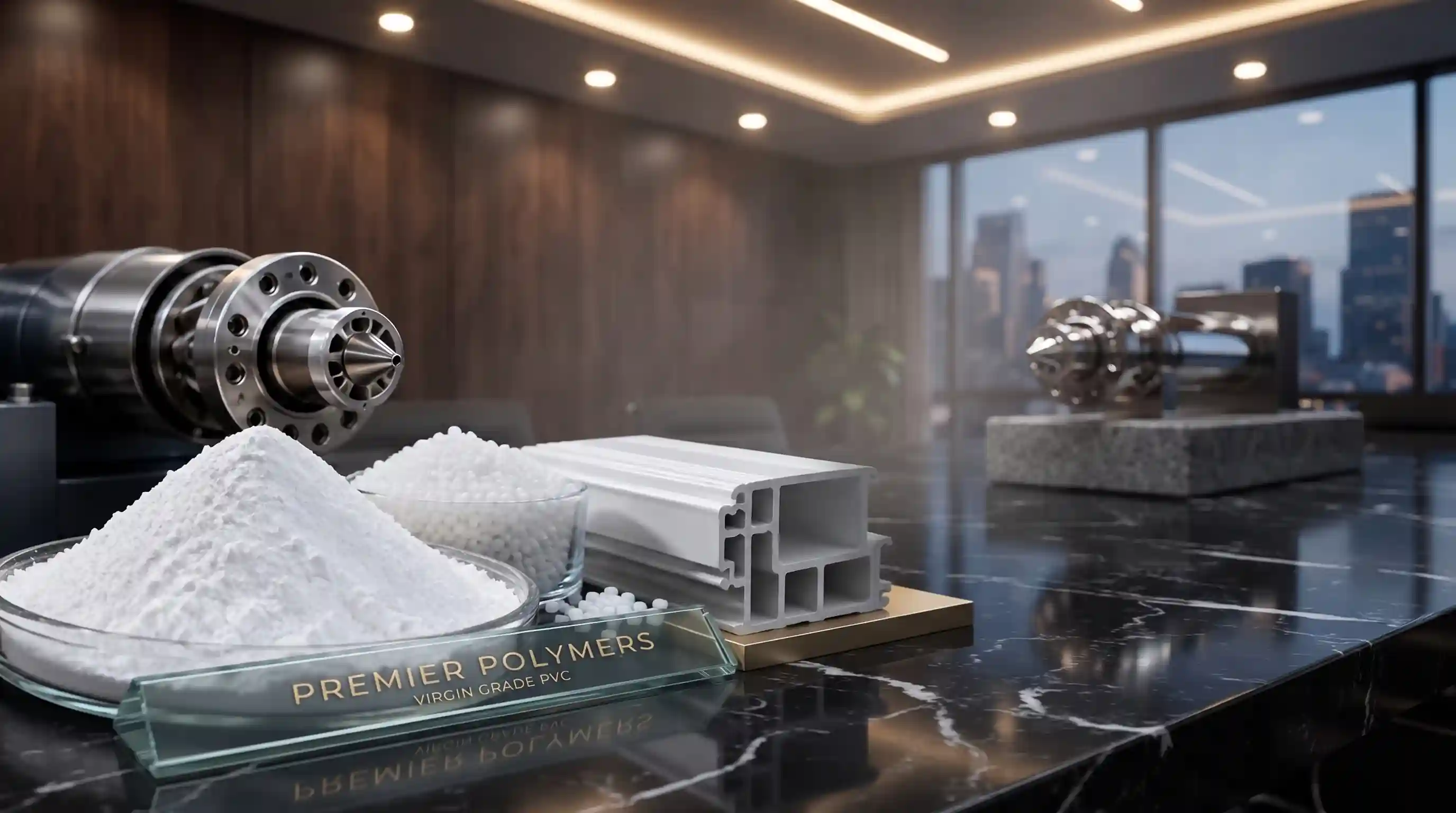
Application of Coated Calcium Carbonate in Compounds and Masterbatches
Compounding is one of the most important stages in the production chain of polymer products; a process in which the base resin, fillers, lubricants, stabilizers, and other additives are mixed and homogenized together in co-rotating twin-screw extruders. Coated calcium carbonate is recognized as the main mineral filler at this stage, because it reduces the formulation cost and improves the processing and functional properties of the product.
In the production of color and additive masterbatches, this product plays the role of an inert and economical carrier. The high concentration of filler in the masterbatch reduces the need for expensive resin, and at the same time, thanks to the surface coating, excellent dispersibility in the base resin is maintained. This issue is especially important in white masterbatches, anti-block masterbatches, and pigment-containing compounds, where color uniformity and clarity in the final product are vital.
The advantages of using this filler in compounds include the following:
- Possibility of high loading (up to tens of weight percent) while maintaining mechanical and processing properties
- Reduced extruder torque and consequently reduced energy consumption and equipment wear
- Reduced adhesion to metals and reduced buildup on the screw and die surface
- Increased output rate and improved product surface quality
- Shrinkage control and improved dimensions in final parts
- Reduced consumption of expensive pigments such as titanium dioxide due to the high opacity of the particles
Also, the importance of choosing the appropriate mesh should be mentioned. In compounds used for thin films, glossy sheets, and delicate parts, finer particles are chosen to reduce the risk of creating defective spots on the surface. In contrast, for bulk compounds and thicker parts, coarser particles are more economically logical. For further study in this field, read the article Familiarity with the Application of Coated Calcium Carbonate in the Plastics Industry. In general, a compound with uniform particle dispersion is the foundation of all high-quality polymer products, and the role of this filler in achieving this uniformity is undeniable.
Application of Coated Calcium Carbonate in Polymer Granule Production
Polymer granules are the raw material of many conversion industries, which are converted into the final product in injection, extrusion, and blow molding processes. Coated calcium carbonate is widely used in the production of polypropylene granules, polyethylene, foam compounds, and engineering granules. The presence of this filler in the granule not only reduces the finished cost, but also improves the rheological behavior of the melt in later production stages.
One of the most important problems of granule producers is controlling the uniformity of the melt flow index (MFI) throughout a production batch. Coated particles, due to their lubricating property and reduced inteal friction, help stabilize the extruder torque and the dimensional uniformity of the granules. This feature causes the speed of pelletizer lines to increase and the amount of dust, stringing, and granules sticking to each other to decrease.
In the production of colored granules and masterbatches, this filler acts as a carrier for additives and pigments. The uniformity of particle dispersion in the polymeric carrier guarantees color stability in the final product. On the other hand, the presence of these white particles in the formulation helps reduce the consumption of expensive pigments and simultaneously increases the opacity and optical coverage of the product.
Other important effects of this filler in granules include the following:
- Increased apparent density and improved behavior in fluid feeders and storage silos
- Reduced dust during transport and handling due to better flowability
- Reduced rate of dimensional changes and quality loss during storage
- Improved printability and color receptivity in final products
- Increased thermal resistance and reduced risk of thermal degradation in the reuse of scraps
Also, it should be noted that choosing the appropriate mesh for the granule depends on its final application. For example, granules used for thin films and delicate containers require very fine particles to reduce the risk of tearing and creating holes in the film. In contrast, for granules used in pipes, fittings, and thick parts, coarser particles are more logical. In all these cases, the quality of the surface coating is a necessary condition for achieving the desired dispersion and maintaining mechanical properties in the final product.
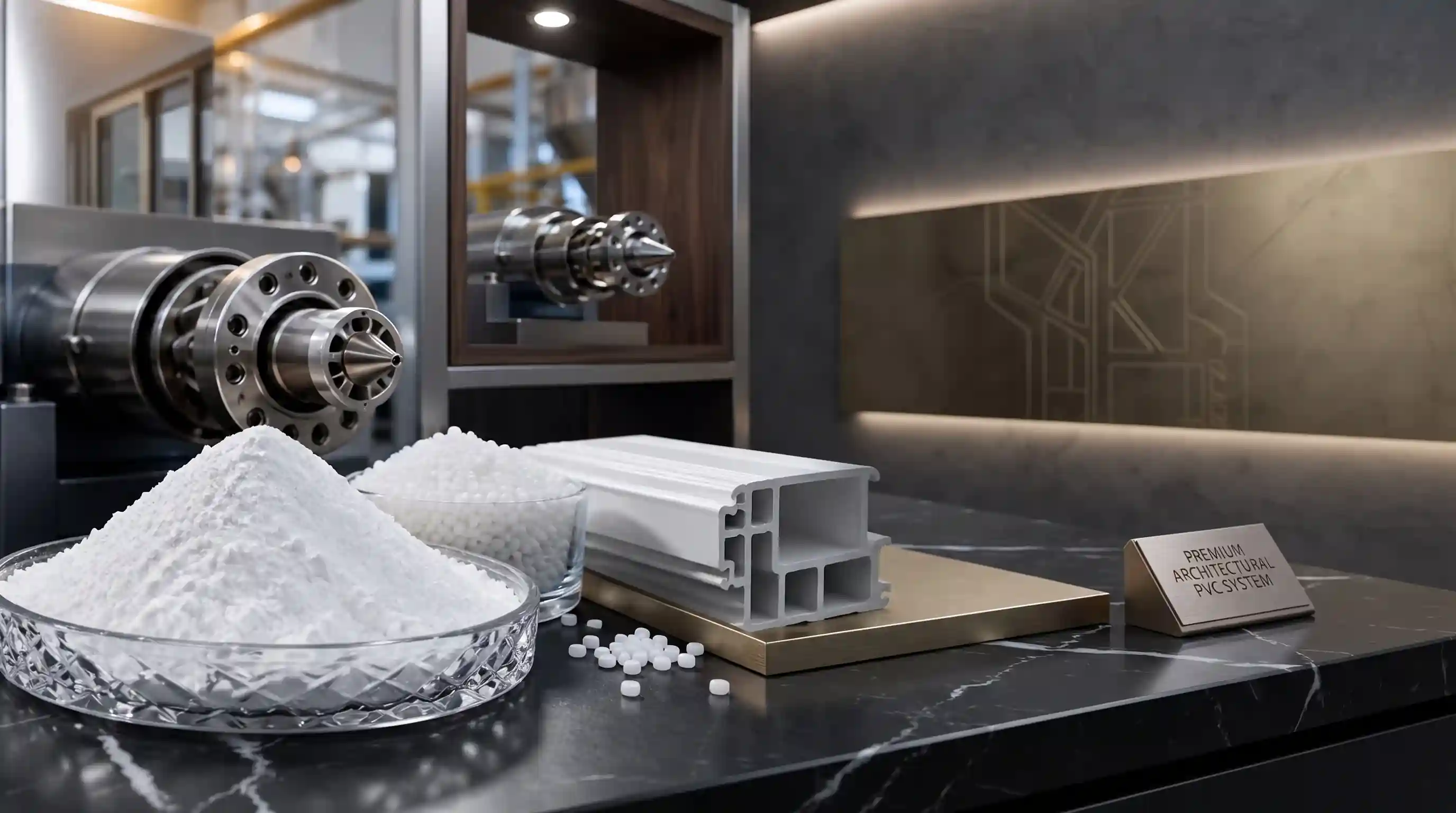
Application of Coated Calcium Carbonate in Profiles and Extrusion Processes
The profile industry is one of the largest consumers of coated calcium carbonate. PVC window and door profiles, structural and decorative profiles, edge banding profiles, foam sheets, and wood-polymer composites (WPC) are all produced in the extrusion process, and in all of them, this filler plays a key role in balancing cost and quality.
In profile extrusion, the melt must pass through a die with a complex cross-section, then be formed in the vacuum calibration stage, and finally cooled and cut. In this process, there are several basic challenges: material buildup on the die walls, loss of surface quality, dimensional fluctuations, the risk of surface dulling, and the melt sticking to metals. The surface coating of this filler, by creating a release property and reducing adhesion, takes an effective step in solving these problems.
Among the technical advantages of this filler in profiles, the following can be mentioned:
- Increased output rate of extrusion lines without loss of surface quality
- Reduced buildup on the die and consequently reduced line stoppages for cleaning
- Improved surface clarity and prevention of dulling and flow lines on the profile
- Increased stiffness and flexural modulus of structural profiles
- Reduced coefficient of thermal expansion and improved dimensional stability in temperature changes
- Reduced barrel and screw wear due to the lubricating property of the coating
In PVC profiles, this filler works simultaneously with stabilizers and impact modifiers (such as CPE or ACR) and, due to its ability to neutralize hydrogen chloride, helps with color stability and long-term resistance to yellowing of the profile when exposed to sunlight. In wood-polymer composites, this filler, while reducing cost, helps reduce moisture absorption and increase resistance to fungi and decay. For a closer examination of this topic, read the article Examining the Technical Benefits of Coated Calcium Carbonate in Extrusion.
Application of Coated Calcium Carbonate in Cable and Flooring Industries
Two large industries that use coated calcium carbonate abundantly are the cable industry and the flooring industry. In the cable industry, this filler is used in various layers of insulation, sheathing, and filler in power cables, telecommunication cables, and automotive cables. In the flooring industry, this product is widely used in vinyl flooring, SPC flooring, liners, top layers, and bottom layers.
In the cable industry, PVC and other polymers are used as insulation and sheathing. The filler must be such that the electrical insulation properties are not reduced and simultaneously flame and smoke resistance are improved. Coated calcium carbonate fulfills this condition by creating uniform dispersion in the matrix. Also in halogen-free cables (LSZH), which require very high filler loading, the quality of the surface coating plays a vital role in maintaining flexibility and processability.
Among the functions of this filler in the cable industry, the following can be mentioned:
- Increased resistance to flame and reduced flame spread speed
- Reduced toxic smoke and assistance in maintaining performance in a fire (in combination with other additives)
- Increased abrasion and mechanical resistance of the cable sheath
- Improved processability in fast extrusion lines
- Reduced finished cost without a significant loss of electrical properties
In the flooring industry, the loading of this filler is usually at a high level, because in addition to cost reduction, it improves stiffness, dimensional stability, and scratch resistance. In SPC (stone-polymer composite) floorings, which have low thickness and high resistance, the presence of filler particles with appropriate dispersion guarantees tensile strength and impact resistance. Also in traditional vinyl floorings, this filler helps control shrinkage, improve printability, and increase the useful life of the product. In both industries, choosing the right particle size and coating quality is the main criterion for achieving stable quality.

Application of Coated Calcium Carbonate in PVC Parts and Plastic Injection Molding
The plastic injection molding process is one of the most widely used methods for producing polymer parts, and coated calcium carbonate in this process, especially in the production of PVC parts, has a special place. Pipe fittings, junction boxes, electrical enclosures, home appliance parts, automotive parts, and building supplies are all among the products produced in this process and using this filler.
PVC is a thermally sensitive polymer and requires stabilizers and lubricants to prevent thermal degradation. This filler, with the ability to neutralize hydrogen chloride, helps with color stability and preventing yellowing of parts. In addition, the surface coating of the particles acts as an inteal lubricant and helps with better plasticization, reduced cycle time, and improved mold filling.
Among the positive effects of this filler in PVC parts, the following can be mentioned:
- Reduced material settling on the die and mold surface and consequently reduced need for cleaning
- Improved part surface quality and reduced flow lines and weld marks
- Reduced sinking and dimensional loss (Sink Mark) in thick areas
- Increased stiffness, modulus, and flexural strength of parts
- Improved filling of complex molds and thier areas
- Reduced cooling time and consequently increased production efficiency
This filler is also used in the injection molding of polypropylene and polyethylene parts. In these cases, the main goal is shrinkage control, dimensional improvement, and finished cost reduction. For parts that require a glossy surface, very fine meshes must be used to minimize lines and defective spots on the surface. For guidance in this field, study the article Guide to Choosing the Suitable Mesh of Coated Calcium Carbonate for Plastic Injection Molding. Ultimately, proper loading of this filler in injected parts requires testing and precise adjustment of the formulation to maintain the balance between price, mechanical properties, and surface quality.
Guide to Choosing Coated Calcium Carbonate Mesh and Conclusion
One of the most important decisions in using coated calcium carbonate is choosing the appropriate mesh. This product is offered in the 450 to 3500 mesh range, and the right choice has a direct impact on the quality of the final product, production rate, and costs. Generally, the higher the mesh number, the finer the particle, and the finer the particle, the better the surface quality, clarity, and impact resistance of the final part; but at the same time, the fineness of the particles brings challenges such as increased oil absorption, reduced fluidity, and a greater tendency to agglomerate.
The following general principles can be a suitable guide for choosing the mesh:
- Coarser meshes: for thick parts, pipes, building profiles, and applications where cost reduction and shrinkage control are more important than surface clarity.
- Intermediate meshes: for general compounds, functional granules, PVC fittings, and floorings where the balance between price and quality is vital.
- Fine meshes: for thin films, transparent sheets, glossy parts, high-quality cables, and products where a flawless surface is vital.
Also, in choosing the mesh, attention should be paid to the type of polymer, loading percentage, type of process (extrusion or injection), product wall thickness, and equipment conditions. Finer particles require more energy for dispersion, and in case of incomplete dispersion, they can cause a loss of quality instead of improving properties. Therefore, the quality of the surface coating and the variety of the product's mesh are the main criteria for choosing a reliable supplier.
In this article, we examined the applications of coated calcium carbonate in compounds, polymer granules, profiles, cables, flooring, and PVC parts. This product, by creating a balance between being economical and technical performance, has become one of the inseparable components of the production chain of the chemical and polymer industries. Amiran Stone Mineral Project offers this product in the 450 to 3500 mesh range, appropriate to the needs of various applications. If you intend to choose a product suitable for your production line, you can be in touch with the experts of this group.

| Question | Answer |
|---|---|
| What is coated calcium carbonate? | It is natural calcium carbonate whose particle surface is coated with fatty acids to make it more compatible with polymer matrices. |
| What is the difference between it and uncoated calcium carbonate? | The coated version absorbs less moisture, has better dispersion, and reduces machine torque. |
| What is the mesh range of this product? | This product is offered in the 450 to 3500 mesh range. |
| Which mesh is suitable for films and glossy parts? | Fine meshes (higher numbers) are more suitable for thin films and glossy surfaces. |
| Which mesh is suitable for thick parts? | Coarser meshes (lower numbers) are more suitable for thick parts and shrinkage control. |
| Does it need pre-drying? | Due to the surface coating, it has low moisture absorption, but gentle drying is recommended depending on storage conditions and loading level. |
| What is the main advantage in extrusion? | Increased output rate, reduced buildup on the die, and improved product surface quality. |
| Is it suitable for PVC parts? | Yes, while reducing thermal degradation, it helps with color stability and surface quality of PVC parts. |
| What is its effect on mechanical properties? | Increased stiffness and tensile modulus; choosing the right mesh and loading is important to maintain impact resistance. |
| What are the main applications of this product? | Compounds, polymer granules, profiles, cables, flooring, and PVC parts. |
The source of this article is the technical product information and the collection of articles on the website of Amiran Stone Mineral Project.

برچسب: Coated Calcium Carbonate,Applications of Coated Calcium Carbonate in Chemical and Plastic Industries,
نویسنده: رساوب آفرین