
درباره سایت
آخرین مطالب
- The role of industrial barite in the papermaking and specialty coatings industries
- How to find the best kaolin supplier in the country?
- How to properly examine feldspar analysis?
- ما هي استخدامات التالك الصناعي في صناعة البلاستيك والمطاط؟
- بررسی مزایای خرید عمده اکسید لیمونیت (گل ماش)
- Calcium Carbonate vs. Silica: Which mineral is more suitable?
- The effect of limonite oxide (yellow ochre) on the quality of construction materials
- ما هي أنواع السيليكا المعدنية وما الفرق بينها؟ دراسة شاملة
- كيف نفحص تحليل الفلسبار بشكل صحيح؟
- كيف تختار أفضل أكسيد حديد أحمر (مغرة) لمشروعك؟
امکانات وب
Introduction to Industrial White Barite and Its Mineral Structure
Industrial white barite is one of the most widely used filler minerals in today's advanced industries, attracting the attention of many manufacturers of paints, coatings, and polymeric products due to its unique combination of physical and chemical properties. Chemically known as barium sulfate (BaSO4), this mineral is classified among heavy minerals, and the root of its popularity can be traced to its high specific gravity and exceptional chemical stability.
In nature, barite is found in various colors including white, yellow, brown, and even colorless, but its white variety commands the highest industrial value in applications where the final color of the product matters due to its higher purity and low level of color impurities. The Amiran Mineral Stone Project introduces this product under the name white barite with the aim of being used in paints, coatings, and polymeric products containing mineral fillers.
The crystal structure of barite is orthorhombic, and this structure is considered one of the main reasons for the mineral's high stability and resistance to harsh chemical conditions. In fact, the cohesive crystal structure allows barium sulfate to resist most acids and bases, maintaining its performance in various industrial environments without deformation or decomposition. This feature is particularly important in the paint and coating industries, where products are exposed to moisture, chemicals, and variable weather conditions.
One of the key points in understanding industrial white barite is its fundamental difference from other mineral fillers such as calcium carbonate, talc, or kaolin. While most common fillers have a specific gravity of about 2.7 to 2.8 g/cm³, white barite occupies a completely different position among mineral fillers with a specific gravity ranging from 4.3 to 4.5 g/cm³. It is this striking difference that makes this product a unique option for applications requiring increased mass, sound control, or improved mechanical properties.
From a processing perspective, mined barite is transformed into a uniform powder with a specific particle size distribution after crushing, bleaching, and precise particle classification. At this stage, the level of precision in controlling particle size has a direct impact on the final quality of the product, as the particle size of industrial white barite powder determines its behavior in the formulation of paints, coatings, and polymeric compounds. The 450 to 2500 mesh range considered for this product demonstrates the breadth of its applications, from high-build architectural coatings to delicate paints and advanced polymer composites.
Specific Gravity of White Barite and Its Role in the Formulation of Industrial Products
Specific gravity or density is one of the most important physical characteristics of any mineral, and in the case of industrial white barite, this property is recognized as the product's primary competitive advantage. The specific gravity of pure barite is approximately 4.5 g/cm³, and even its industrial samples typically fall within the range of 4.3 to 4.5 g/cm³, which is nearly twice that of most common mineral fillers.
But why is high specific gravity so important in the paint, coating, and polymer industries? The answer to this question lies in the science of rheology and the physics of coatings. In paint production, one of the main challenges for manufacturers is controlling the rate of settling and sedimentation of fillers during the product's shelf life. Heavier particles like barite have a greater tendency to settle, but at the same time, using very fine particles of white barite with a high surface area can tu this challenge into an opportunity to produce high-quality paints.
In the coating industry, high specific gravity means an increase in coating mass per unit area. This is important in applications such as automotive underbody coatings, architectural paints, and industrial coatings, where the thickness and mass of the coating directly affect the coverage and durability of the product. Additionally, in polymeric products, the addition of white barite as a mineral filler allows engineers to precisely control the density of the final part and adjust its physical properties in accordance with application requirements.
One of the most important applications of barite's high specific gravity is its use in the production of soundproofing and radiation-shielding sheets and panels. In these products, high mass per unit area prevents the passage of sound waves and rays, improving the acoustic performance and safety of the product. This very feature has made barite a staple in the production of advanced acoustic insulation materials and protective coatings.
In the formulation of polymeric products, the specific gravity of white barite also plays a decisive role in adjusting mixing ratios, filler levels, and production process design. Polymer engineers must carefully adjust formulation ratios when replacing lighter fillers with white barite so that, while benefiting from the advantages of high density, problems such as excessive viscosity increase or production line speed reduction are avoided. A thorough understanding of these concepts greatly aids the optimal use of industrial white barite.
Another point worthy of reflection is the direct relationship between specific gravity and filler behavior in mixing processes. Heavier particles require stronger agitation systems and longer mixing times to achieve a uniform dispersion within the matrix. Manufacturers who take these technical points into account can offer much higher quality final products.

Acoustic Properties of White Barite: Mechanisms of Sound Transmission Control and Reduction
One of the most fascinating and yet lesser-known aspects of industrial white barite is the impact of this mineral on the acoustic properties of the products in which it is used. To understand this, one must first become familiar with the basic principles of sound science and the behavior of sound waves in materials, because barite's sound control mechanism is completely different from what occurs in conventional sound-absorbing materials like foams and mineral wools.
When sound waves strike a surface, they reflect part of their energy, absorb some, and transmit another portion through the surface. Light and porous materials like foam absorb sound through inteal friction and the conversion of sound energy into heat. However, in heavy and dense materials such as compounds containing white barite, the dominant mechanism is the reduction of sound transmission, technically known as Transmission Loss. According to the mass law in acoustics, the amount of sound transmission loss is directly related to the increase in surface mass; meaning that the heavier the surface, the less sound passes through it.
The very high specific gravity of white barite makes it an effective agent for increasing the mass of polymeric compounds and coatings. When the particles of this mineral are uniformly dispersed within the polymer matrix, the density of the final material increases, and sound waves suffer energy loss as they pass through different layers. In addition to the mass effect, the acoustic impedance mismatch between the barite particles and the polymer matrix causes inteal scattering and reflection of sound waves, which also contributes to the reduction of sound transmission.
In practical applications, these acoustic properties are utilized in a diverse range of products: architectural acoustic insulation panels, industrial flooring, automotive anti-vibration coatings, and high-noise fluid transport pipes can all benefit from the advantages of using white barite. In fact, in many of these products, barite has replaced lighter fillers such as calcium carbonate, delivering better acoustic performance without the need to increase thickness.
The important point is that the acoustic efficacy of white barite depends on factors such as particle size distribution, loading level in the formulation, and the quality of dispersion within the matrix. Very fine particles in the upper range of the mesh create a greater contact surface with the polymer matrix, improving the scattering of sound waves. On the other hand, in polymeric products where weighted sound control at low frequencies is targeted, using higher levels of this product yields a better result.
It should also be noted that the acoustic properties of white barite are interrelated with its mechanical properties; a combination that leads to the improvement of one of these two features usually affects the other as well. For this reason, formulation design must be carried out in an integrated maer, taking both aspects into consideration.
White Barite in Polymer Composites and Enhancement of Mechanical Properties
Polymer composites with mineral fillers are a class of advanced materials in which mineral particles are added to a polymer matrix to improve physical, mechanical, and functional properties. Among numerous mineral fillers, white barite has found a special place in the composite industry due to its unique combination of high specific gravity, suitable hardness, and chemical stability.
One of the most important effects of adding white barite to polymer matrices is increasing the strength and stiffness of the final composite. When dispersed in the polymer matrix, the hard barite particles resist deformation, resulting in an increased elastic modulus and composite stiffness. This feature is of utmost importance in the production of industrial parts exposed to mechanical loads. For a deeper study in this field, the article Investigating the Role of White Barite in Improving the Mechanical Properties of Composites provides specialized and comprehensive information.
In addition to strength, white barite plays an effective role in improving the wear resistance of composites due to its crystal structure and particle shape. By creating a harder and more resistant surface, barite particles significantly increase the lifespan of parts such as gears, bearings, and automotive interior components. Furthermore, the thermal stability and flame resistance of this mineral make it an ideal choice for composites used in high-temperature environments.
In the production process of polymer composites, how the barite particles are dispersed within the matrix is of key importance. Agglomeration of particles can cause a decrease in product uniformity and the creation of stress concentration points, ultimately leading to a drop in mechanical properties. For this reason, selecting the appropriate particle size, using coupling agents, and precisely adjusting mixer parameters are essential. The wide range of 450 to 2500 mesh considered for industrial white barite allows for the selection of the appropriate size based on the polymer type and processing method.
Additionally, fine barite particles in composites can act as nucleating agents, improving the crystal structure of semi-crystalline polymers. This, in tu, can help balance the mechanical, thermal, and transparency properties of the product. Ultimately, the use of white barite in polymer composites not only improves mechanical and physical properties but also represents an economical solution due to its reasonable final cost.
From another aspect, the combination of barite's high specific gravity with its favorable dispersion capability in polymer matrices makes it possible to produce composites with controlled density and optimized acoustic properties. This unique characteristic has tued industrial doors, vehicle interior panels, and audio device components into parts where white barite plays a vital role.
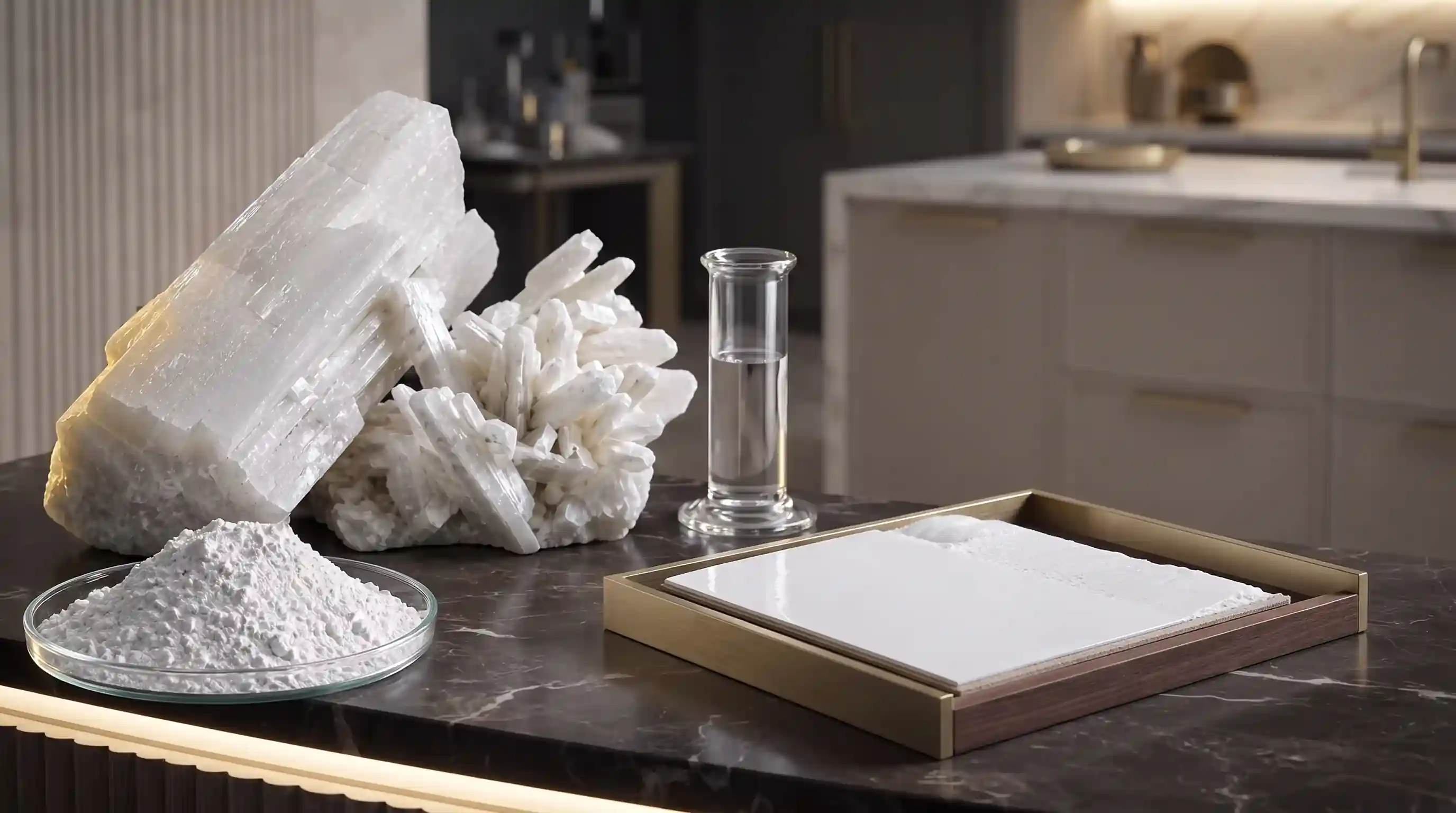
The role of white barite in the paint and coating industry
The paint and coating industry is one of the largest consumers of mineral fillers in the world, and among them, industrial white barite accounts for a significant share of this market due to its unique characteristics. The product supplied by Amiran Mineral Stone Project is precisely designed to meet the needs of this industry, and its 450 to 2500 mesh range covers a wide spectrum of applications.
In paint formulations, white barite plays various roles. Its first and most important role is acting as an active filler that increases paint volume without sacrificing quality. But beyond this, barite particles, due to their suitable shape and size, play an effective role in improving the rheological properties of the paint. Viscosity uniformity, prevention of paint sagging during application, and pumpability and stirrability are all influenced by the type and size of the filler particles.
Another prominent feature of white barite in paints is its chemical resistance and hydrophobicity. Paints containing barite show higher resistance to moisture, acids, and corrosive chemicals, which is of vital importance for industrial, marine, and automotive underbody coatings. The cohesive crystal structure of barium sulfate makes it difficult to accommodate water molecules and chemicals, resulting in a strong protective barrier against environmental destructive factors.
In terms of color and appearance, white barite, due to its bright color and inherent transparency, creates the least interference with the main color of the paint. This feature allows manufacturers to produce paints with high colorability and excellent color stability. Also, very fine barite particles at the end of the mesh range act as a matting agent in the production of matte and semi-gloss paints, making it possible to control the gloss level of the paint.
From another technical perspective, white barite, due to its high specific gravity, is used in the production of high-density paints and sound-deadening coatings. These paints, which are used in noisy industrial environments, help reduce noise pollution in workshops and factories by absorbing and blocking sound waves. This is closely related to the acoustic properties of barite discussed in the previous chapter.
Finally, the use of white barite in the paint and coating industry is also economically justifiable. As a substitute for more expensive fillers, this mineral significantly reduces production costs while maintaining and even improving the quality of the final product. Furthermore, the high durability of paints containing barite increases the service life of the coating and reduces the need for repainting, which is an important advantage for end consumers.
The importance of particle size and the role of the 450 to 2500 mesh range in product quality
Particle size is one of the most vital characteristics of any mineral powder, and in the case of industrial white barite, the variety of the 450 to 2500 mesh range demonstrates the broad applications of this product. For better understanding, the mesh unit indicates the number of holes in a sieve screen per inch; meaning that the higher the mesh number, the finer the particles. For example, 450 mesh particles are about 32 microns and 2500 mesh particles are only about 5 microns in diameter.
In the paint and coating industry, the choice of particle size depends on factors such as paint type, application method, and final film thickness. Architectural paints and high-build underbody coatings typically use coarser particles in the lower range (450 to 800 mesh), as these particles can fill more volume and provide better hiding power at high thicknesses. In contrast, delicate paints, topcoats, and high surface quality coatings require finer particles in the upper range.
In polymer products, the importance of particle size is twofold. Finer particles create a larger contact surface with the polymer matrix, which helps with better dispersion, higher mechanical strength, and greater transparency. However, at the same time, very fine particles have a greater tendency to agglomerate and require more precise processing and more compatibilizers. Choosing the right size is a delicate balance between these factors that formulation engineers must manage carefully.
Particle size distribution is also of special importance. A good distribution means that the particles are concentrated within a specific range with a deficiency of very fine or very coarse particles. This uniformity creates predictable behavior in the manufacturing process and prevents problems such as sedimentation, agglomeration, or quality degradation. Industrial white barite provides high uniformity in this regard through precise control of particle distribution.
Another point is the effect of particle size on moisture and surface coverage. Finer particles have a higher specific surface area and consequently absorb more moisture. This is important in the processing of polymer products where moisture can cause degradation or bubbles in the final product. For this reason, proper drying and packaging of barite powder play a key role in maintaining its quality.
Finally, the importance of coordination between particle size and production equipment must be mentioned. Using particles that do not match the equipment can cause problems such as equipment wear, pipe clogging, or a drop in production efficiency. Choosing the right size of white barite is one of the most important decisions in designing the formulation of industrial products and should not be done without a thorough review of technical requirements.

Comparison of white barite with other mineral fillers
In the highly competitive market of mineral fillers, white barite must compete with numerous rivals such as calcium carbonate, talc, kaolin, mica, and silica. Each of these materials has its own specific advantages and limitations, and understanding their differences helps in selecting the appropriate filler for each application. In this chapter, we compare white barite with the most common mineral fillers.
Calcium carbonate is the most widely used mineral filler in the paint and polymer industries, and its main advantage is its low price and availability. However, the specific gravity of calcium carbonate is around 2.7 g/cm³, which is almost half that of white barite. In applications requiring high mass, sound control, or increased product weight, calcium carbonate caot be a suitable substitute for barite. Additionally, the chemical resistance of calcium carbonate, especially against acids, is significantly lower than that of barite.
Talc is another popular mineral filler that, due to its layered structure and greasy feel, is used as a reinforcement and lubricant in polymers. Talc has a specific gravity of about 2.7 to 2.8 g/cm³ and performs better than barite in applications requiring lubrication and friction reduction. For a more detailed understanding of this mineral's properties, you can read the article Study of physical and mechanical properties of industrial talc powder . However, talc also has a different standing compared to barite in terms of specific gravity and acoustic properties.
Kaolin, or china clay, is widely used in the production of paper, paint, and ceramics due to its extraordinary whiteness and very fine particle size. The chemical resistance of kaolin is good, but its specific gravity is also around 2.6 g/cm³. Kaolin performs better in applications where product appearance and transparency are priorities, but it caot compensate for the mass and density advantages of barite.
Mica is used in the electrical industries and protective coatings due to its layered structure and insulating properties. The specific gravity of mica is about 2.8 to 3.0 g/cm³, and its light-reflecting property is utilized in producing special paints and brighteners. In applications where electrical and thermal insulation are desired, mica is a better choice, but barite still maintains superiority in terms of mass and acoustic control.
Finally, silica or quartz is used in applications where wear and scratching are the main issues due to its very high hardness and abrasion resistance. However, silica has a specific gravity of about 2.65 g/cm³ and does not offer the high-density property of barite. Furthermore, health conces regarding silica dust have limited its use in certain industries.
The conclusion of this comparison shows that the choice of mineral filler depends on the specific requirements of each application. Industrial white barite is an ideal choice when high specific gravity, acoustic properties, chemical resistance, and product mass control are prioritized.
Practical tips, warehousing, and proper selection of industrial white barite
Optimal use of industrial white barite in the paint, coating, and polymer industries requires adhering to a series of technical and executive tips, the most important of which we cover in this chapter. These tips, formulated based on scientific principles and industrial experiences, help manufacturers get the best results from this valuable mineral filler.
The first tip in using white barite is choosing the appropriate particle size based on the product type and production method. As discussed in the sixth chapter, the 450 to 2500 mesh range provides a wide selection. In paint and coating projects, it is recommended to choose the particle size according to the final film thickness and desired surface quality. In polymer products as well, the polymer type, processing method (injection, extrusion, or compression), and the required properties of the final product determine the appropriate size.
The second important point is proper particle dispersion within the matrix. To prevent particle agglomeration and quality loss, it is essential to use stirrers with appropriate speed and design, coupling agents, and optimization of mixing time and temperature. It is better to check particle dispersion using microscopic methods after the final product is manufactured.
In terms of warehousing and storage, white barite powder should be kept in a dry, moisture-free environment. Moisture absorption can cause particle agglomeration, reduced dispersion, and problems in the production process. Also, proper packaging must provide protection against moisture and environmental contaminants. For accurate and specialized information in this field, the article Comprehensive guide to warehousing and storage of industrial white barite powder It is a very useful resource.
The third point is paying attention to safety when working with barite powder. Although barite is chemically inert and non-toxic, prolonged inhalation of its dust can be harmful to the respiratory system. For this reason, the use of protective masks, proper ventilation systems in working environments, and compliance with industrial hygiene principles are mandatory.
The fourth point is raw material quality control. Before using barite powder, checking specifications such as particle size distribution, moisture content, color, and purity helps ensure that the product meets formulation requirements. If there are significant differences in specifications, it is better to consult with technical experts before use.
The fifth point is preliminary laboratory-scale testing. Before full-scale production, it is suggested that formulations containing white barite be prepared in the laboratory and their properties evaluated. This prevents resource waste and allows for precise formulation adjustment.
Finally, choosing a reputable supplier plays a decisive role in the quality of the final product. Amiran Mineral Stone Project, by supplying industrial white barite with defined technical specifications and a wide mesh range, strives to meet the diverse needs of the paint, coating, and polymer industries. Customers can make an informed choice suited to their needs by visiting the product page and receiving specialized information.
| Question | Answer |
|---|---|
| What is industrial white barite and in which industries is it used? | White barite is the mineral barium sulfate (BaSO4), which is widely used as a mineral filler in paints, coatings, and polymer products containing mineral fillers. |
| What effect does the specific gravity of white barite have on its applications? | The specific gravity of white barite ranges from 4.3 to 4.5 grams per cubic centimeter, which increases product mass, improves acoustic properties, and controls the density of polymer products. |
| How do the acoustic properties of white barite work? | Due to its high specific gravity and based on the mass law in acoustics, white barite reduces sound transmission, and sound waves suffer energy loss when passing through compounds containing it. |
| What does the mesh range of 450 to 2500 mean, and which size is suitable for my products? | A higher mesh number indicates finer particles. Lower meshes are used for thick coatings, while higher meshes are used for delicate paints and advanced composites. |
| Can white barite be used in architectural paints? | Yes, white barite is used as a filler with high chemical resistance and durability in architectural paints, primers, and industrial paints. |
| How does white barite differ from calcium carbonate and talc? | The specific gravity of barite is approximately twice that of calcium carbonate and talc, making it superior in applications requiring high mass and sound control, whereas talc is more suitable for reducing friction. |
| What is the correct method for storing and warehousing barite powder? | Barite powder should be stored in a dry environment, free of moisture, and in suitable packaging to prevent particle agglomeration and quality loss. |
| Is the use of white barite harmful to humans? | Barite is chemically inert and non-toxic, but prolonged inhalation of its dust should be controlled using protective masks and proper ventilation systems. |
| How can the agglomeration of barite particles in the polymer matrix be prevented? | The use of appropriate agitators, coupling agents, and precise adjustment of mixing time and temperature helps achieve uniform particle dispersion. |
| Where can industrial white barite be procured? | Industrial white barite with a mesh range of 450 to 2500 is supplied by the Amiran Mineral Stone Project and is accessible through the product page. |
The main source of information for this article is the white barite product page on the Amiran Mineral Stone Project website (https://ksamiran.ir/products/white-barite/)
برچسب: White barytes,Comprehensive review of acoustic properties and specific gravity of industrial white barytes,
نویسنده: رساوب آفرین