
درباره سایت
آخرین مطالب
- The role of industrial barite in the papermaking and specialty coatings industries
- How to find the best kaolin supplier in the country?
- How to properly examine feldspar analysis?
- ما هي استخدامات التالك الصناعي في صناعة البلاستيك والمطاط؟
- بررسی مزایای خرید عمده اکسید لیمونیت (گل ماش)
- Calcium Carbonate vs. Silica: Which mineral is more suitable?
- The effect of limonite oxide (yellow ochre) on the quality of construction materials
- ما هي أنواع السيليكا المعدنية وما الفرق بينها؟ دراسة شاملة
- كيف نفحص تحليل الفلسبار بشكل صحيح؟
- كيف تختار أفضل أكسيد حديد أحمر (مغرة) لمشروعك؟
امکانات وب
Introduction to Industrial Talc and Its Importance in Mode Industries
Industrial talc is one of the most widely used minerals in today's manufacturing industries. Talc, with the chemical formula hydrated magnesium silicate, is classified under silicate minerals and has found a unique place in many industrial processes due to its layered structure and specific softness. This mineral, which is extracted in nature in the form of rock masses, is converted into powders of various mesh sizes after processing and milling, each of which has a specific application.
Among various types of mineral fillers, industrial talc is noted for its special combination of physical and chemical properties. The layered or plate-like structure of this mineral allows its particles to disperse well in polymer and rubber matrices, reducing slipperiness and stickiness. This property makes talc an excellent anti-blocking and processing aid. Furthermore, talc is chemically neutral and inert, meaning it does not react with most industrial chemicals and additives, which increases the stability of the final products.
One of the most important factors in choosing industrial talc is its grade or mesh size. Mesh refers to the particle size of the powder; the higher the mesh number, the finer and softer the particles will be. Industrial talcs available on the market are usually offered in various ranges from 300 to 1200 mesh. Choosing the right mesh directly affects the quality of the final product, as particle size determines dispersion, transparency, surface quality, and mechanical properties of the product.
The industrial talc product offered by the Kani Sang Amiran project, with a mesh range of 450 to 1000, is chosen for applications in polymer, rubber, paint, and other industrial uses. This wide range allows for the selection of the appropriate grade for any type of production process; from reinforced plastics and technical rubber products to industrial paints. If you want to know more technical details about this material, read the article "Examination of physical and mechanical properties of industrial talc powder .
In addition to the plastic and rubber industries, industrial talc is also used in the gypsum, ceramic, papermaking, sanitary ware, and construction materials industries. This diversity of application demonstrates the strategic importance of talc as a base mineral in the industrial supply chain. Talc acts as a filler, processing aid, anti-blocking agent, and reinforcing agent, imparting specific properties to the final product in each application.
In the following chapters, we will examine in detail the applications of industrial talc in the plastics, rubber, and paint industries and discuss the technical tips for selecting and using this mineral. The goal is that, in addition to general knowledge, readers will be able to make the best decision for their production line.
Application of Industrial Talc in the Plastic Industry
The plastic industry is one of the largest consumers of industrial talc in the world. In this industry, talc is used as a mineral filler and reinforcing agent in polymer compounds. The main goal of adding talc to plastics is to improve the physical, mechanical, and thermal properties of the final product while reducing production costs. Compared to other fillers like calcium carbonate, talc provides better mechanical properties and is widely used in technical plastics.
One of the most important effects of talc on plastics is increasing stiffness. Talc's plate-like particles sit in the polymer matrix and provide resistance against deformation. This feature is crucial for industrial parts subject to load and pressure. For example, in polypropylene (PP), which is one of the most widely used plastics in the automotive industry, adding talc significantly increases flexural strength and modulus of elasticity.
Industrial talc also improves the thermal resistance of plastics. Talc particles act as an insulating agent, raising the temperature at which the plastic softens. This is very important for parts that work in hot environments or are subject to friction. Additionally, talc reduces the shrinkage of plastic during cooling, which increases the dimensional accuracy of manufactured parts, a critical factor for engineering components.
In the production process, industrial talc also acts as a processing aid. The presence of talc in the plastic compound reduces adhesion to equipment and improves melt flow. This feature facilitates product extraction from molds in the production of plastic films and sheets and improves surface quality. Talc is also used as an anti-blocking agent in the production of polyethylene and polypropylene films to prevent the layers from sticking together.
The economic advantage of using industrial talc in the plastic industry is also significant. Talc is considered a suitable replacement for part of the expensive polymer, lowering production costs by reducing resin consumption. At the same time, the higher density of talc must be considered in compound design to control weight increases in the product. Choosing the right mesh grade is also important; finer talcs (high mesh) provide better dispersion and are more suitable for high surface quality products.
Industrial talc is also used in the production of Masterbatch. Masterbatches are concentrated compounds of filler and polymer that are added to plastic at the production stage. Due to its thermal properties and good dispersion, talc is one of the primary fillers in the production of industrial masterbatches. Finally, it should be noted that talc is used in various plastics including polypropylene, polyethylene, PVC, PS, and ABS, and the amount and grade of talc must be determined based on the formulation and final application.

Application of Industrial Talc in the Rubber Industry
The rubber industry is another major consumer of industrial talc. In this industry, talc has numerous applications, from a filler in rubber compounds to an anti-blocking agent in production processes. Natural and synthetic rubbers are sticky in their raw state and require materials during processing that prevent the rubber from sticking to equipment and prevent parts from fusing together. Industrial talc performs this role well.
In the rubber manufacturing process, talc is dusted as an anti-tack powder on the surface of raw rubber to allow rubber layers and belts to be easily separated. This application is especially important in tire production, where multiple layers of rubber and fabric are placed on top of each other. Using talc at this stage of production increases the quality and uniformity of the final product and prevents surface defects.
Industrial talc is also used as a filler in rubber compounds. Adding talc to the rubber mixture improves mechanical properties such as tensile strength, tear resistance, and hardness. In technical rubbers used for industrial applications, these properties are of vital importance. Furthermore, talc acts as an insulating agent against heat and electricity and is suitable for insulating and technical rubbers.
One of the interesting applications of industrial talc in rubber manufacturing is its role as a mold release agent. During the vulcanization process, rubber is placed in metal molds and may stick to the mold walls. The presence of talc in the compound or on the surface of the mold ensures easy part removal and reduces the need for mold oils. This improves the surface quality of the product and reduces production costs.
Choosing the right mesh grade is very important for the rubber industry. Coarser talcs are suitable for anti-blocking and mold release applications, while finer talcs (high mesh) work better as fillers in rubber compounds because they provide better dispersion and result in more uniform mechanical properties. Industrial talc with a mesh range of 450 to 1000, offered by the Kani Sang Amiran project, can cover the various needs of the rubber industry.
Rubber manufacturing is an industry where the combination of several mineral and chemical materials determines the final result. Industrial talc, along with carbon black, silica, calcium carbonate, and clay, creates a complete combination for high-quality rubber. Understanding the role of each of these materials and the balance between them is the key to producing high-quality rubber.
Applications of Industrial Talc in Polymer Products
Polymer products include a wide range of industrial and consumer goods in which industrial talc plays an important role. In the automotive industry, talc is used in the production of reinforced plastic parts such as bumpers, dashboards, interior trim, engine components, and battery cases. These parts must be resistant to impact, heat, and wear, and talc, as a reinforcing agent, imparts these properties. The use of talc in reinforced polypropylene is an industry standard in the automotive sector.
In the appliance industry, many inteal and exteal parts of devices are produced from plastics containing talc. Refrigerator bodies, washing machines, microwave dishes, and inteal appliance components usually contain talc. This mineral gives these parts strength, thermal stability, and a high-quality finish. Talc also makes these parts stable against temperature and humidity changes and increases the useful life of the appliance.
The packaging industry is also a major consumer of industrial talc in polymer products. Polyethylene and polypropylene films, bags, adhesive tapes, and labels can all contain talc. In these products, talc acts as an anti-blocking agent and prevents the film layers from sticking together. In addition, talc is also used in the production of sheets and disposable containers, improving their mechanical properties.
In the plastic pipe and fittings industry, industrial talc has a special application. PVC, PP, and PE pipes used for water, sewage, and chemical transport gain ring stiffness, pressure resistance, and dimensional stability with the addition of talc. These properties are critical for pipes installed in harsh and underground environments. Talc also increases extrusion speed and reduces energy consumption.
Electrical and electronic parts also benefit from industrial talc. Switch housings, outlets, sockets, and insulating parts are usually produced from plastics containing talc because talc is a good insulator against electricity and heat. This application is very important for the safety of electrical products and is subject to strict standards. If you also care about the quality of your manufactured products, read the article "The key role of industrial talc in improving the quality of manufactured products do not miss.
Industrial talc is also used in the plastic recycling industry. Recycled plastics usually have weaker mechanical properties, and adding talc to them compensates for the lost strength to a large extent. This contributes to the circular economy and the reduction of plastic waste, and increases the value of recycled products.
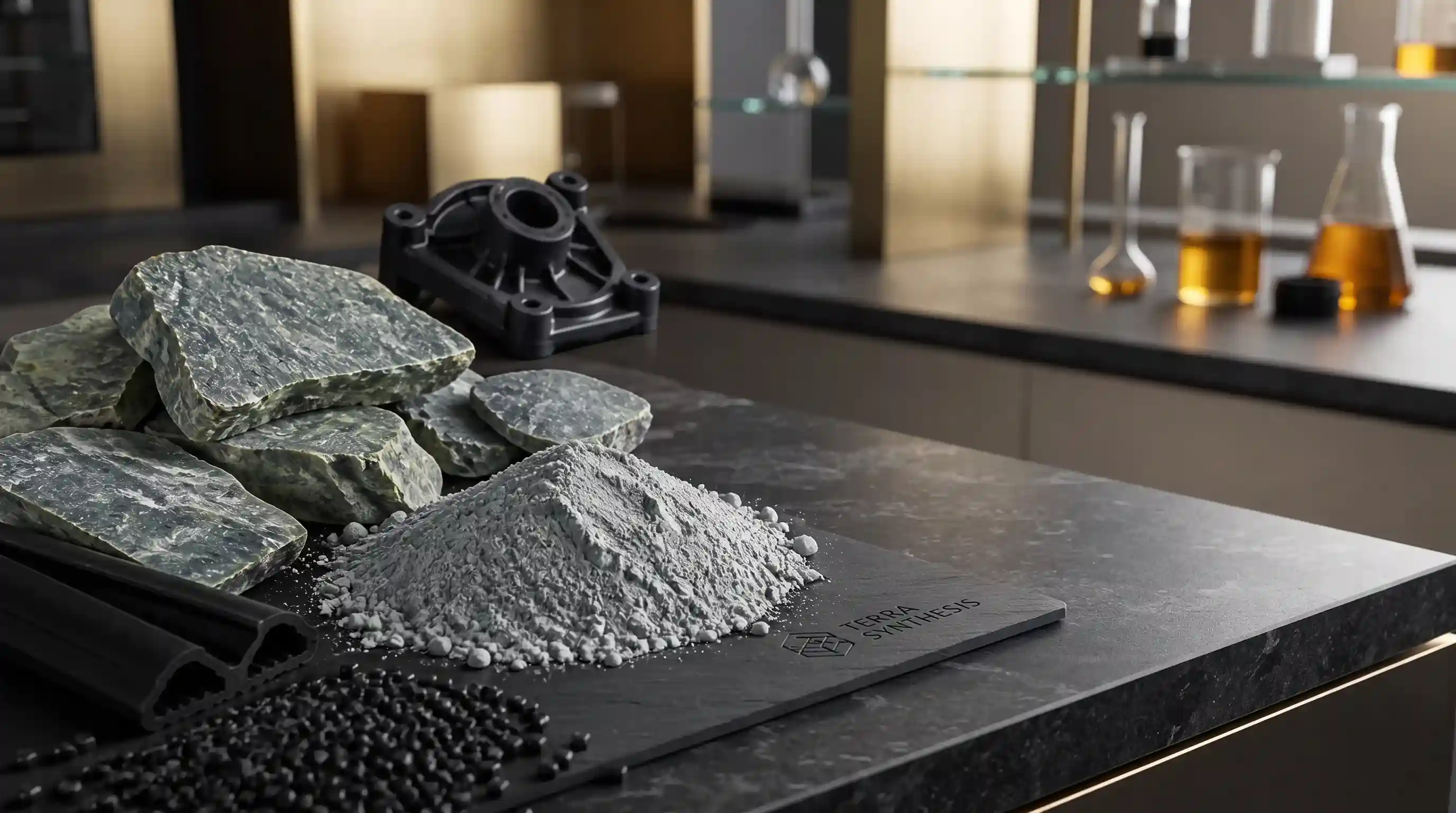
Applications of industrial talc in rubber products
Rubber products include a wide range of industrial and consumer goods, in the production of many of which industrial talc plays a role. In the tire industry, the largest consumer of rubber in the world, talc is used in several stages of production. From dusting rubber belts with talc powder to prevent sticking to adding it to rubber compounds to improve mechanical properties, talc is a vital material in this industry. Tires must be resistant to wear, heat, and pressure, and talc contributes to these properties.
Hoses and conveyor belts are also rubber products in which industrial talc is used. Industrial hoses used for transporting water, oil, gas, and chemicals require strength, flexibility, and resistance to pressure. Adding talc to the rubber compound of these hoses improves their mechanical properties and durability. Conveyor belts used in the mining, agricultural, and manufacturing industries also benefit from talc.
In the production of gaskets, sealing rings, and rubber sealing components, industrial talc is of particular importance. These parts must have a smooth and clean surface for proper sealing. As a release agent, talc facilitates the removal of the part from the mold and ensures its surface quality. Furthermore, talc in the rubber compound increases resistance to pressure and temperature, which is critical for industrial seals.
The footwear industry is also a consumer of industrial talc in rubber products. Rubber shoes, slippers, coatings, and shoe soles usually contain talc. This material adds strength, abrasion resistance, and a suitable surface to the rubber compound. In addition, talc is also used in the production of technical rubber items such as machine parts, rubber springs, insulating gloves, and industrial flooring.
Technical rubber products used in the oil, gas, and petrochemical industries also benefit from talc. These products must be resistant to chemicals, high temperatures, and high pressure, and talc, as a neutral and stable filler, contributes to these properties. Choosing industrial talc with the appropriate mesh grade for each application plays an important role in the quality of the final product.
Talc is also present in everyday rubber products. Rubber toys, balls, bicycle parts, and sports equipment can all contain talc. This mineral increases the safety of these products and gives them a clean, non-sticky surface. In fact, every rubber product that uses a mold in its production is related to talc in some way.
Industrial talc in the paint and coating industry
Another important application of industrial talc is its use in the paint and coating industry. Talc is used as an extender pigment in the production of industrial, architectural, and decorative paints. Extender pigments are materials added to paint to increase paint volume, improve coverage, and reduce production costs without negatively impacting paint quality.
Industrial talc plays multiple roles in paint manufacturing. First, it acts as a filler and increases the volume of the paint. Second, due to its layered structure, it improves the opacity of the paint and makes the paint layers stronger. Third, fine-grained talc causes the paint surface to become uniform and smooth, creating higher quality paint. These features are very important for industrial paints that must last in harsh environmental conditions.
One of the most important properties of talc in the paint industry is its resistance to water and moisture. The plate-like particles of talc are arranged in layers within the paint film and lengthen the path for water and moisture penetration. This feature makes paints containing talc suitable for humid environments, environmental industrial paints, and marine paints. Furthermore, talc improves the paint's resistance to UV radiation and weather conditions.
In the production of industrial paints and anti-corrosion coatings, industrial talc holds a special place. These paints are used to protect metal structures, machinery, industrial equipment, and pipelines. Talc imparts mechanical strength, abrasion resistance, and good surface adhesion to these paints. In addition, talc is also used in the production of fillers and epoxy floorings.
Choosing the mesh grade of talc is very important for the paint industry. Finer talcs (high mesh) are suitable for high-quality paints and topcoats because they create better surface quality. Coarser talcs are more suitable for architectural paints and primers. Industrial talc with a mesh range of 450 to 1000, chosen for the paint industry, can cover a wide range of the industry's needs.
Industrial talc is also widely used in architectural paints. Plastic paints, acrylic paints, colored plasters, and wall fillers all contain talc. This material gives these products coverage, strength, and a high-quality surface while reducing production costs. Talc also acts as a viscosity control agent, helping the paint spread evenly over the surface.
Advantages and technical points of using industrial talc
Using industrial talc in the plastic, rubber, and paint industries has several benefits. In this chapter, we examine the most important of these benefits and the technical tips for choosing and using talc. The first and most important advantage of talc is its unique combination of properties. Talc simultaneously offers mechanical strength, thermal insulation, electrical insulation, chemical resistance, and suitable density. This combination of properties distinguishes talc from other mineral fillers.
The second advantage of industrial talc is its reasonable price compared to other industrial fillers. As an abundant mineral, talc is considered an economical substitute for part of expensive polymers. This is especially important in high-volume production such as automotive plastic parts, pipes, and packaging films. The third advantage is the abundance and stability of supply; talc is mined in many parts of the world, and its supply chain is stable.
Technically, choosing the right mesh grade is the most important factor in using industrial talc. Particle size has a direct impact on dispersion, mechanical properties, surface quality, and product transparency. 450-mesh talc is suitable for general applications, and 1000-mesh talc is suitable for high-quality and precise products. The moisture content of the talc is also important; moisture above the permissible limit can cause problems in the production process and must be controlled before use.
Another point is the dispersion of talc in the polymer matrix. Due to its layered structure, talc requires powerful mixing machines to be completely dispersed in the compound. Poor dispersion creates weak points in the product. Also, the amount of talc used must be determined based on the formulation and the needs of the product. Excessive consumption can cause brittleness, increased density, and reduced tensile properties.
Industrial talc is comparable to other fillers such as calcium carbonate, mica, and kaolin. While calcium carbonate is mostly used to reduce costs, talc creates better mechanical properties and is preferred in technical plastics. Mica has better insulation but is higher in price. Kaolin also acts similarly to talc but has weaker anti-stick properties. Choosing between these fillers depends on the product's needs and budget.
Finally, industrial talc has applications beyond the plastic and rubber industries in other sectors. To lea about another important application of this mineral, read the article "The role of industrial talc in the plaster and building materials industry ". Also, proper storage and maintenance of talc prevents it from clumping and absorbing moisture, preserving product quality.
Conclusion and guide to choosing industrial talc
In this article, we comprehensively examined the applications of industrial talc in the plastic, rubber, and paint industries. We saw that talc, as a versatile mineral filler, plays a vital role in improving the mechanical, thermal, and chemical properties of polymer and rubber products. From automotive parts and home appliances to tires, hoses, industrial paints, and seals, industrial talc is present in everyday and industrial products.
The most important tips for choosing the right industrial talc are: First, determine the required mesh grade based on the application. For high-quality and precise products, finer talcs (800 to 1000 mesh) are suitable, and for general applications, 450 to 600 mesh talcs are appropriate. Second, pay attention to the purity and color of the talc, which affects the quality of the final product. Third, check the moisture and particle size distribution. Fourth, choose a reliable supplier who guarantees product quality.
Product Industrial talcThe Kani Sang Amiran project is selected for polymer, rubber, paint, and industrial applications with a mesh range of 450 to 1000. This wide range allows manufacturers to find the appropriate grade for any type of process and product. For more information and to view product details, you can visit the product page.
It is also recommended to test talc samples on your production line before making a bulk purchase. This will help you determine the appropriate mesh grade and consumption rate, and ensure the quality of the final product. Consulting with technical experts and reviewing the supplier's past records can also help in making the right choice.
In today's competitive world, choosing the right raw materials can make the difference between a successful product and an unsuccessful one. Due to its diverse applications and unique properties, industrial talc is one of those materials that can add significant value to your products. From reinforcing automotive plastic parts to improving the durability of industrial paints and increasing the quality of technical rubber, this mineral plays an effective role in every application.
In conclusion, industrial talc has cemented its position in manufacturing industries due to its special combination of properties, reasonable price, and abundance. By choosing correctly and using this mineral properly, you can increase product quality and reduce production costs. We hope this article has helped you better understand the applications of industrial talc and select the right product.
| Question | Answer |
|---|---|
| What is industrial talc? | Industrial talc is a magnesium silicate mineral powder used as a filler and reinforcing agent in the plastic, rubber, and paint industries. |
| What are the main applications of industrial talc? | Its main applications include polymer products, rubber products, paint, and other industrial products. |
| What is the mesh range of industrial talc? | The industrial talc of the Kani Sang Amiran project is offered in a mesh range of 450 to 1000. |
| What role does industrial talc play in the plastic industry? | Increasing strength and stiffness, improving thermal resistance, reducing shrinkage, and improving the mechanical properties of polymer products. |
| Why is talc used in rubber manufacturing? | To prevent layer adhesion, facilitate mold release, and improve the mechanical properties of rubber. |
| What is the application of talc in the paint industry? | As an extender pigment, improving opacity, moisture resistance, and paint surface quality. |
| How does industrial talc differ from calcium carbonate? | Talc provides better mechanical and thermal properties and is more suitable for technical plastics, but calcium carbonate is cheaper. |
| Which mesh grade is suitable for my product? | For high-quality products, 800 to 1000 mesh, and for general applications, 450 to 600 mesh are suitable. |
| Is industrial talc safe? | Talc is chemically neutral and inert, and it is considered safe in the composition of industrial products. |
| Where to buy industrial talc? | From reputable mineral material suppliers such as the Kani Sang Amiran project, which offers talc with a mesh range of 450 to 1000. |
The information in this article has been compiled from technical resources in the polymer, rubber, and paint industries and the industrial talc product page of the Kani Sang Amiran project (https://ksamiran.ir/products/industrial-talc/)
برچسب: Industrial Talc,What are the applications of industrial talc in the plastic and rubber industry?,
نویسنده: رساوب آفرین