
درباره سایت
آخرین مطالب
- معايير جودة الباريت الأبيض؛ 5 عوامل رئيسية في التقييم
- Applications of White Talc in Plastic Production and Industrial Polymer Industries
- Applications of Coated Calcium Carbonate in Chemical and Plastic Industries
- What is Coated Calcium Carbonate? A Guide to Its Application in the Construction Industry
- كيفية اختيار كربونات الكالسيوم المطلي بناءً على التدرج الحبيبي
- How to Choose High-Quality White Barite: Key Purchasing Tips
- استانداردهای دانهبندی تالک سفید برای مصارف گوناگون در صنایع
- White Talc in the Construction Industry: Its Applications and Key Features
- Industrial Barite or Calcium Carbonate? A Complete Comparison of Applications and Benefits
- استانداردهای کیفیت باریت صنعتی و روشهای آزمایش و کنترل آن
امکانات وب
Introduction to the Sewer Pipe Industry and the Importance of Additives
The sewer pipe manufacturing industry is one of the main pillars of urban and industrial infrastructure development, requiring high precision in the selection of raw materials and polymer additives. Durability, mechanical strength, and resistance to pressure and chemicals are vital characteristics of these equipment. Meanwhile, the use of fillers and modifiers plays a significant role in optimizing the final properties of the product. To better understand this topic, studying the specialized article The Role of Calcium Carbonate in Plastic Pipe Manufacturing provides complete information for engineers.
Manufacturers are constantly looking for solutions to enhance the mechanical and appearance quality of pipes while reducing final costs. This is achieved through the use of processed mineral materials that are specifically designed for polymer matrices. In this regard, precise knowledge of the physical and chemical properties of raw materials is the key to success in mode sewer pipe formulation, the various dimensions of which we will discuss below.
Introduction to Coated Calcium Carbonate and Its Structural Features
Coated calcium carbonate is a type of processed mineral whose particle surface is covered with an organic coating (usually fatty acid or stearate). This coating changes the surface characteristics of the particle from hydrophilic to hydrophobic, which significantly increases its compatibility with various polymers. The unique properties of this material have given it a special place in various industries and transformed the final quality of compounds.
One of the most important standard products in this field is Coated Calcium Carbonate, which is produced with a mesh range of 450 to 3500. This wide range of mesh allows manufacturers to choose the best granulation based on the exact needs of their production process. The surface coating of this product prevents particle agglomeration and ensures homogeneous distribution throughout the polymer matrix.

The Role of Coated Calcium Carbonate in Improving the Pipe Extrusion Process
The extrusion process is one of the most sensitive stages in the sewer pipe production line, where granules and compounds are shaped under heat and pressure. Using suitable additives can improve the flowability of molten materials and prevent pressure drops in the machine. To examine these benefits more closely, reading the article Reviewing the Technical Benefits of Coated Calcium Carbonate in Extrusion will be very helpful.
Due to its hydrophobic nature and reduction of inteal friction caused by the surface coating, coated calcium carbonate helps reduce melt viscosity at processing temperatures. This phenomenon leads to reduced energy consumption of the extruder, uniformity of pipe walls, and increased production line speed, all of which are major conces for industrial production managers.
Economic Benefits and Financial Justification of Using Coated Calcium Carbonate
In today's industrial economy, managing production costs without compromising quality is the biggest competitive advantage for manufacturing units. Using high-quality mineral fillers is a proven solution to reduce the consumption of expensive polymers. More details around this topic are discussed in detail in the article Reviewing the Economic Benefits of Using Coated Calcium Carbonate in Manufacturing.
Since coated calcium carbonate is offered at a more affordable price than base resins, replacing a percentage of the polymer with this mineral material significantly reduces the final costs of raw materials. Also, due to improved production efficiency and reduced waste caused by extrusion disorders, the overall profitability of the sewer pipe production line increases.

The Effect of the 450 3500 Mesh Range on Mechanical and Physical Properties of Parts
Choosing the particle size, or the mesh range, is one of the key parameters in compound engineering and polymer formulation. The 450 3500 mesh range covers a wide spectrum of particle sizes, each suitable for specific applications including compounds, polymer granules, profiles, cables, flooring, and PVC parts. Finer particles (higher meshes) create a larger contact surface and enhance impact resistance and tensile strength.
In the production of sewer pipes, the particle size distribution of coated calcium carbonate plays a direct role in resistance against exteal loading and environmental stresses. Particles with a suitable mesh penetrate well into the polymer network and minimize stress concentration points, resulting in the production of a pipe with long lifespan and desirable quality standards.
Improving Dispersion and Compatibility with Polymer Matrices
One of the biggest challenges in using traditional mineral fillers is the phenomenon of agglomeration and particle accumulation due to lack of chemical compatibility with hydrophobic polymers. This problem is completely solved by using coated calcium carbonate; because the fatty acid or stearate layer on the particles creates a strong and stable bond between the filler and the polymer matrix.
This optimal compatibility leads to a completely homogeneous distribution of particles throughout the cross-section of the pipe. As a result, the mechanical properties of the final product are completely uniform, and weaknesses caused by the accumulation of mineral particles will not be observed in the pipe structure, which guarantees the safety of sewer systems.
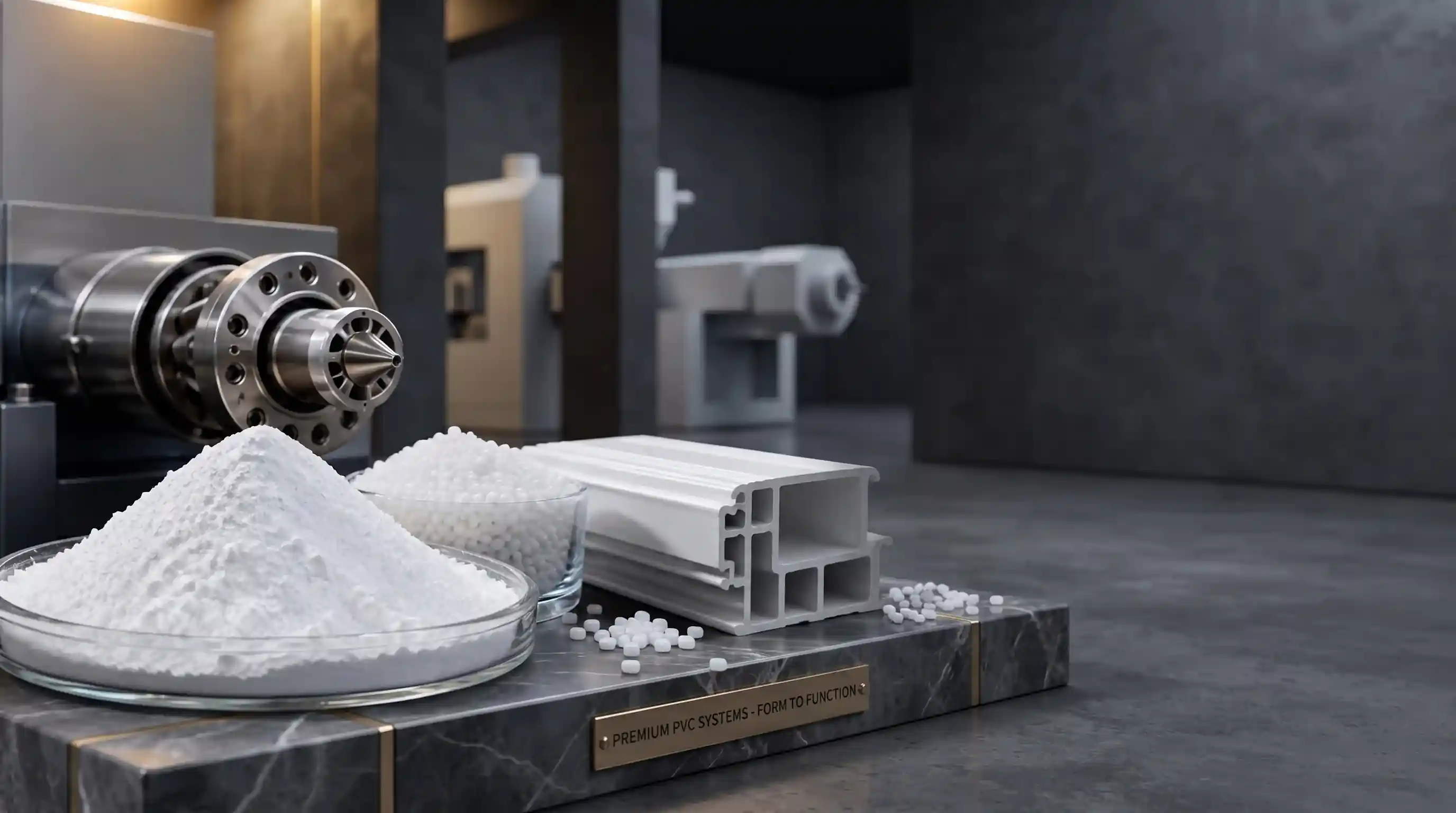
Widespread Applications of Coated Calcium Carbonate in Polymer Industries
Although the application of this material in sewer pipes is of special importance, the scope of its applications is much broader and includes various polymer industries. The unique properties of this mineral make it a versatile additive for manufacturers that is efficient in various sectors of the polymer industry.
Based on industrial standards, coated calcium carbonate is widely used in the production of compounds, polymer granules, profiles, cables, flooring, and various PVC parts. The suitability of this material's mesh with the specific needs of each industry provides the possibility of customizing the formulation and brings the highest efficiency.
Conclusion and Technical Recommendations for Choosing the Best Formulation
Ultimately, selecting high-quality raw materials suited to process conditions is the coerstone of producing high-quality and competitive polymer products. Coated calcium carbonate, with features such as a compatible surface coating, a mesh range of 450 to 3500, and homogeneous distribution capability, provides a comprehensive answer to engineering needs in the production of sewer pipes and other PVC parts.
Strict adherence to mixing ratios, selection of the appropriate mesh based on the type of extruder machine, and utilizing the experiences of industry experts can maximize the final product quality. Kani Sang Amiran project is always ready to assist the country's polymer industries on the path of development and quality improvement by providing standard products.

| Question | Answer |
|---|---|
| What is coated calcium carbonate? | It is a type of processed calcium carbonate whose particle surface is covered with an organic coating to increase compatibility with polymers. |
| What is the mesh range of coated calcium carbonate? | This product is produced and supplied in a mesh range of 450 to 3500. |
| What is the main advantage of particle coating? | Creating hydrophobicity, preventing agglomeration, and improving particle distribution in the polymer matrix. |
| What are the main applications of this material? | Compounds, polymer granules, profiles, cables, flooring, and PVC parts. |
| How does it affect pipe extrusion? | By reducing melt viscosity, it decreases energy consumption and improves extrusion speed and quality. |
| Is using this material economically justified? | Yes, by reducing the consumption of expensive resins, it significantly lowers production costs. |
| What is its role in sewer pipes? | It increases mechanical resistance, dimensional stability, and durability of pipes against stresses. |
| How does it bond with the polymer? | The fatty acid coating on the particles creates a strong chemical and physical bond with the polymer matrix. |
| Does mesh sizing affect mechanical properties? | Yes, higher and finer meshes create a larger contact surface and enhance tensile strength. |
| How can this product be procured? | It can be ordered through the dedicated product page on the Kani Sang Amiran website. |
Kani Sang Amiran Project — Production of Minerals and Specialized Polymer Additives

برچسب: Coated Calcium Carbonate,Reviewing the Role of Coated Calcium Carbonate in Sewer Pipe Manufacturing,
نویسنده: رساوب آفرین