
درباره سایت
آخرین مطالب
- چرا کیفیت دولومیت کانی سنگ امیران متمایز است
- The Impact of Limonite Oxide (Gole Mash) on Product Quality
- How to Measure Feldspar Purity in the Laboratory?
- الدليل الشامل لشراء السيليكا عالية الجودة للمصانع
- تأثير النقاء الكيميائي للسيليكا على جودة الزجاج الإنشائي
- لماذا تتميز جودة دولوميت کاني سنگ أميران
- Why the Quality of Kanisang Amiran Dolomite Is Distinctive
- Guide to Receiving Technical Catalogue and Expert Analysis of Silica
- كيفية قياس نقاء الفلدسبار في المختبر؟
- The Effect of Silica Chemical Purity on Architectural Glass Quality
امکانات وب
What is Dolomite? Introduction to the Mineral, its Composition, and its Role in Agriculture
Dolomite is one of the most important carbonate group minerals, known chemically as a double calcium and magnesium carbonate with the formula CaMg(CO3)2. This mineral mainly forms in ancient marine environments and sedimentary-evaporitic basins, and large rock masses of it are found in parts of the Earth's crust. The name of this mineral was chosen in honor of "Dolomieu," the French geologist who first described it.
What distinguishes dolomite from ordinary limestone (calcite) is the presence of the element magnesium in its crystalline structure. While calcite is pure calcium carbonate, dolomite consists of almost equal amounts of calcium and magnesium. This feature gives this mineral a special value in agriculture—where soils simultaneously need calcium and magnesium—in addition to its industrial applications.
In agricultural terms, the powder resulting from crushing dolomite rock is referred to as "dolomitic lime." This material has been used for years as a soil amendment in regions with acidic soils. Continuous rains, long-term use of acidifying chemical fertilizers, and rapid decomposition of organic matter wash calcium and magnesium out of the soil, resulting in a decrease in soil pH. Under such conditions, dolomite plays the role of both an amendment and a nutrient fertilizer.
Mode agriculture today looks at dolomite not just as a plant nutrient source, but as a multifunctional material in fertilizer production lines: filler, anti-caking agent, coating for fertilizer granules, and even a diluent. That is why the application of dolomite in the production of agricultural fertilizers has become one of the important topics for fertilizer manufacturing plants.
In this article, we intend to examine how dolomite works in the soil, what benefits it has for plants, how it differs from other amendments, and how it is used in fertilizer formulations. We will also take a look at the industrial applications of this mineral in the glass, ceramic, and construction materials industries so that you gain a complete picture of the value of this mineral.
Dolomite extracted from reputable mines enters the market after crushing, sizing, and in some cases, calcination. The final quality of the product is directly related to the purity percentage of calcium and magnesium carbonates, the amount of impurities such as silica, iron oxide, and alumina, as well as its particle size distribution (mesh). In the next chapter, we will examine these specifications more precisely.
Chemical Composition and Properties of Dolomite; What You Should Know About Its Quality
In pure dolomite rock, the molar ratio of calcium to magnesium is approximately one to one. The theoretical composition of this mineral includes about 54.35% calcium carbonate (CaCO3) and 45.65% magnesium carbonate (MgCO3). If we express this same composition in oxide form, theoretical dolomite will contain about 30.4% calcium oxide (CaO), 21.7% magnesium oxide (MgO), and 47.9% carbon dioxide (CO2). This composition is the standard for measuring the purity of dolomitic products in the market.
In nature, dolomite rock is rarely found completely pure. Impurities such as silica (sand), iron oxides, alumina, clay compounds, and organic matter can be present in it. Silica is undesirable for chemical processes due to its abrasive nature, and iron oxide also changes the color of the product. In agricultural applications, iron and alumina are not as problematic as silica, but a high purity of carbonates is always a sign of higher quality.
In terms of physical properties, the hardness of dolomite on the Mohs scale is between 3.5 and 4, and its specific gravity is about 2.8 to 2.9 grams per cubic centimeter. The color of this mineral in its pure state is white, and in the presence of impurities, it is gray, yellow, brown, and sometimes pink. Its crystalline system is trigonal, and its luster is glassy to greasy. These properties determine how dolomite should be crushed and sized.
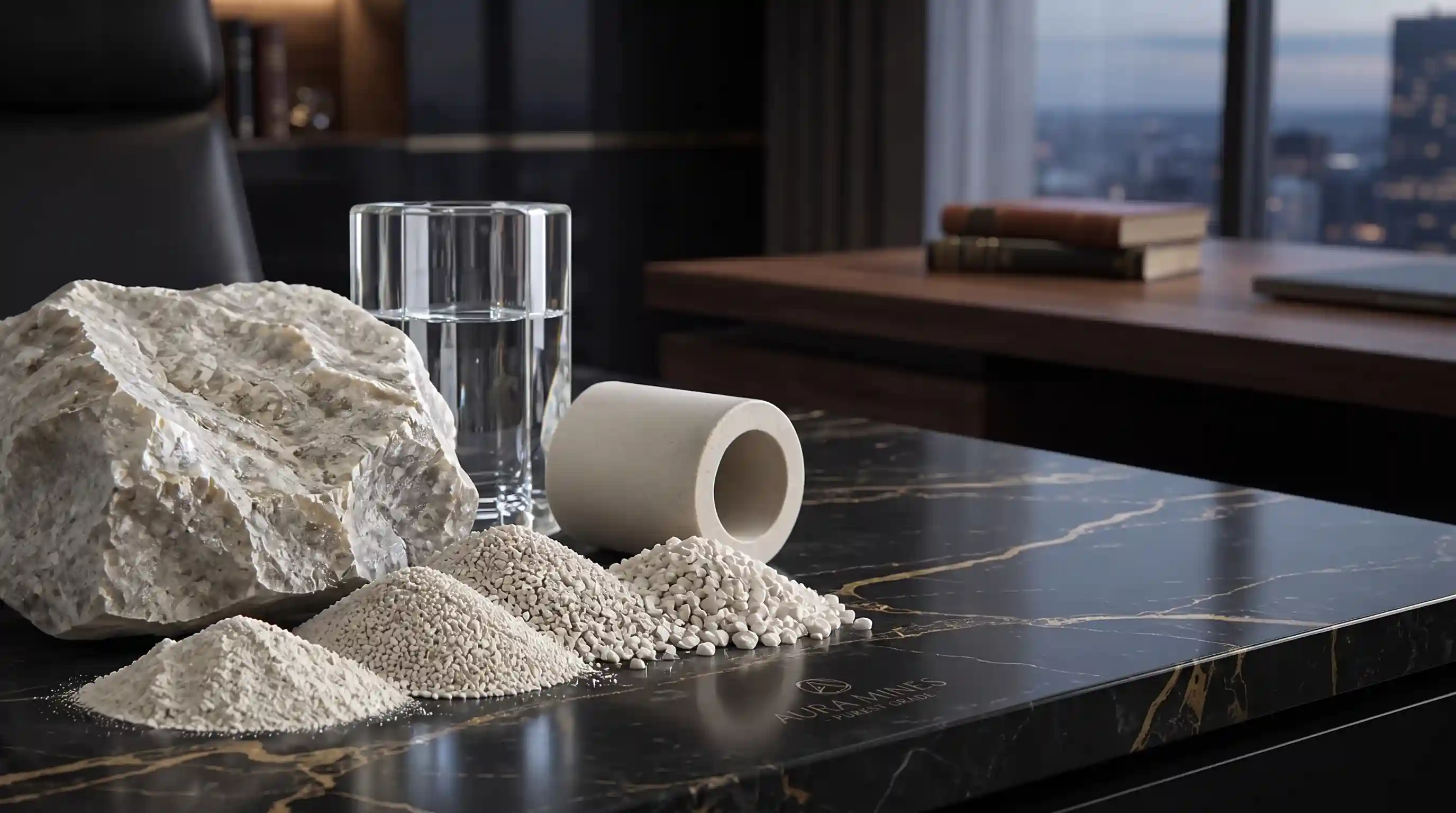
One of the most important commercial characteristics of dolomite is its particle size, or its "mesh". In fact, the word mesh refers to the number of holes per square inch of a sieve; the higher the mesh number, the finer the particles. For example, the dolomite product from the Amiran Stone Mineral Project is produced in the 10 to 40 mesh size range and is offered for glass applications, ceramic products, and construction materials.
In agricultural application, particle size has a different importance: finer particles dissolve faster in the soil and have a faster effect on pH, while coarser particles have slower release and are more suitable for long-term soil amendment. For this reason, fertilizer production plants choose the product's dimensions depending on the type of fertilizer and the required speed.
When buying or evaluating the quality of dolomite, it is essential to pay attention to a few points: the total percentage of carbonates (or CaO and MgO equivalent), the calcium-to-magnesium ratio, the percentage of silica and metallic impurities, the uniform distribution of particle sizes, and the moisture content of the product. It is better to request the product's analysis sheet from the supplier before a large purchase.

Application of Dolomite in the Production of Agricultural Fertilizers
The production of agricultural fertilizers is not limited to the combination of nutritional elements. Fertilizer factories need materials that improve the production process, transportation, storage, and field application. Dolomite is one of the few materials that plays a role both as a technical auxiliary material and as a plant food source.
1. Filler in compound fertilizers: In the production of NPK fertilizers, fillers make up part of the product volume so that the concentration of nutrients reaches the standard amount and uniform spreading in the field is maintained. Due to its abundance, suitable price, and low reactivity with other compounds, dolomite is one of the most common fillers.
2. Anti-caking agent: Chemical fertilizers, especially their saline types, have a high tendency to absorb moisture and cake. Dolomite powder settles on the surface of fertilizer granules, absorbs moisture, and prevents the granules from sticking together. This improves packaging quality and the performance of planting machines.
3. Coating for fertilizer granules: In the production process of granular and drum-rounded fertilizers, dolomite is used as an outer layer so that the surface of the granules becomes smooth, uniform, and non-sticky. This increases the shelf life and flowability of the product in agricultural machinery.
4. Supplying calcium and magnesium: Some specialized fertilizers are formulated for soils poor in magnesium. In these products, dolomite is directly the source supplying these two key elements and replaces more expensive sources such as pure magnesium carbonate or magnesium sulfate.
5. Soil amendment before planting: Farmers and large-scale producers apply dolomite to the soil before planting to raise the pH of acidic soil and store calcium and magnesium. This creates conditions in which subsequent chemical fertilizers will be more efficient.
6. Combining with organic fertilizers: In the production of organic fertilizers and compost, dolomite is used to adjust the pH during fermentation and to prevent excessive acidification of organic materials. It also reduces the plant's uptake of heavy metals by binding to them.
The main advantage of dolomite for the fertilizer industry is its economics: with one inexpensive material, two nutritional elements are supplied, and several technical problems in the production line are solved. That is why the demand for dolomite in agricultural industries is increasing.
Benefits of Using Dolomite in Soil and Plants
Using dolomite has numerous benefits for soil, plants, and ultimately the quality of the agricultural product. These benefits can be categorized into several main axes:
- Regulation of acidic soil pH: Dolomite is a natural alkali that gradually neutralizes soil acidity. A suitable pH provides better growth conditions for most crop plants and stimulates the activity of beneficial soil microorganisms.
- Supplying calcium: Calcium is essential for cell wall formation, root tip growth, root system development, and fruit quality. Calcium deficiency causes diseases such as blossom-end rot in tomatoes and potatoes.
- Supplying magnesium: Magnesium is the central atom of the chlorophyll molecule, and without it, photosynthesis stops. Magnesium also plays a role in enzyme activation, protein synthesis, and the translocation of phosphorus within the plant.
- Increasing phosphorus and other element uptake: In highly acidic soils, aluminum and iron ions fix phosphorus and do not make it available to the plant. By correcting the pH with dolomite, phosphorus is released and the efficiency of phosphate fertilizers increases.
- Reducing aluminum toxicity: In acidic soils, soluble aluminum is toxic to plant roots and limits growth. Dolomite eliminates this limitation by reducing aluminum solubility.
- Improving soil structure: The calcium present in dolomite causes clay particles to flocculate, improving aeration, water infiltration, and soil functioning. This is especially important in heavy clay soils.
- Increasing plant resistance: Plants that receive sufficient calcium and magnesium are more resistant to diseases, pests, and environmental stresses such as heat and drought.
One of the strengths of dolomite is that its release is gradual; meaning that during the growing season, it provides calcium and magnesium to the plant slowly and reduces the risk of root buing due to a sudden change in pH. This same feature makes it ideal for fall application and land preparation before spring planting.
It is worth noting that the results of dolomite application depend heavily on soil conditions; in alkaline soils or soils that already have high magnesium, excessive use can cause problems. Therefore, a soil test should be performed before taking any action.
Dolomite or Agricultural Lime; Which Option is More Suitable for Your Soil?
One of the common questions among farmers is whether to use ordinary limestone (calcitic) or dolomite. The answer to this question depends on soil conditions, especially the acidity level and the magnesium status of the soil. Calcitic lime mainly supplies calcium and raises pH, while dolomite provides both calcium and magnesium simultaneously.
The general rule is: if the soil is acidic and the soil test shows its magnesium is at a low or critical level, dolomite is the best choice. But if the soil has an optimal magnesium status and only needs a pH increase, calcitic lime is more efficient because it has a higher reaction rate in the soil.
In terms of speed of effect, calcitic lime acts faster because its crystalline structure dissolves more readily in water. Dolomite, due to its denser structure, decomposes over a longer period in the soil. This slowness is a disadvantage in some cases, but in the field, it is often considered an advantage because it creates a more stable amendment effect.
Gypsum (calcium sulfate) is another material often compared with dolomite. Gypsum does not change soil pH and is mainly used to amend sodic soils and improve the structure of clay soils. Combining gypsum and dolomite has given good results in some farms, but the final decision must be made based on laboratory data.
Price is also one of the choosing factors. Calcitic lime is usually cheaper, but when there is a need to supply both calcium and magnesium simultaneously, using dolomite is considered a more cost-effective option than combining calcitic lime with another magnesium fertilizer.
To make the right decision, be sure to use soil testing services and measure parameters such as pH, calcium level, magnesium level, cation exchange capacity, and soil texture. Then consult with an agricultural expert on which amendment material and at what rate is needed.
How and How Much Dolomite to Use in Farms and Orchards
Correct use of dolomite is accompanied by a few key principles: soil testing, right timing, application rate, and application method. Following these principles ensures you get the highest efficiency at the lowest cost.
1. The importance of soil testing: First of all, the soil's pH and magnesium level must be determined. Without this data, applying dolomite is a hit-or-miss that might have no effect or even harm the soil. A soil test also shows how much amendment your soil needs.
2. Timing of use: The best time to apply dolomite is fall and winter, or a few months before planting. In these seasons, the soil is moist, and the amendment finds enough time to react with the soil. For permanent orchards, late fall or late winter is suitable.
3. Application rate: The exact application rate depends on the initial pH of the soil, its texture, and its buffering capacity. Generally, in light soils with mild acidity, smaller amounts of about one to two tons per hectare are sufficient, while heavier and more acidic soils may require higher amounts. These amounts are only general examples, and the actual rate should be determined by an expert based on a soil test.
4. Method and depth of application: Dolomite should be spread uniformly over the field surface and then mixed with the soil by deep plowing (about 15 to 20 centimeters). In orchards, it can be spread under the tree canopy and incorporated into the soil with a disc or plow. Not mixing dolomite with the soil severely reduces its effectiveness.
5. Repetition interval: The effect of dolomite usually remains in the soil for several years. Depending on conditions, repeating the application every three to five years is sufficient, unless the soil test shows that acidity has decreased again.
6. Combining with organic materials: Mixing dolomite with manure or compost not only reduces spreading costs but also brings about a better amendment effect. The combination of organic materials and dolomite simultaneously improves soil structure and fertility.
Precautions: Avoid over-applying dolomite; an excessively high pH reduces the plant's uptake of iron, manganese, zinc, and boron, and causes symptoms of deficiency of these elements in the plant. Also, using dolomite in alkaline soils is not recommended.
Industrial Applications of Dolomite; From Glassmaking to Construction Materials
In addition to its widespread application in agriculture, dolomite is a strategic mineral in various industries. The calcium oxide and magnesium oxide present in this mineral give it properties that are irreplaceable in thermal and chemical processes.
Glass industry: Dolomite is one of the main raw materials in glass production. Magnesium oxide, along with calcium oxide, lowers the melting point of glass, increases its chemical and mechanical resistance, and prevents the clouding and re-crystallization of glass. Dolomite plays a key role in the production of container glass, flat glass, and specialty glasses.
Ceramic industry: In the body and glaze of ceramics, porcelain, tiles, and sanitary ware, dolomite acts as a natural flux. This material lowers the firing temperature, increases the thermal stability of products, and gives glazes transparency and durability. High-quality ceramic products usually contain high-purity dolomite.
Construction materials: Dolomite is used as rubble stone and stone material in construction. Also, after calcination, it tus into dolomitic lime, which is used in the production of mortar, plaster, cement, and building paints. To become more familiar with these applications, read the article Important Application of Dolomite in Construction and Manufacturing Industries.
Dolomite also holds a special place in the paint and resin industries; as a cheap and readily available mineral filler, it adds bulk to paint, improves its coverage, and increases the resistance of the paint film to abrasion and weather conditions. On this subject, the article Investigating the Application of Dolomite in the Paint and Resin Industries provides more details.
Interestingly, the same chemical composition that gives your soil calcium and magnesium also works in glass and ceramic kilns. This versatility has made dolomite one of the most in-demand minerals in the market.
In the Amiran Stone Mineral Project, dolomite is produced in the 10 to 40 mesh size range and is offered for glass applications, ceramic products, and construction materials. The variety of sizes and applications of this mineral shows that the quality of the supplier directly affects the quality of your final product.
Conclusion and Guide to Buying High-Quality Dolomite
Dolomite is a versatile material that plays a vital role in both agriculture and industry. In agriculture, this mineral regulates soil acidity, supplies plant calcium and magnesium, improves the uptake of phosphorus and other elements, and amends soil structure. In fertilizer production industries, it is widely used as a filler, anti-caking agent, and coating.
In the industrial sector, this same mineral is used in the production of glass, ceramic products, construction materials, and paint and resin compounds. These diverse applications show that high-quality dolomite is the foundation of success for many production lines.
When buying dolomite, pay attention to these points: the purity percentage of calcium and magnesium carbonates, the balanced ratio of these two elements, the amount of silica and metallic impurities, the uniform distribution of particle sizes based on your application needs, and finally, the supplier's credibility. Be sure to request the product's technical analysis sheet and test the sample if possible.
The Amiran Stone Mineral Project, as a producer of mineral materials, produces various mineral fillers, including dolomite and kaolin. If you deal with the rubber or plastics industries, becoming familiar with the properties of other minerals is also useful; for example, read the article Application of Kaolin in Car Tires.
Ultimately, whether you are a farmer or an active player in the glass and ceramics industry, choosing a reputable supplier with high-quality products guarantees the quality of your final product. Consulting with technical experts before a large purchase is always a smart move.
| Question | Answer |
|---|---|
| What is dolomite and what is its application in agriculture? | Dolomite is a double calcium and magnesium carbonate and is used in agriculture to regulate the pH of acidic soils, supply calcium and magnesium, and amend soil structure. |
| Why is dolomite used in the production of agricultural fertilizers? | Dolomite is used in fertilizer plants as a filler, anti-caking agent, coating for fertilizer granules, and a source of calcium and magnesium. |
| What is the difference between dolomite and agricultural lime? | Agricultural lime mainly contains calcium, but dolomite supplies both calcium and magnesium and is more suitable for acidic soils poor in magnesium. |
| What is the application rate of dolomite per hectare? | The application rate depends on the pH, soil texture, and soil test results and must be determined by an expert; application without a soil test is not recommended. |
| When is the best time to apply dolomite? | Fall and winter, or a few months before planting, is the best time because dolomite finds enough time to react with the soil. |
| How long does it take for dolomite to take effect? | Dolomite dissolves slowly in the soil; its full effect may take several months to a season, but its effect lasts for years. |
| Is excessive application of dolomite harmful? | Yes, over-application can raise the soil pH too much and reduce the uptake of iron, manganese, zinc, and boron. |
| What role does the magnesium in dolomite play for the plant? | Magnesium is the central atom of chlorophyll and plays a key role in photosynthesis, enzyme activation, and plant protein synthesis. |
| Is dolomite only used in agriculture? | No; dolomite is also widely used in the production of glass, ceramics, construction materials, and paint and resin industries. |
| How can high-quality dolomite be identified? | Through a high percentage of calcium and magnesium carbonates, low silica, uniform particle sizes, and the provision of a technical analysis sheet by a reputable supplier. |
Source: Amiran Stone Mineral Project (mineral materials production) and technical information from the dolomite product page.
برچسب: Dolomite,Investigating the Application of Dolomite in the Production of Agricultural Fertilizers,
نویسنده: رساوب آفرین