
درباره سایت
آخرین مطالب
- معايير جودة الباريت الأبيض؛ 5 عوامل رئيسية في التقييم
- Applications of White Talc in Plastic Production and Industrial Polymer Industries
- Applications of Coated Calcium Carbonate in Chemical and Plastic Industries
- What is Coated Calcium Carbonate? A Guide to Its Application in the Construction Industry
- كيفية اختيار كربونات الكالسيوم المطلي بناءً على التدرج الحبيبي
- How to Choose High-Quality White Barite: Key Purchasing Tips
- استانداردهای دانهبندی تالک سفید برای مصارف گوناگون در صنایع
- White Talc in the Construction Industry: Its Applications and Key Features
- Industrial Barite or Calcium Carbonate? A Complete Comparison of Applications and Benefits
- استانداردهای کیفیت باریت صنعتی و روشهای آزمایش و کنترل آن
امکانات وب
Introduction to the Role and Importance of Feldspar in Mode Industries
Feldspar, as one of the most abundant mineral groups in the Earth's crust, plays an essential role in the supply chain of diverse industries. This mineral, which forms a major part of igneous and metamorphic rocks, has become a strategic material for the glassmaking, tile and ceramic production, and glaze industries due to its unique physical and chemical properties. In fact, after quartz, feldspar is the most abundant mineral in the Earth's continental crust, and this relative abundance makes it an ideal choice for broad industrial applications.
The fundamental importance of feldspar in manufacturing industries stems above all from its function as a flux. Fluxes are materials that reduce the melting temperature of other compounds, helping them melt and form a liquid phase at lower temperatures. This characteristic significantly reduces energy consumption in glass and ceramic firing kilns, thereby lowering production costs and increasing the economic efficiency of plants. In addition, the presence of feldspar in ceramic body and glass formulations improves the mechanical strength, chemical stability, optical transparency, and durability of the final products.
In the glassmaking industry, feldspar serves as a source of alkali oxides (sodium and potassium) and plays a decisive role in adjusting viscosity, preventing devitrification, and increasing the chemical resistance of glass. In the tile and ceramic industry, this mineral is used in the body and glaze structure of products such as wall tiles, floor tiles, food containers, sanitaryware, and technical ceramics. Each of these applications has specific quality requirements, making the supply of suitable raw material a complex issue.
Despite this undeniable importance, the feldspar supply chain faces numerous multifaceted challenges. These challenges begin at the exploration and extraction stage in mines and extend through processing, transportation, quality control, and delivery to the final consumer. Variation in the quality of mineral deposits, the presence of undesirable impurities such as iron and titanium oxides, the aging of certain mining and transportation infrastructures, demand fluctuations in global markets, and increasing competition with alteative materials all add to the complexity of this chain.
The purpose of this article is a comprehensive and analytical examination of the challenges of supplying feldspar for various industries. In the following, we first become familiar with the chemical structure and different types of this mineral, then examine its main applications by industry, and finally analyze the challenges of extraction, processing, the supply chain, and practical solutions for addressing them. If you are looking for a reliable source to supply feldspar with suitable technical specifications, you can visit the Feldspar product introduction page on the Amiran Stone Mineral Project website.
Chemical Structure and Types of Feldspar
Feldspar is actually the name of a mineral group composed of aluminum silicates with alkali and alkaline-earth compounds. The general chemical formula of feldspars can be represented as (K, Na, Ca, Ba)(Al, Si)₄O₈, in which alkali or alkaline-earth elements are substituted. The crystal structure of feldspars consists of three-dimensional tetrahedral networks in which aluminum ions replace part of the silicon ions; to maintain electrical neutrality, alkali or alkaline-earth ions are placed in the empty spaces of the network. This structure is the reason for their high chemical and physical stability as well as their characteristic fluxing behavior.
Feldspars are divided into two main groups: alkali feldspars (including orthoclase, microcline, and sanidine) and plagioclase feldspars (including albite, oligoclase, andesine, labradorite, bytownite, and anorthite). Orthoclase and microcline are potassium-bearing (K-feldspar), albite is sodium-bearing (Na-feldspar), and anorthite is calcium-bearing (Ca-feldspar). In the glass, ceramic, and glaze industries, alkali feldspars are mainly used because they have better fluxing behavior and a lower melting temperature.
The difference between sodic and potassic feldspar is especially important because each has different properties and applications. To understand these differences more precisely and choose the appropriate type for each application, you can refer to the specialized article Examining the Differences Between Sodic and Potassic Feldspar. In brief, sodic feldspar (albite) is more common in glassmaking, while potassic feldspar (orthoclase) has broader use in ceramics and glaze.
In addition to chemical composition, the level of impurities plays a key role in determining the quality and application of feldspar. Important impurities in feldspar include iron oxide (Fe₂O₃), titanium oxide (TiO₂), and manganese compounds. The presence of these impurities, especially in the production of clear glass and white ceramics, is undesirable because it causes coloring, reduces transparency, and changes the thermal behavior of the product. For this reason, controlling and reducing these impurities is one of the main challenges in feldspar processing.
The physical properties of feldspar, such as hardness (about 6 on the Mohs scale), specific gravity (about 2.5 to 2.7 g/cm³), varied colors (white, pink, cream, gray, and brown), and monoclinic or triclinic crystal system, all affect the extraction, processing, and final application of this mineral. Precise knowledge of these characteristics is essential for designing the processing workflow and controlling the quality of the final product.
It should also be noted that due to their crystal structure, feldspars have moderate resistance to weathering and chemical alteration, and over geological time they may transform into clay minerals. This is important in evaluating the quality of deposits and predicting the mineral's behavior during processing.
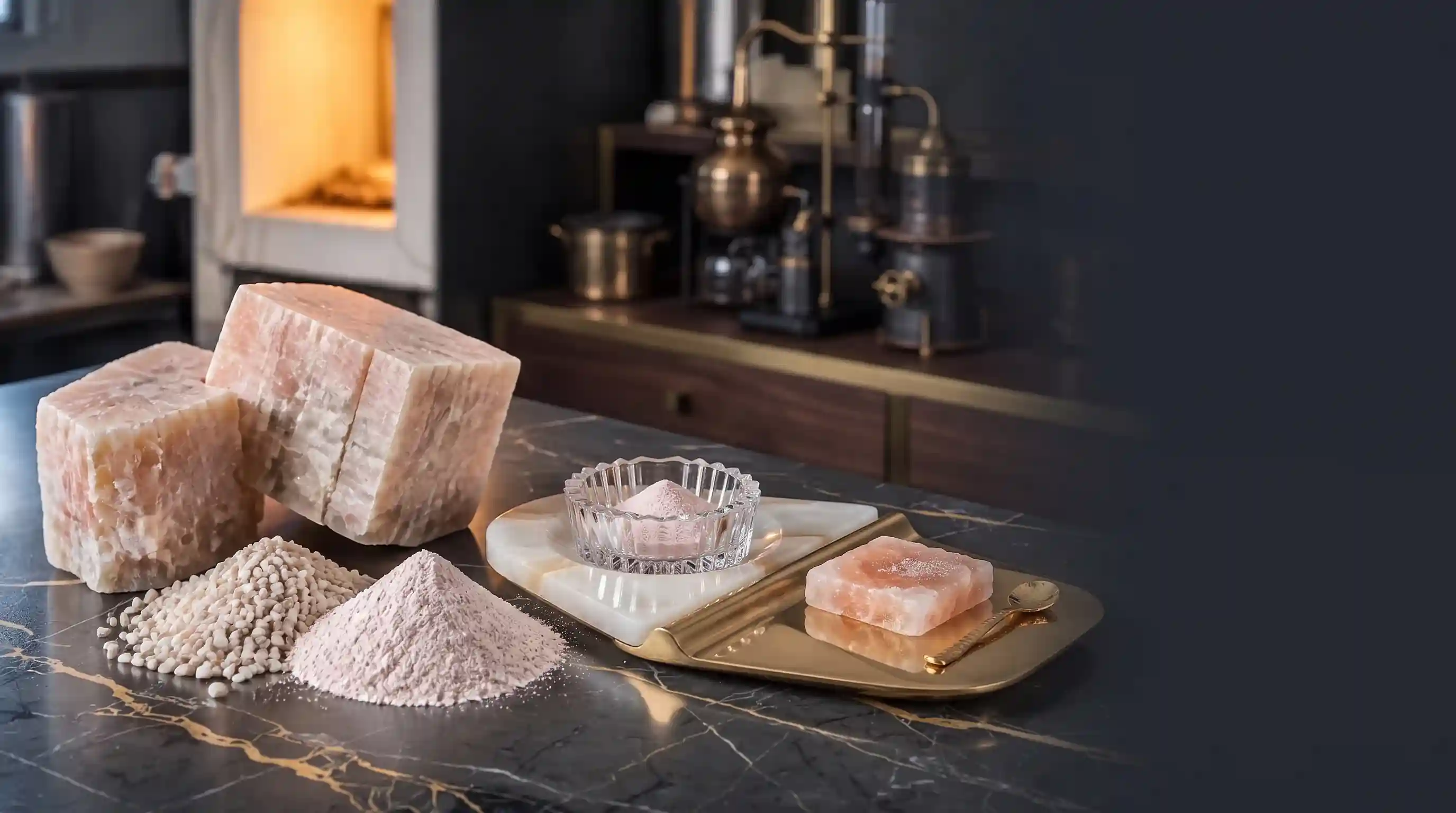
Main Applications of Feldspar in the Glass, Tile, Ceramic, and Glaze Industries
The applications of feldspar are very broad, but its four main uses are in the glassmaking, tile production, ceramic products, and glaze industries. In each of these industries, the role and quality requirements of feldspar differ, and understanding these differences is important for supplying the appropriate raw material.
In the glassmaking industry, feldspar is one of the main components in the body formulations of container glass, flat glass (building and automotive glass), crystal glass, and glass fibers. The main function of feldspar in this application is to supply alkali oxides to reduce the melting temperature and improve the chemical resistance of glass. Sodic feldspar is preferred in this industry because it provides better transparency and suitable viscosity. Also, the alumina present in feldspar prevents the devitrification of glass and increases its transparency and strength.
In the tile industry, feldspar acts as a flux and binder in the body of wall and floor tiles. By creating a liquid phase at the firing temperature, this mineral causes the tile body to densify and sinter, improving the mechanical strength and water resistance of the product. In addition, in tile glaze, feldspar acts as the main flux and creates a smooth, glossy surface resistant to abrasion and chemicals.
In the ceramic industry in general, feldspar is used in the production of kitchenware, sanitaryware (washbasins and flush toilets), technical ceramics, and electrical insulators. In these products, feldspar guarantees the thermal, mechanical, and electrical resistance of the product by creating an appropriate crystalline structure during firing. The quality of the feldspar used in this industry, especially the level of iron impurities, directly affects the color and visual quality of the final product.
In the glaze industry, feldspar has a dual role: it lowers the temperature as a flux and, by supplying alumina, increases the strength and durability of the glaze surface. Potassic feldspar is more widely used in this application due to its color stability and suitable thermal behavior. In addition, feldspar is used in other industries such as rubber manufacturing as a filler and reinforcing agent; to lea how to choose suitable feldspar for the rubber industries, you can refer to its specialized article.
The availability of feldspar powder in the 10 to 450 mesh size range enables the use of this mineral in a wide spectrum of industrial processes. The exact particle size affects firing behavior, compositional uniformity, and final product quality, and supplying powder with the correct mesh classification is one of the key requirements for consumers. In general, the finer the particle size, the greater the contact surface and the higher the reactivity at the firing temperature; however, processing costs also increase accordingly.
Challenges of Feldspar Exploration and Extraction in Mines
Feldspar extraction is the first link in the supply chain of this strategic mineral and involves numerous challenges. The first challenge is exploration and reserve estimation. Feldspar deposits form as magmatic, pegmatitic, and alluvial ore bodies, and each of these deposit types has a different quality and chemical composition. Identifying high-quality deposits suitable for the glass and ceramic industries requires precise geological studies, exploratory drilling, and costly reserve estimation, all of which are time-consuming and require high expertise.
The second challenge is the variation and fluctuation of quality within a single mine and even within a single working face. The chemical composition of the extracted feldspar may differ significantly in different parts of a mine. This variation is due to changes in the percentage of associated minerals, impurities, and the degree of alteration. For consumers who require a product with consistent specifications, these fluctuations are a serious problem because they affect their production process and final product quality.
The third challenge is the extraction method. Most feldspar mines are extracted by the open-pit method, which requires heavy equipment, controlled blasting, and management of large volumes of waste and overburden. Extraction costs depend on the mine depth, the waste-to-ore ratio, and weather conditions. In addition, in many mines, feldspar is extracted along with other minerals such as quartz, mica, and iron-bearing minerals, which requires separation operations in later stages.
The fourth challenge is environmental and social issues. Open-pit extraction of feldspar has environmental impacts through dust generation, machinery noise, destruction of natural landscapes, and the production of mine waste. Obtaining environmental permits, managing mine water, and reclaiming mined land are legal requirements that increase operating costs. On the other hand, the proximity of some mines to residential and agricultural areas has created social challenges and local opposition.
The fifth challenge is the aging of equipment and infrastructure in older mines. Many active mines operate with wo machinery and equipment, resulting in low efficiency, high maintenance costs, and safety risks. Investing in equipment modeization, especially for small and medium-sized mines, is difficult due to financial limitations and difficulties in securing loans.
Finally, the lack of accurate national statistics on deposits and their qualities has made mine development plaing and investment attraction difficult. This lack of information creates a serious challenge in long-term raw material supply, especially for industries that require feldspar with specific specifications.
Challenges of Feldspar Processing, Crushing, and Quality Control
After extraction, crude feldspar must be transformed through a multi-stage process into a product usable by industries. This processing includes crushing, grinding, size classification (meshing), impurity separation, and in some cases chemical and thermal treatment. Each of these stages has its own challenges.
The first processing challenge is reducing undesirable impurities. Iron and titanium impurities are the most important factors in reducing feldspar quality. To remove or reduce these impurities, various methods are used, such as magnetic separation (wet and dry), acid washing, flotation, and gravity separation. The effectiveness of these methods depends on the type of impurity mineral, particle size, and their degree of liberation. In many cases, reaching the desired impurity level requires a combination of several methods and considerable cost.
The second challenge is controlling particle size distribution. Feldspar used in different industries requires a specific mesh classification. For example, coarser meshes are generally used in the glass industry, while finer powder is needed in ceramics and glaze. Producing powder in the 10 to 450 mesh range requires precise grinding and classification equipment and continuous control. Excessive or insufficient grinding negatively affects firing behavior and final product quality.
The third challenge is uniformity and consistency of quality over time. Industrial consumers require a product with a stable chemical composition and mesh classification so they can continue their production process without frequent adjustments. However, due to fluctuations in the quality of the raw material entering the processing plant, maintaining product consistency is a continuous challenge. This requires precise quality control at all stages, regular sampling, and chemical and physical testing, which demand high cost and expertise.
The fourth challenge is water and wastewater management in processing. Wet separation methods and acid washing consume large volumes of water and produce wastewater containing chemicals and suspended particles. Treating and disposing of this wastewater in accordance with environmental regulations is costly, and in regions with limited water resources, it is a serious challenge.
The fifth challenge is quality control and laboratory work. Precisely determining the chemical composition (especially the percentages of Fe₂O₃, Na₂O, K₂O, and Al₂O₃), particle size distribution, moisture, and other characteristics requires equipped laboratories and skilled persoel. Many small producers lack such infrastructure and perform quality control using traditional methods that do not provide the necessary accuracy.
The sixth challenge is energy consumption in processing. Crushing and grinding feldspar, especially for fine meshes, consumes a large amount of electrical energy. High energy costs and, in some cases, unstable energy supply affect the final product cost and producers' competitiveness.
Feldspar Supply Chain, Logistics, and Market Challenges
The feldspar supply chain, beyond extraction and processing, also includes challenges related to transportation, storage, marketing, and market fluctuations. These challenges affect producers' ability to supply product to industrial consumers in a timely and economical maer.
The first challenge is the distance between mines and consumption centers. Feldspar mines are usually located in areas far from cities and industrial centers. Transporting feldspar, whether in bulk or bagged, by truck or rail, involves considerable cost, which is reflected in the final product price. Road conditions, a shortage of specialized transport fleets, and fuel price fluctuations affect these costs and delivery reliability.
The second challenge is storage and handling. Feldspar must be stored under conditions that prevent contamination with impurities (especially iron and organic materials), moisture absorption, and mixing with other products. At ports and large warehouses, inventory management and preventing quality loss during storage require infrastructure and careful management.
The third challenge is market and demand fluctuations. The feldspar market, especially in Iran and the region, is influenced by fluctuations in downstream industries (glass, tiles, and ceramics). A recession or boom in the construction industry directly affects feldspar demand. These fluctuations make production plaing and pricing difficult for producers.
The fourth challenge is competition with alteative materials and imports. In some applications, feldspar competes with materials such as nepheline syenite, apatite, or synthetic chemical compounds. The quality and price of these alteative materials affect the market share of domestic feldspar. Also, imports of high-quality feldspar from other countries create competitive pressure on domestic producers.
The fifth challenge is standards and technical specifications. Each industry and each plant defines its own technical specifications for feldspar. Non-compliance with these specifications, even in minor cases, can lead to product rejection and financial losses. Understanding national and inteational standards for industrial minerals is very important for producers; as discussed in the article Examining National and Inteational Standards in White Talc Production.
The sixth challenge is financing and capital supply. High working capital, long collection periods from large customers, and the need to invest in equipment and infrastructure put feldspar producers under financial pressure. Exchange rate instability and inflation intensify this challenge.
The seventh challenge is market information and transparency. The absence of comprehensive informational platforms about the price, quality, and supply of feldspar creates market opacity and causes difficulties for both producers and consumers in decision-making.

Solutions and Iovations for Addressing Feldspar Supply Challenges
Despite the numerous challenges in the feldspar supply chain, solutions and iovations exist that can help improve the situation. These solutions can be divided into several general categories.
The first category, technical and processing solutions: The use of high-intensity advanced magnetic separation methods, selective flotation, and optimized acid washing can effectively reduce iron and titanium impurities. Also, the use of mode mills and precise classification systems enables the production of powder with controlled particle size distribution over the wide 10 to 450 mesh range. Automation and digital process control also contribute significantly to product quality stability.
The second category, managerial and quality-control solutions: Establishing quality management systems, setting up equipped laboratories with XRF and XRD instruments, and regular sampling and testing at all stages from extraction to the final product can greatly increase product consistency and reliability. Creating a database of deposit quality and production history helps with plaing and forecasting.
The third category, exploration and reserve-development solutions: Investment in systematic exploration, the use of mode geological methods (remote sensing, geophysics, and geochemistry), and the preparation of quality maps of existing deposits can help identify new high-quality resources and plan long-term extraction. Also, a precise understanding of the differences between feldspar types and matching deposit quality to the needs of target industries prevents resource waste.
The fourth category, logistical and infrastructure solutions: Developing a specialized transport fleet, improving access roads to mines, establishing standard warehouses near consumption centers, and using appropriate packaging (sturdy bags and standard palletizing) can reduce the costs and risks of the supply chain.
The fifth category, market and marketing solutions: Establishing direct, long-term relationships between producers and consumers, making prices and quality transparent, providing complete technical documentation (datasheets and test certificates), and developing export markets can help stabilize the market.
The sixth category, environmental solutions: Implementing wastewater management programs, recycling process water, controlling dust, and restoring mined lands not only satisfy legal requirements but also improve social image and business sustainability.
Finally, cooperation among miners, processors, consumers, govement institutions, and universities, for knowledge exchange, standard development, and support for investment in infrastructure, is a macro-level and vital solution. Fortunately, in Iran, numerous scientific and industrial centers are active in the field of minerals, and there is a high capacity for such cooperation.
The Future of the Feldspar Market and Conclusion
A look at the future of the feldspar market indicates continued demand growth in the coming decades. The growth of the glass, tile, and ceramic industries in emerging markets, increasing demand for technical and advanced ceramics, and the expansion of new feldspar applications across various industries are the drivers of this growth. Projections indicate that the global feldspar market will grow at a moderate but steady rate.
In Iran, significant feldspar deposits exist in various provinces, providing a good opportunity for the development of this industry. However, realizing this potential requires overcoming the challenges addressed in this article: improving extraction methods, developing advanced processing, implementing strict quality control, expanding logistical infrastructure, and increasing market transparency.
One important future trend is the movement toward higher-value-added products. Instead of selling crude feldspar, producing processed powders with precise mesh classification and controlled quality generates much higher income. Also, developing products that meet the specific needs of each industry (such as low-iron glass or technical ceramics) creates new markets.
Another trend is environmental sustainability and social responsibility. Legal and social pressures to reduce the environmental impacts of mines and processing plants are increasing. Companies that address these issues earlier will gain a competitive advantage.
Conclusion
Feldspar is a strategic mineral for the glass, tile, ceramic, and glaze industries. The sustainable and high-quality supply of this material faces numerous challenges, including fluctuations in deposit quality, undesirable impurities, processing and energy costs, logistical problems, and market volatility. However, these challenges can be overcome through investment in technology, quality management, systematic exploration, and industry cooperation.
The Amiran Stone Mineral Project contributes to addressing part of these challenges by supplying processed feldspar in the 10 to 450 mesh size range, tailored to the needs of the glass, tile, ceramic, and glaze industries. Given the diversity of industrial needs, choosing a supplier that guarantees product quality and consistency is of special importance.

| Question | Answer |
|---|---|
| What is feldspar and in which industries is it used? | Feldspar is a group of alkali aluminum silicates used as a flux in the glass, tile, ceramic, and glaze industries. |
| Which type of feldspar is more suitable for the glass industry? | Sodic feldspar (albite) is more common in glassmaking because it provides better transparency and suitable viscosity. |
| What does the 10 to 450 mesh range mean? | This range indicates the particle-size diversity of feldspar powder, which enables its use in various industrial processes. |
| Why is iron impurity harmful in feldspar? | Iron oxide causes coloring, reduces glass transparency, and changes the product's thermal behavior, and is undesirable for white ceramics. |
| What is the difference between sodic and potassic feldspar? | Sodic feldspar is used more in glassmaking and potassic feldspar more in ceramics and glaze; for further details, refer to the relevant specialized article. |
| What are the most important challenges in supplying feldspar? | The main challenges include fluctuations in deposit quality, undesirable impurities, processing and energy costs, logistical problems, and market volatility. |
| How is the quality of feldspar controlled? | Through chemical testing (XRF), determining particle size distribution, moisture testing, and impurity control in equipped laboratories. |
| How does feldspar affect ceramic production costs? | As a flux, feldspar lowers the melting temperature and reduces energy consumption in kilns. |
| Is feldspar used in industries other than glass and ceramics? | Yes, feldspar is also used in the rubber industry as a filler and reinforcing agent. |
| How should a suitable feldspar supplier be selected? | Attention should be paid to quality consistency, mesh classification suited to the requirement, impurity levels, logistical capability, and the supplier's technical documentation. |
This article has been prepared based on technical information published in the field of industrial minerals and the experience of the Amiran Stone Mineral Project (ksamiran.ir).

برچسب: Feldspar,Examining the Challenges of Feldspar Supply for Industries,
نویسنده: رساوب آفرین