
درباره سایت
آخرین مطالب
- Applications of White Talc in Plastic Production and Industrial Polymer Industries
- Applications of Coated Calcium Carbonate in Chemical and Plastic Industries
- What is Coated Calcium Carbonate? A Guide to Its Application in the Construction Industry
- كيفية اختيار كربونات الكالسيوم المطلي بناءً على التدرج الحبيبي
- How to Choose High-Quality White Barite: Key Purchasing Tips
- استانداردهای دانهبندی تالک سفید برای مصارف گوناگون در صنایع
- White Talc in the Construction Industry: Its Applications and Key Features
- Industrial Barite or Calcium Carbonate? A Complete Comparison of Applications and Benefits
- استانداردهای کیفیت باریت صنعتی و روشهای آزمایش و کنترل آن
- Application of White Barite in Producing Paint and Durable Industrial Coatings
امکانات وب
What Is Silica Powder and Why Is It Important in Adhesive and Resin Production?
Silica powder, also known in technical literature as silicon dioxide or SiO₂, is one of the most fundamental and widely used mineral materials in mode industries. It is mainly obtained from natural quartz rock and, after extraction, crushing, grinding and particle classification, is supplied as a powder in different sizes within the 10 to 450 mesh range. The term “mesh” is actually a unit for measuring particle size; as the mesh number increases, the particle size becomes finer. This characteristic allows silica powder to meet the diverse needs of different industries precisely and purposefully.
In the Amiran Stone Minerals Project, silica is introduced for main applications such as glass, casting products, ceramic products and construction materials. However, the application of this mineral is not limited to these industries; the chemical, paint, coating, sealing, adhesive and resin industries also benefit from the advantages of silica particles. The reason for this breadth is a special combination of physical and chemical properties that has tued silica into a multipurpose material.
Silica is an inert and stable material; it shows high resistance to most acids and bases, considerable hardness against abrasion and scratching, and good stability against temperature and atmospheric conditions. In addition, the abundance of its natural reserves in Iran and the world has made the finished cost of silica-containing products lower than filler-free formulations or those containing expensive fillers. This same combination of “technical performance + economic advantage” is the fundamental reason for silica’s importance in industrial adhesive and resin formulations.
In the adhesive and resin industry, silica acts as an “active mineral filler”; this means it does not merely fill the volume and weight of the formulation, but also affects properties such as viscosity, adhesion, mechanical strength, thermal stability and the final durability of the product. Selecting the appropriate particle size, controlled moisture and the correct addition method makes the difference between a high-quality adhesive and a weak product.
In the rest of this article, we examine the role of silica powder in adhesive and resin production step by step; from viscosity control and adhesion to the effect of particle size, economic advantages, comparison with other mineral fillers, and technical and safety tips during use.
The Role of Silica in Adhesive Production: From Viscosity Control to Adhesion
Adhesives and sealants are usually composed of a base adhesive (polymeric or resinous), solvent, functional additives and mineral fillers. Silica powder simultaneously plays several key roles in these systems, and for this reason it is widely used in water-based, solvent-based, two-part epoxy, polyurethane, acrylic, construction and tile adhesives.
One of the most important roles of silica in adhesive production is viscosity and rheological behavior control. The adhesive must be easy to spread on the surface and, after application on vertical and ceiling surfaces, must not sag or slump. With their network structure, silica particles give the formulation pseudoplastic and thixotropic behavior; in other words, the adhesive flows during stirring and pumping, but in a static state and after application, it maintains its stable paste-like form. This property is vital for tile and stone adhesives, construction adhesives, window sealants and industrial adhesives applied on vertical surfaces.
The second role of silica is improving adhesion and filling gaps. In filler adhesives and structural adhesives, silica particles fill the empty space between two surfaces and help create a thicker, more uniform adhesive layer. This is especially important when the surfaces have roughness, irregularity or dimensional tolerance. Filling these gaps, in addition to increasing the strength of the adhesive joint, prevents shrinkage and cracking during drying or curing.
Silica also helps increase the strength and durability of adhesives. Hard silica particles act as reinforcement points within the polymer matrix and raise the adhesive layer’s resistance to tension, shear, abrasion and impact. In wood and paper adhesives, automotive sealants and repair adhesives, this property extends the product’s service life.
Another application of silica in adhesive production is reducing finished cost. The base adhesive (resin) is the most expensive part of the formulation, and replacing part of it with silica powder significantly reduces production cost without a loss of quality. At the same time, by reducing shrinkage during drying, silica maintains and even improves the surface quality and performance of the adhesive.
In soft sealants and adhesives such as silicone and polyurethane, fine silica particles act as reinforcing agents and adjust hardness and elasticity. Also, in water-based adhesives, silica can help regulate the rate of water absorption into the substrate and improve initial tack. This combination of applications has made silica an inseparable component of the adhesive production industry.
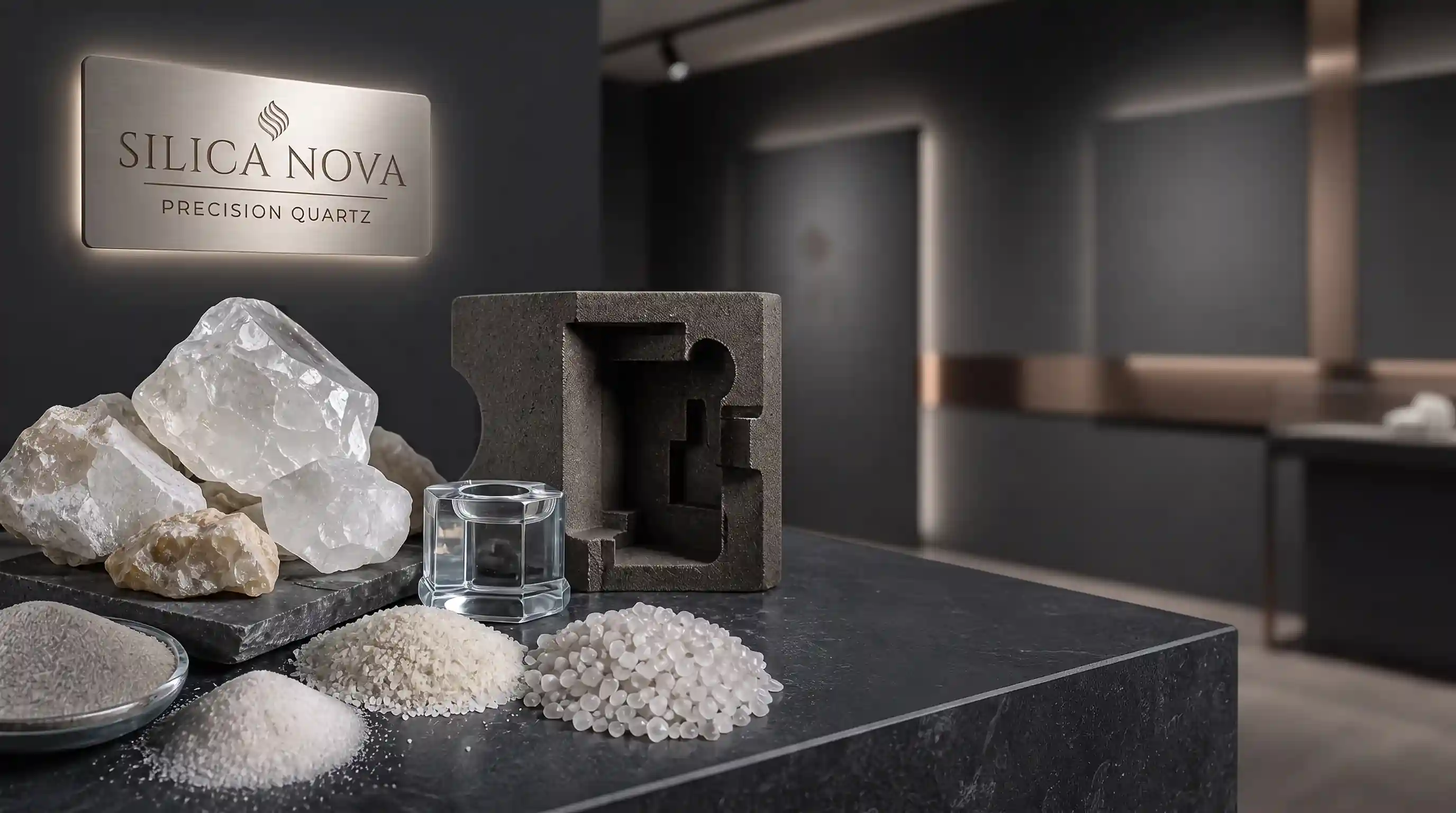
Application of Silica in Resin Production and Improvement of Mechanical Properties
Resins, whether thermosetting (such as epoxy, phenolic and unsaturated polyester) or thermoplastic (such as PVC, polyethylene and polypropylene), form the basis of many industrial products, composites, coatings and molds. Silica powder is known as one of the most important mineral fillers in the resin industry and has a direct effect on the mechanical, thermal, chemical and economic properties of the final products.
The first and most obvious application of silica in resin production is increasing mechanical resistance. Due to their high hardness, silica particles act as reinforcing points within the polymer network and increase the tensile strength, flexural strength, surface hardness, and scratch and abrasion resistance of the final part. In the production of composite parts, industrial sheets, panels, boat hulls and automotive parts, adding silica to resin is a well-known way to improve mechanical performance.
The second important effect of silica is reducing shrinkage and controlling heat generation during curing. The curing reaction of resins, especially epoxy and polyester, is exothermic, and this heat causes expansion and then volumetric contraction, resulting in warping, cracking and dimensional loss in the part. Silica particles occupy part of the resin volume, absorb and dissipate the reaction heat, and strongly reduce the final shrinkage. This property is very vital for thick parts, epoxy molds, industrial floors and repair layers.
The third application is increasing thermal stability and chemical resistance. Silica is inert and stable and does not decompose at high temperatures; therefore, adding it to phenolic, epoxy and polyester resins raises the operating temperature of the final part and improves its resistance to acids, bases, solvents and moisture. For this reason, silica is used in tank linings, pipes, industrial parts and chemical floors.
The fourth application of silica in resins is viscosity and process behavior control. In sprayable resins, gelcoats, SMC and BMC composites, and casting resins, the viscosity must be precisely adjusted so that the resin both fills the mold well and does not sag after application on vertical surfaces. Silica particles act as a thickening and thixotropic agent and enable a more stable process.
The fifth application is cost reduction and volume extension. Resin is the most expensive component of the formulation, and silica, with its lower finished cost, replaces part of its volume. In addition to lowering the product’s finished price, this in some cases brings improved quality in the final part (reduced shrinkage, increased hardness and improved machinability).
Also, in the production of mastics, putties, gelcoats and surface coatings, silica acts as an agent for adjusting matting, surface hardness and sandability. In fact, silica is a material that delivers useful performance both in thick composite layers and in thin coating layers.
The Effect of Particle Size and Mesh Range on Adhesive and Resin Performance
One of the most important factors in selecting silica powder for adhesive and resin applications is particle size, or the mesh number. Silica powder is supplied in a wide range from 10 to 450 mesh, and each of these sizes has its own behavior and application in the formulation. Recognizing these differences is the key to designing a successful and optimized formulation.
Coarse particles (low meshes, around 10 to 100): These particles are mostly used as volume fillers and for filling large gaps. In construction adhesives, tile adhesives, repair putties, resin mortars and thick composites, coarse particles fill empty space and reduce resin consumption. These particles have low oil and water absorption, do not raise viscosity excessively, and allow a high amount of filler to be used. Their weak point is reduced transparency and a rougher final surface.
Medium particles (around 100 to 250 mesh): This range creates a good balance between price, mechanical properties and processability, and is used in many general industrial adhesives and resins. These particles both give the system suitable strength and increase viscosity in a controlled way. This range is widely used in structural epoxy adhesives, polyester resins, industrial coatings and sealants.
Fine particles (around 250 to 450 mesh and finer): Fine particles have a high specific surface area and interact strongly with the polymer matrix. The result is increased viscosity and strong thixotropic behavior, improved adhesion and inteal cohesion, and increased mechanical and abrasion resistance of the final layer. Fine particles are used in gelcoats, delicate sealants, high-quality coatings, transparent resins and adhesives with a uniform surface. Also, very fine silica particles can play a matting and gloss-adjusting role in coatings.
In addition to average particle size, particle size distribution (PSD) is also very important. A good distribution includes a combination of fine and coarse particles so that the fine particles fill the space between the coarse particles. This optimized packing structure allows the greatest amount of filler to enter the formulation with the least viscosity increase; that is, cost decreases while mechanical properties are maintained.
Ultimately, the mesh range should be selected based on the type of final product, applied layer thickness, application method (trowel, spray, injection), required transparency, drying speed and target cost. Experience shows that many successful formulations use a combination of two or more different silica mesh ranges to achieve optimal performance. Therefore, having access to silica in the wide 10 to 450 mesh range is a major advantage for adhesive and resin manufacturers.

Economic and Technical Advantages of Using Silica in Formulations
Using silica powder in the adhesive and resin industry is not only a technical choice but also a smart economic decision. To better understand this, we examine silica’s advantages in two technical and economic sections.
Economic advantages: The first and clearest advantage is reducing the product’s finished cost. Polymer-based resins and adhesives are the most expensive components of a formulation, and using silica as an abundant and economical filler makes it possible to replace part of their volume. In today’s competitive market, this cost reduction can be the difference between a successful product and a marginal one. The second economic advantage is reducing the hidden costs caused by waste, because silica, by reducing shrinkage and warping, lowers production waste and rework. The third advantage is the stable availability and abundance of domestic reserves, which minimizes the risk of supply chain fluctuations.
Technical advantages: Silica simultaneously improves several properties in the formulation:
- Reduced shrinkage and cracking: During drying and curing, volumetric contraction is strongly reduced.
- Increased hardness and abrasion resistance: The final layer becomes more resistant to scratching and abrasion.
- Improved adhesion: Creation of a larger contact surface and better filling of gaps between two surfaces.
- Viscosity and rheology control: Prevention of sagging on vertical surfaces and improved applicability.
- Increased thermal stability: Retention of properties at higher temperatures and reduction of curing exothermic effects.
- Chemical and moisture resistance: Improved durability against acids, bases, solvents and moisture.
- Electrical insulation: Suitable for electronic resins, cables and insulating parts.
- Machinability and sandability: Very useful in putties, fillers and industrial coatings.
Another important advantage is silica’s compatibility with the environment and common production processes. Silica is an inert, non-toxic mineral material that performs well in water-based and solvent-based processes, and it is also compatible with other additives such as silicone oils, oxides and pigments. It can also be combined with other mineral fillers such as kaolin, dolomite, talc and calcium carbonate to obtain a combination of their properties.
In general, silica is a versatile filler that, despite its simplicity, provides the manufacturer with a set of useful properties at a reasonable cost, and that is why it is found in almost every advanced adhesive and resin factory.
Comparison of Silica with Other Mineral Fillers in Adhesives and Resins
Silica is not the only mineral filler available on the market; materials such as kaolin, dolomite, talc and calcium carbonate are also widely used in the adhesive, resin and coating industries. Each of these materials has its own strengths and weaknesses, and recognizing their differences helps in selecting the right material.
Silica versus calcium carbonate: Calcium carbonate is the cheapest and most widely used filler and is mainly used to reduce cost and increase volume. However, silica is far superior in hardness, abrasion resistance and chemical stability. In acidic environments and applications where abrasion resistance matters, silica performs better, while in general and more economical products, calcium carbonate is the more common option.
Silica versus kaolin: Due to its platy structure and high whiteness, kaolin is mostly used in coatings, paints and rubber, and it shows good reinforcing properties in polymer products. For example, the article Investigating the Application of Kaolin in the Automotive Tire Industry refers to kaolin’s reinforcing role in polymer compounds. Compared with kaolin, silica is harder and more inert, and it is preferred in applications where abrasion, chemical and thermal resistance are priorities.
Silica versus dolomite: Dolomite is also a widely used mineral filler in the paint, resin and coating industries. In the article Investigating the Application of Dolomite in the Paint and Resin Industries, its role in adjusting coating properties and reducing costs is discussed. The main difference is that dolomite is mostly used in decorative and economical coatings, whereas silica delivers better performance in formulations requiring high hardness, chemical stability and controlled rheological behavior.
Silica versus talc: Due to its layered structure and natural lubricity, talc is mainly known as a lubricating, reinforcing and adjusting agent in the polymer, paint and paper industries, and its quality follows precise standards; as examined in the article Investigating National and Inteational Standards in White Talc Production. Silica has different strengths: high hardness, chemical stability and the possibility of use in a wide size range.
In practice, professional manufacturers usually use a combination of several fillers; for example, silica for hardness and viscosity control, kaolin for reinforcement and whiteness, and calcium carbonate for final cost reduction. A smart combination of these materials creates a balanced formulation that is both economical and technically optimized.

Technical Tips for Preparation, Dispersion and Quality Control
Successful use of silica powder in adhesives and resins is not limited to selecting the right mesh range; it requires observing a set of technical points in preparation, mixing and quality control. Following these points makes the difference between a stable formulation and an unstable product.
Moisture control: Mineral powder can absorb moisture during extraction, grinding, transportation and storage. The moisture present in silica can react with isocyanates, epoxies and water-sensitive systems and cause bubbling, loss of adhesion, foaming and reduced pot life. For this reason, it is recommended that silica be dried before use and stored in moisture-barrier bags or dry silos. The moisture level should be checked and recorded for every incoming batch.
Addition and dispersion method: Fine silica particles tend to agglomerate. If these clusters are not properly broken and dispersed, the final product will have weak points, a rough surface and reduced mechanical properties. The best method is to add silica stepwise and with a high-shear mixer (inline high-shear or disperser) to the resin. For very fine particles, using high-speed mixers, homogenizers or bead mills is essential to achieve complete dispersion. Suddenly adding all the powder at once causes lumping and increases process time.
Use of coupling agents: To increase adhesion between mineral particles and the polymer matrix, coupling agents such as silanes are used. These compounds modify the surface of silica particles and create a better bond with the resin. The result is improved mechanical properties, moisture resistance and overall product durability. Of course, the type and amount of coupling agent should be selected based on the resin chemistry.
Order of adding components: In multi-component systems, the order of adding materials matters. Usually, the resin and liquid additives are mixed first, then the filler is added stepwise, and finally pigments and sensitive additives are incorporated. In water-based systems, premature reaction of silica with ion-sensitive adhesives and loss of emulsion stability must be prevented.
Quality control: The main parameters to be controlled are: particle size distribution, moisture percentage, final formulation viscosity, density, volatile content and, in final products, bond strength, adhesion, drying time and storage stability. Continuously recording these parameters guarantees production consistency.
By following this set of principles, silica powder can deliver its full technical and economic potential in adhesive and resin formulations without causing problems on the production line.
Challenges, Safety and a Final Look at Silica Application
Alongside all the advantages, using silica powder in the adhesive and resin industry also involves challenges whose recognition is essential for successful production.
Dust and safety challenge: Silica powder, especially in very fine forms, can become airboe and, if inhaled for long periods, create respiratory hazards. This issue is much more serious for crystalline silica dust. Therefore, in receiving, storage, weighing and mixing sections, local exhaust ventilation, dust collection devices, proper packaging and personal protective equipment such as a standard respirator should be used. Observing the occupational exposure limit and continuously training persoel play a key role in protecting workers’ health.
Equipment abrasion challenge: Silica is a hard material and, in continuous contact with equipment, pipelines, pumps and mixers, causes early wear and erosion. Selecting equipment with abrasion-resistant parts (such as nickel cast iron or ceramic linings), proper transfer-path design and a preventive maintenance program can manage this challenge.
Dispersion and viscosity increase challenge: Using fine particles rapidly increases viscosity, which sometimes makes pumping and application difficult. Also, particle aggregation reduces product quality. The solution to this challenge is using suitable mixing equipment, selecting the right particle size distribution, and using viscosity-reducing additives and surface-modifying agents.
Quality consistency challenge: Since silica is a natural product, variation in quality and different reserves can affect product uniformity. Supplying from a reliable source with clear quality control is the main solution to this challenge.
Final look: Silica powder is one of the fundamental minerals in the adhesive and resin industry, supplied in a wide range from 10 to 450 mesh, and with a special combination of technical and economic properties, it has gained a distinct place in mode formulations. From viscosity control and thixotropic behavior to increased hardness, reduced shrinkage, improved adhesion and reduced finished cost, silica plays a role in almost all aspects of product performance. Success in using this material depends on accurately understanding the product’s needs, selecting the right mesh range, controlling moisture, using correct mixing equipment and observing safety guidelines. If these principles are followed correctly, silica becomes one of the most valuable product-development tools in adhesive and resin factories.

| Question | Answer |
|---|---|
| What role does silica powder play in adhesive production? | Controlling viscosity and thixotropic behavior, preventing sagging on vertical surfaces, filling gaps, improving adhesion, increasing strength and reducing finished cost. |
| In which types of resins is silica used? | Epoxy, unsaturated polyester, vinyl ester, phenolic, polyurethane, acrylic, water-based resins and SMC/BMC systems. |
| What difference does the 10 to 450 mesh range make in performance? | Coarse particles are mostly economical volume fillers; finer particles improve viscosity, adhesion, strength and surface quality. |
| Does silica reduce production cost? | Yes; replacing part of the expensive resin with abundant silica reduces the finished cost without a loss of quality. |
| What is the difference between ground silica and active (fumed/precipitated) silica? | Ground silica is mainly a general filler and reinforcer; active silicas have a much higher specific surface area and are mainly used for strong viscosity control and matting. |
| How is silica added to resin? | Stepwise and with a high-shear mixer or homogenizer, while controlling the powder’s moisture and preventing particle agglomeration. |
| What are the safety tips when working with silica powder? | Using local exhaust ventilation, a dust collection system, a standard respirator and persoel training to prevent prolonged dust inhalation. |
| Does silica react with the chemicals present in adhesives? | Silica is inert and stable and has no particular chemical reaction, but the moisture it has absorbed can react with water-sensitive systems. |
| What effect does silica have on resin transparency and color? | Coarse particles reduce transparency and make the surface more matte; very fine particles can create a controlled matting effect. |
| Where can suitable silica powder for the adhesive and resin industries be obtained? | From reliable mineral suppliers with clear quality control, such as the Amiran Stone Minerals Project, which supplies silica in the 10 to 450 mesh range. |
This article has been prepared based on the technical product information for silica in the Amiran Stone Minerals Project and the general applications of this material in the adhesive and resin industries.

برچسب: Silica,Application of Silica Powder in the Production of Adhesives and Resins,
نویسنده: رساوب آفرین