
درباره سایت
آخرین مطالب
- آنالیز و ویژگیهای تالک صنعتی: عوامل تعیینکننده کیفیت
- معايير تدرج التلك الأبيض للاستخدامات المختلفة في الصناعات
- کاربرد تالک صنعتی در تولید سرامیک و کاشیسازی چیست؟
- Applications of White Calcium Carbonate Powder in Various Industries
- الفرق بين التلك الصناعي والبنتونيت: أيهما مناسب لتطبيقك؟
- White Talc vs. Dolomite: A Comparison of Applications and Prices in Industry
- كيف تختار السيليكا المناسبة لصناعتك؟ دليل شامل
- How to Choose the Right Silica for Your Industry? A Complete Guide
- ما هي السيليكا؟ الدليل الشامل لتطبيقات هذه المادة المعدنية في الصناعات المختلفة
- What is Silica? A Comprehensive Guide to the Applications of This Mineral in Various Industries
امکانات وب
Introduction to White Talc and Dolomite: A Look at Two Widely Used Minerals
White talc and dolomite are two minerals that are both known in various industries as fillers, coating agents, and intermediate materials; however, their chemical nature, crystal structure, and physical behavior have fundamental differences that make choosing either one a specific technical decision. In recent years, with the increasing demand for high-quality mineral powders, comparing these two materials has become a frequent topic among purchasing managers of masterbatch, compound, paint, paper, and ceramic factories.
Talc is known by the chemical formula magnesium silicate hydroxide and belongs to the group of layered silicates. This layered structure is the main reason for talc's extreme softness, its greasy surface feel, and its lubricating property. Talc has a hardness of about one on the Mohs scale, and this feature has made it the softest known mineral. When talc is processed with appropriate purity and whiteness, a product called white talc is obtained, which is suitable for sensitive applications such as masterbatch, compounds, paint, paper, and ceramics.
Dolomite, on the other hand, is a double carbonate of calcium and magnesium, known geologically mostly as a building stone and ore. Dolomite's hardness is around 3.5 to 4 on the Mohs scale, and its reactivity with acids shows a completely different behavior from talc. Dolomite powder is mostly used in industries that require structural strength, lower price, and availability; although it also plays a filling and fluxing role in some ceramic and glassmaking applications.
The reason for the importance of comparing these two materials is not just the price difference. Choosing between talc and dolomite directly affects the quality of the final product, energy consumption in the production process, dimensional stability of polymer parts, paper brightness, and uniformity of ceramic glaze. For example, incorrect use of dolomite instead of talc in a polypropylene masterbatch can lead to a decline in mechanical properties, unwanted density increase, and even problems in the plastic injection process.
In this article, we intend to examine white talc and dolomite in eight structured sections: first, the chemical and mineralogical differences, then the physical properties and gradation, after that the main applications in the polymer, paint, paper, and ceramic industries, and finally an analysis of price, economic value, and final selection criteria. The goal is for the reader to be able to make the best purchasing decision for their production line with a technical vision and based on market realities.
Chemical and Mineralogical Differences Between Talc and Dolomite
Understanding the chemical differences between talc and dolomite is the starting point for any correct decision in selecting a mineral. Talc is a layered magnesium silicate in which silica and brucite layers are alteately arranged. This special structure is the main factor for talc's slippery property, greasy surface, and neutral chemical behavior. Talc is resistant to most acids and bases and shows good thermal stability at high temperatures up to about 900 degrees Celsius; a feature that makes it ideal for sensitive ceramic and polymer applications.
Dolomite, on the other hand, is a double carbonate of calcium and magnesium and belongs to the carbonate group. This material releases carbon dioxide gas when reacting with weak acids and decomposes at high temperatures. This very chemical behavior limits dolomite's use in processes involving extreme heat or contact with acid. However, in industries such as lime production, steel, glass, and building materials, dolomite plays a very important role due to its calcium and magnesium composition.
One of the key differences is the moisture content and water absorption. Talc is inherently not hydrophilic, and this feature gives it stable performance in polymer systems and water-based paints. Dolomite, although supplied as dry powder, its carbonate structure absorbs moisture over time in humid environments, and as a result, requires more precise control in processes needing very low moisture.
From a mineralogical perspective, talc is usually formed by the transformation of dolomitic and siliceous rocks under high-pressure and temperature conditions; interestingly, many talc mines are located adjacent to dolomite deposits, and this sometimes causes an apparent similarity between the two materials. However, laboratory identification through X-ray diffraction and chemical spectroscopy clearly shows the differences: talc has high silica and magnesium and is carbonate-free, while dolomite consists mainly of calcium and magnesium carbonate.
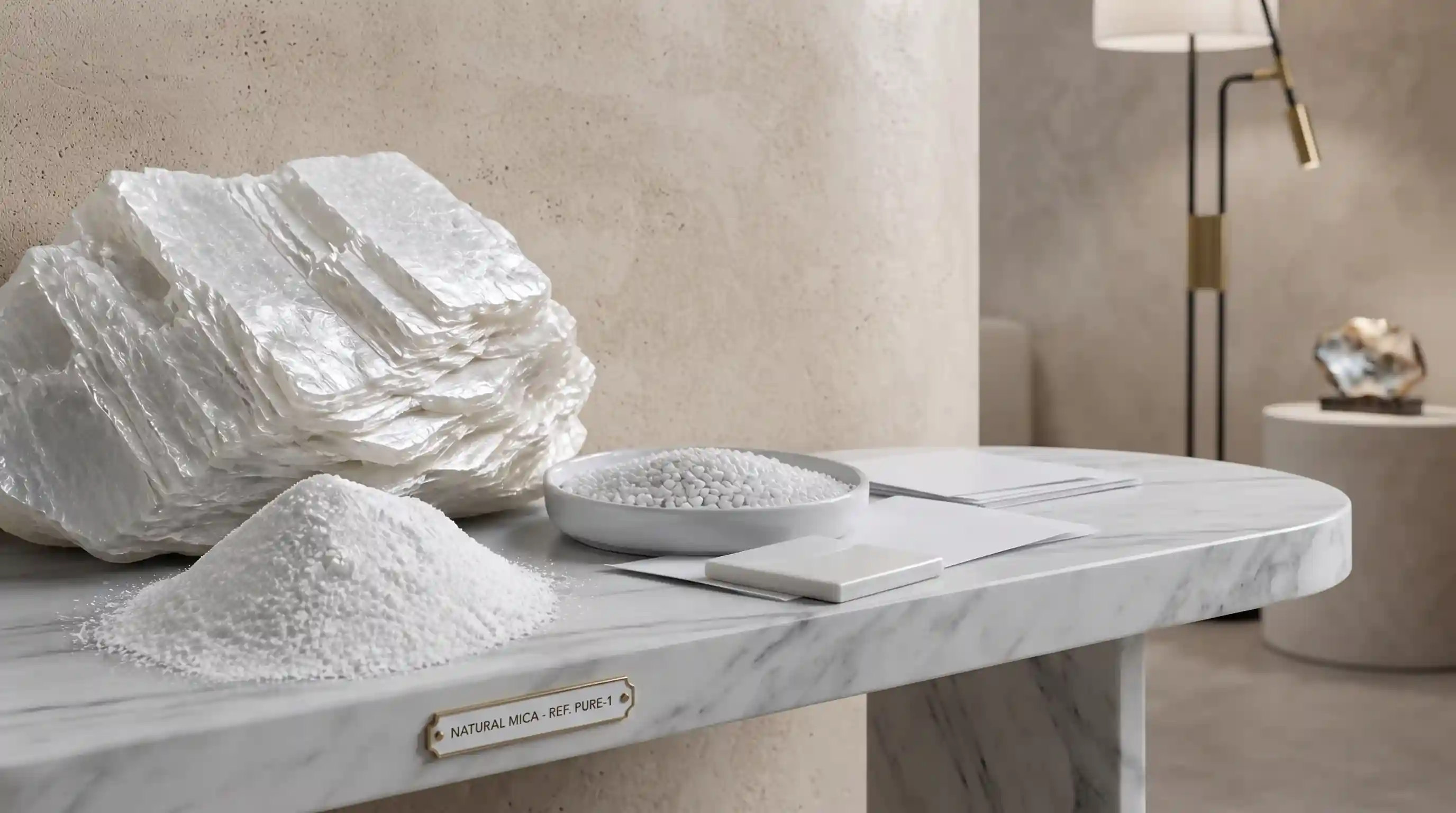
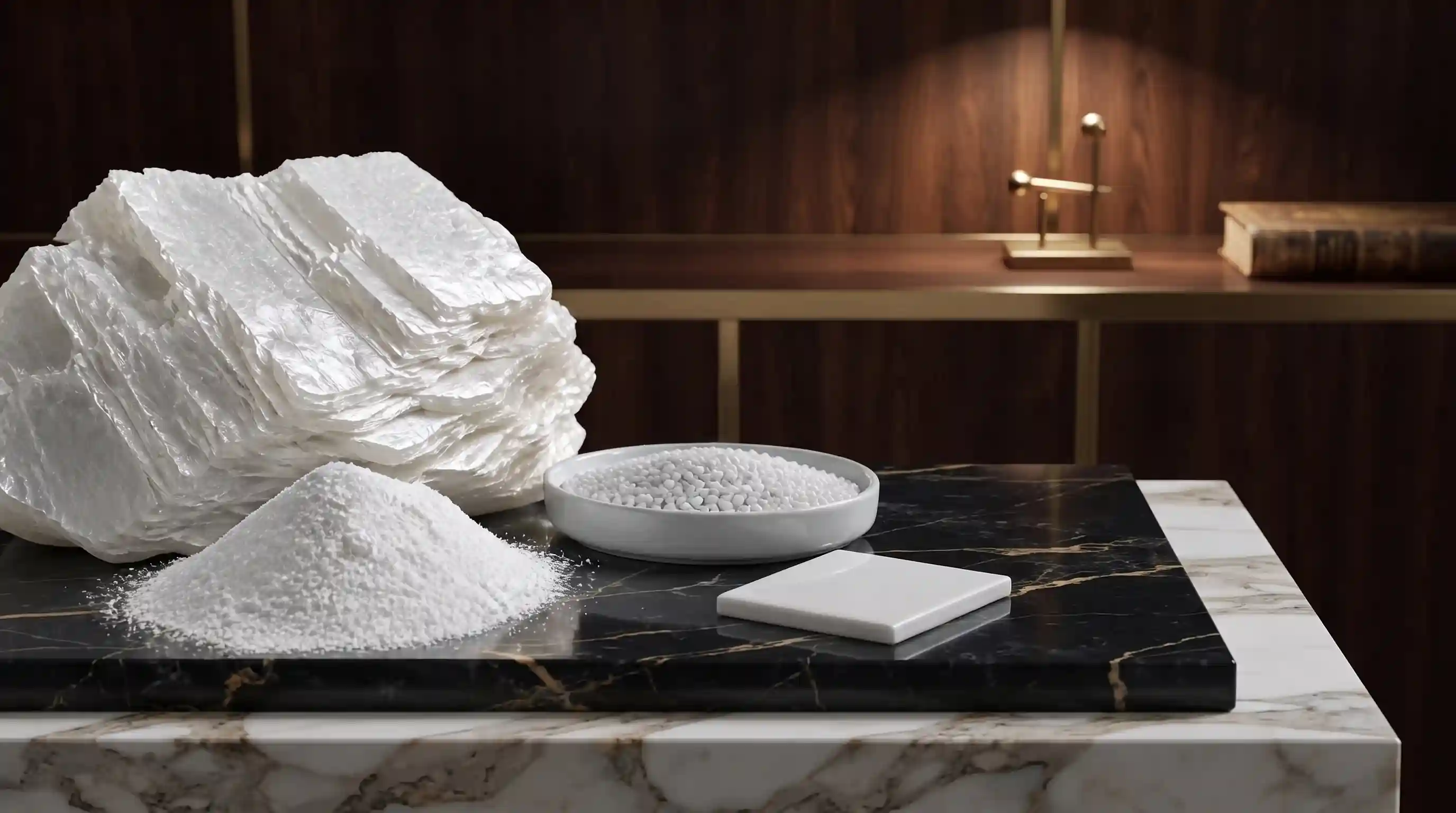
In evaluating apparent quality, one must also be careful. Whiteness, brightness, and uniform particle distribution are important criteria that distinguish white talc from lower-grade talcs. In this regard, familiarization with the appearance and quality of white dolomite powder also helps buyers to detect the subtle differences between these two products in practice.
Physical Properties, Whiteness, and Gradation: The Importance of Mesh Range
The physical properties of mineral powders are the determining factor in the quality of the final product. In the comparison discussion, three main features are important: gradation or particle size, whiteness, and particle shape. White talc offered for advanced industries is usually processed in the mesh range of 450 to 2500 mesh; a range that allows use in diverse applications from polymer filler to high-brightness papers.
Particle size is measured with the mesh unit; the higher the mesh number, the finer the particles. For example, 450 mesh powder is suitable for applications such as ceramics and general compounds, while 2000 to 2500 mesh powders are used to produce high-quality printing papers, final paints, and fine masterbatches. At this level of fineness, the specific surface area of the particles increases drastically, and the behavior of the material in the process changes.
Particle shape is also very important. Talc particles have a broad and layered structure, which gives them high covering and adhesive properties. This feature is very valuable in the papermaking and paint industries, as it creates a uniform and smooth layer on the surface. Dolomite particles, in contrast, have a prismatic crystalline shape that creates different covering properties and caot be an exact substitute for talc in some applications.
Whiteness is another key indicator. High-purity talc has very good whiteness, and this feature becomes extremely important in the production of colored masterbatches, white paper, and decorative paints. In applications where the final color of the product matters, any degree of decrease in filler whiteness will require increased consumption of titanium dioxide or expensive pigments.
Also, attention must be paid to the relationship between particle fineness and lubricity. Due to its layered structure, talc retains its lubricating property even at high meshes, and this is an important advantage in plastic extrusion and injection processes. Precise quality control in this area is mandatory; therefore, familiarization with national and inteational standards in white talc production can be a valuable guide for evaluating the quality of available products in the market.
Application of White Talc in Masterbatch and Compounds
The masterbatch and compound industry is one of the most important consumer markets for white talc in Iran and the world. In this industry, talc acts as a mineral filler and reinforcer, bringing properties such as whiteness, color uniformity, dimensional stability, and reduced final product cost. Due to its layered structure and high whiteness, talc holds a special place in white and colored masterbatches.
In polypropylene and polyethylene masterbatches, talc acts as a reinforcing agent and improves tensile and flexural properties. In fact, due to its layered structure, talc establishes good compatibility with the polymer matrix, leading to improved hardness and a reduced coefficient of thermal expansion. This feature is very valuable in the production of injection-molded parts for the automotive and home appliance industries.
In engineering compounds, in addition to its filling role, talc also acts as a process regulator. The lubricating property of talc particles reduces the torque required in extrusion, consequently lowering energy consumption and machinery wear. This feature is considered an economic advantage for manufacturers dealing with high production volumes.
One of the important technical points in using talc for masterbatch is choosing the right mesh. Typically, 450 to 800 meshes are used in general masterbatches, but for parts with high surface quality or light colors, higher mesh talc such as 1250 to 2500 is chosen. The finer the particles, the better the dispersion in the polymer matrix, and the surface quality of the final part improves.
Compared to dolomite, talc holds a superior position in the polymer industry, because dolomite, due to its carbonate structure and higher density, increases the product's density in polymer systems and offers fewer mechanical properties. Also, gas release due to dolomite's thermal decomposition can cause problems in the extrusion process, whereas talc has very good thermal stability.
Talc is also widely used in anti-block and anti-dust masterbatches for agricultural and greenhouse films. Talc's layered particles spread over the film's surface and prevent layers from sticking together; an application in which dolomite caot provide similar performance.
Application in the Paint and Surface Coatings Industry
In the paint industry, white talc plays a very important role as a functional filler and coating agent. Talc's layered and broad particles orient on the paint surface and create a uniform layer that increases the paint's covering and adhesive properties. This feature helps reduce the consumption of main pigments like titanium dioxide, consequently reducing paint production costs significantly.
One of the important features of talc in paint making is its greasy and lubricating property, which allows the paint to spread easily on the surface and creates a smooth and uniform final surface. This feature is very important in architectural paints, industrial paints, and decorative coatings. Also, due to its low chemical reactivity, talc has good compatibility with other paint compounds and maintains paint stability over time.
In water-based and solvent-based paints, talc is used as a high-performance filler. In water-based paints, talc, due to its inherent lack of hydrophilicity, helps suspension stability and reduces particle sedimentation over time. In solvent-based paints, talc, with its layered structure, helps create a layer resistant to wear and moisture.
The main issue in this industry is choosing the right mesh. In ordinary architectural paints, 450 to 800 meshes are used, but for high-quality paints, automotive paints, and special coatings, higher mesh talc (1250 to 2500) is required. Finer particles make the final paint have a smoother and more brilliant surface, while the matting of the paint is better controlled.
Compared to dolomite, talc has a clear advantage in the paint industry. Dolomite particles have a crystalline shape and their covering property is not as good as talc's. In addition, due to its carbonate structure, dolomite is limited in acid-based paints and can cause blistering and reduced surface quality by releasing gas. For this reason, in most high-quality paint formulations, talc is the first choice.
Talc is also used in industrial anti-corrosion paints. The layered structure of this material makes the path for water and oxygen penetration to the metal surface longer, thereby increasing the paint's corrosion resistance. This is a clear example that choosing the right mineral affects not only the price but also the quality and lifespan of the final product directly.
Application in the Paper and Ceramic Industry
The papermaking industry is one of the largest consumers of mineral powders in the world, and white talc plays a key role in this industry. Talc acts in paper simultaneously as a filler and as a coating pigment. In high-quality printing papers, a talc coating increases brightness, improves print quality, and reduces fuzzing on the paper surface. Talc's layered particles create a thin and smooth layer on the paper surface, absorbing printing ink uniformly.
In filtration papers and colored papers, talc has significant advantages due to its lack of hydrophilicity and low chemical reactivity. Also, in papermaking, talc is used as an oil and grease absorber in recycled papers and is used in greaseproof papers. In these applications, particle size must be controlled very precisely, and higher meshes (1250 to 2500) are typically used.
In contrast, in the ceramic industry, talc plays a completely different role. Talc is one of the important raw materials in the production of fine ceramics, steatite, and technical ceramics. In calcium-magnesium ceramics, talc acts as a flux and lowers the firing temperature. Also, talc is used in the production of ceramic bodies with a low coefficient of thermal expansion, suitable for thermal shock resistant ceramics.
In the production of ceramic glaze, high whiteness talc and its particle uniformity are very important. Talc improves glaze fluidity, increases glaze surface hardness, and reduces blistering. In tiles and architectural ceramics, talc is used as a cheap and effective additive in the body and can reduce the amount of expensive frit. In this application, 450 to 800 meshes are typically used.
Dolomite is also used in the ceramic industry, but its role is different. Dolomite acts as a cheap calcium-magnesium flux in tile and ceramic bodies and is used in opaque and matte glazes. In glass production, dolomite is used as a magnesium supplier. Therefore, in ceramics, both materials have their place, and their choice depends on the type of final product.
Also, talc has many applications in the building materials industry. To become more familiar with this topic, you can read the article The Role of Industrial Talc in the Gypsum and Building Materials Industries.

Price and Economic Value Comparison: Talc is More Expensive but More Cost-Effective
One of the most important questions in choosing between talc and dolomite is their price difference. Generally, the price of white talc is always higher than dolomite. The reason for this price difference is not the rarity of the raw material, but the more complex processing steps. Producing high-quality talc requires selecting a mine with high purity, multi-stage crushing, precise particle classification, and in some cases, washing and whitening processes.
Dolomite is abundantly found in many parts of Iran, and its extraction is relatively simple. Dolomite processing usually involves primary crushing and milling to the desired mesh. This simplicity in processing makes dolomite's price in the market significantly lower than talc. For applications where surface quality, whiteness, and chemical properties do not matter, dolomite is an economical choice.
But the price comparison must be done as an "economic value". For example, in a white masterbatch, using high-whiteness talc reduces titanium dioxide consumption, and as a result, despite talc's higher price, the total cost of the formulation decreases. In high-quality paints too, talc, with its good covering property, helps reduce pigment consumption and has higher economic value.
In the paper industry, talc, with its high brightness and covering power, improves print quality, and the final product can be sold at a higher price. Therefore, in these applications, talc is not merely a cost, but an investment in quality. Instead, in building materials, limestone, and general tiles, dolomite with its lower price is a reasonable choice.
In addition, hidden costs must also be considered. Dolomite, due to its higher density, increases the product's weight in polymer systems, and in processes involving extreme heat, it can release gas, which causes quality drops and even machinery damage. Talc, with its high thermal stability and good lubricity, reduces these hidden costs.
Ultimately, the decision between talc and dolomite should be made based on the technical requirements of the final product, quality standards, and total cost of ownership (TCO), not just the price per kilogram of raw material. To view detailed product specifications and receive more information, you can visit the White Talc page.
Final Selection Guide: Which Material is Right for Your Project?
After fully examining the chemical, physical, and application differences, the time for selection has arrived. Answering the question of whether white talc or dolomite is more suitable for your project depends on several factors, which we will examine step by step in this section.
If you are active in the masterbatch and compound industry and your final product requires high whiteness, thermal stability, good mechanical properties, and excellent surface quality, talc is the definitive choice. Especially if you are producing white masterbatch, anti-block films, or reinforced polypropylene compounds, talc with a mesh of 450 to 2500 is chosen based on your needs.
In the paint industry, if your paint is water-based or solvent-based and requires good covering, surface uniformity, and wear resistance, talc is the better choice. But if you are producing cheap architectural paints where top-grade surface quality does not matter, you can use dolomite as an economical filler.
In the papermaking industry, talc is the primary choice due to its brightness and high print quality. In the production of filtration papers and high-quality printing papers, higher mesh talc (1250 to 2500) is used. Dolomite has a limited place in this industry and is mostly used for lower-quality papers.
In the ceramic industry, the choice depends on the product type. For technical ceramics, steatite, and high-quality glazes, talc is chosen for its thermal stability and whiteness. For architectural tiles, ceramic bodies, and glass, dolomite is suitable as a cheaper flux. In many factories, a combination of both materials is used to optimize cost and quality.
Finally, it is recommended to definitely request a sample and conduct the necessary tests before purchasing. Maximally examining the particles, whiteness, moisture, and size distribution will help you make the best decision. Also, consulting with technical experts and reviewing product standards prevents costly mistakes.
In summary, both talc and dolomite are valuable minerals that have their place in industry. High-quality, high-whiteness talc for advanced applications, and dolomite for general and economical applications. The right choice affects not only your product's quality but also the success of your business.
| Question | Answer |
|---|---|
| What is white talc? | White talc is a high-quality talc powder formed from magnesium silicate hydroxide, processed with high purity and whiteness for industrial applications such as masterbatch, compounds, paint, paper, and ceramics. |
| What is the main difference between white talc and dolomite? | Talc is a layered magnesium silicate with lubricating properties and thermal stability, while dolomite is a double carbonate of calcium and magnesium mostly used in economical and building applications. |
| What is the mesh range of white talc? | The mesh range of white talc in high-quality products varies from 450 to 2500 mesh, chosen depending on the final application. |
| In the masterbatch industry, is talc or dolomite better? | In masterbatch and compounds, talc is considered the better choice due to its whiteness, thermal stability, mechanical properties, and lubricity, even though it has a higher price. |
| Why is talc used in the papermaking industry? | Talc is used as a filler and coating pigment in high-quality papers due to its brightness, covering power, and printability. |
| What is the application of talc in the ceramic industry? | Talc is used in ceramics as a flux to lower the firing temperature, in the production of steatite, and in glazes to improve fluidity and surface hardness. |
| Is white talc suitable for paint making? | Yes, white talc is used as a filler in paints and improves covering properties, surface uniformity, and wear resistance. |
| Why is talc's price higher than dolomite's? | Talc's higher price is due to the need for selecting a mine with high purity and more complex processing, including multi-stage crushing, precise classification, and quality control. |
| In which industries is dolomite preferred? | Dolomite is preferred in the construction, steel, glass, tile, and general ceramics industries due to its lower price and availability. |
| How to buy the right white talc? | Before buying, you should check technical specifications such as mesh, whiteness, particle size distribution, and moisture, and request a laboratory sample to ensure the product is compatible with your process needs. |
The information in this article is extracted from the technical sources of the Kani Sang Amiran project ( https://ksamiran.ir ).
برچسب: White Talc,White Talc vs, Dolomite, A Comparison of Applications and Prices in Industry,
نویسنده: رساوب آفرین