
درباره سایت
آخرین مطالب
- آنالیز و ویژگیهای تالک صنعتی: عوامل تعیینکننده کیفیت
- معايير تدرج التلك الأبيض للاستخدامات المختلفة في الصناعات
- کاربرد تالک صنعتی در تولید سرامیک و کاشیسازی چیست؟
- Applications of White Calcium Carbonate Powder in Various Industries
- الفرق بين التلك الصناعي والبنتونيت: أيهما مناسب لتطبيقك؟
- White Talc vs. Dolomite: A Comparison of Applications and Prices in Industry
- كيف تختار السيليكا المناسبة لصناعتك؟ دليل شامل
- How to Choose the Right Silica for Your Industry? A Complete Guide
- ما هي السيليكا؟ الدليل الشامل لتطبيقات هذه المادة المعدنية في الصناعات المختلفة
- What is Silica? A Comprehensive Guide to the Applications of This Mineral in Various Industries
امکانات وب
Introduction to the Role of Silica Particle Size in Industrial Product Quality
Silica, with the chemical formula SiO₂, is one of the most abundant and widely used minerals in mode industries and plays a key role in the production of glass, foundry products, ceramic products, and building materials. In the past, the attention of factories was primarily focused on the purity of silica; but today, production methods and standards show that silica particle size, alongside purity, is one of the most decisive factors in the quality of the final product.
Particle size is essentially a label that indicates how fine or coarse the raw materials are and how they behave during the production process. This characteristic directly affects melting speed, dispersion, bulk density, reactivity, dust generation, and ultimately the quality and uniformity of the final product. For example, in the glass industry, finer and more uniform particles accelerate the melting process and reduce surface defects, while in foundry work, a proper combination of different gradations is essential for creating porous and durable molds.
The silica production mesh range in the Kani Sang Amiran project is defined from 10 mesh to 450 mesh; meaning the products of this group cover a broad spectrum of particles from relatively coarse to very fine. This variety enables the selection of the most precise size based on the needs of each industry. Understanding what particle size each application requires helps production managers, technology engineers, and buyers both improve the quality of their products and prevent the waste of materials and energy.
In this article, we will examine why silica particle size is so important, what particle size distribution (PSD) means, and how it affects each of the main applications of this mineral. The goal is that, in the end, a clear and practical picture of the relationship between particle size and the quality of industrial products is presented, so that you can make a more informed and precise choice.
Ultimately, paying attention to this simple yet key issue can create a competitive advantage for factories; because choosing the appropriate silica size not only improves the quality of the final product but also optimizes energy consumption, process time, and production costs.
What Is Silica and Why Is Its Particle Size Distribution Vital?
Silica, or silicon dioxide, is a mineral, usually of the quartz type, found in nature in various forms. In industrial applications, in addition to the SiO₂ content and impurities such as iron, aluminum, and calcium oxides, the physical property of gradation is also of great importance. In fact, two shipments with identical purity can perform completely differently on the production line, simply because their particle sizes differ.
When we speak of particle size, we do not mean just a single number; rather, we mean particle size distribution (Particle Size Distribution), which shows what percentage of the particles in a shipment fall within each size range. Indicators such as d50 (the size below which 50% of the particles fall) and d90 help production engineers predict the behavior of the material.
To express particle size in the mining industry, the mesh unit is typically used. The word “mesh” refers to the number of openings per inch of a standard sieve; therefore, the higher the mesh number, the finer the sieve openings and the smaller the particles that pass through. Generally, 100 mesh is approximately equivalent to particles with a diameter of about 150 microns, and 200 mesh is equivalent to particles of about 75 microns. The 10 to 450 mesh range covers a broad spectrum of particles, from coarse ones of several millimeters down to very fine micron-sized particles.
Why is this so important? Particle size has a direct effect on several key characteristics:
- Surface area: The finer the particles, the greater the surface area per unit mass becomes, and as a result, reactivity, melting speed, and the tendency toward chemical reactions (such as pozzolanic reactions) increase.
- Bulk density: The correct combination of sizes reduces the empty space between particles and contributes to a better product density.
- Flow behavior and workability: Very fine particles may cause problems in storage and transport due to cohesion and static electricity.
- Dust and environment: Finer particles increase the risk of dust generation in the workplace and require more stringent safety measures.
Therefore, before choosing the raw material, you must specify what characteristics your process requires. To view the mesh range and product specifications, you can visit the silica product page and then make your final decision based on the needs of your factory.

The Impact of Silica Particle Size on Glass Quality
In the glassmaking industry, silica is the primary forming component and usually constitutes the bulk of the melting batch. For this reason, the quality of the final glass is directly related to the quality and particle size of the silica used. One of the most important effects of particle size is the acceleration of the melting process; finer particles have a larger contact surface with the other melting materials, and as a result, the chemical reactions in the fuace proceed faster and more completely. This helps reduce the melting temperature and achieves significant savings in energy consumption.
The uniformity of particle size is as important as its fineness. A uniform distribution makes the batch composition homogeneous and prevents the formation of regions with a different composition within the melt. Non-uniformity in particle size can cause unmelted regions, fine bubbles (Seed), and chemical cords (Cord) in the final glass, which are undesirable in terms of appearance and strength. These defects severely reduce the quality in products such as transparent architectural glass, automotive glass, and glass containers.
On the other hand, the use of very fine particles is not without limitations. Very fine silica may encounter problems such as clumping, adhesion to walls, and increased dust during transport and fuace feeding. Also, very fine particles can cause a rapid reaction with sodium carbonate and the gases released in the initial melting stage; therefore, managing the precision of the batch and controlling the feeding system are very important.
In contrast, the presence of coarse particles in the batch has its own consequences: larger particles may not fully melt within the normal process time and can create unmelted grains (Stone) in the final product. This defect is unacceptable in high-quality glasses that demand high transparency and desirable uniformity.
Another point is the effect of particle size on energy absorption and light reflection in the fuace. A balanced combination of different sizes can help optimize the heat transfer patte in the fuace. In the glass industry, silica with a gradation suited to the product type and the fuace is typically used, and the 10 to 450 mesh range provides the necessary flexibility to meet this need.
In summary, precise control of silica particle size in glassmaking means faster melting, greater homogeneity, fewer surface defects, lower energy consumption, and ultimately clearer and more durable products.
The Role of Silica Particle Size in the Quality of Foundry Products
In the foundry industry, silica sand is one of the most widely used materials for making molds and cores. The reason for this is the availability, high thermal resistance, and affordable price of silica. But the behavior of the mold against the molten metal is strongly influenced by the size and distribution of the silica grains. In fact, selecting the appropriate size is a fundamental criterion for achieving a smooth surface, precise dimensions, and a reduction in molding defects.
One of the key concepts in this industry is mold permeability (Permeability). The mold must allow the gases produced during casting to escape. If the silica particles are too fine, the space between the particles decreases and the permeability drops; the result is gas accumulation, increased pressure, and the creation of defects such as bubbles, fine holes (Pinhole), or even mold fracture. In contrast, coarser particles create more space, but the mold surface becomes rougher and the final surface of the part becomes so-called rough.
Therefore, instead of a single size, foundry engineers typically seek an optimal distribution of particles; a distribution in which the coarse particles form the skeleton of the mold, the medium particles fill the empty spaces, and the fine particles smooth the surface. This approach also minimizes the amount of binder (such as resin adhesives or clay), and as a result, the volume of gas evolved decreases.
Particle size also has a direct effect on binder consumption; finer particles require more adhesive, which can increase costs and raise the volume of gas generated during casting. Also, the dimensional accuracy of the final part depends on the fineness and homogeneity of the molding sand.
Another point is the thermal resistance and phenomena such as the thermal expansion of silica. At high temperatures, silica undergoes phase changes, and if there is insufficient control, defects such as spalling or mold cracking may occur. Selecting an appropriate and uniform gradation, alongside other factors, helps reduce these risks.
Ultimately, the quality of the cast part—whether a smooth surface, precise dimensions, or the absence of inteal defects—depends on the precise design of the mold structure, and silica particle size is one of the main tools in this design. The wide 10 to 450 mesh range enables the production of molds with diverse characteristics for different parts.

The Impact of Silica Particle Size on Ceramic Products
Ceramics are among the oldest human products, used today in various industries including tiles, tableware, technical ceramics, and refractories. In this industry, silica serves as a main body component, a flux (melting aid), and a filler. In each of these applications, silica particle size plays a decisive role in the quality of the final product.
One of the most important effects of particle size is its role in the sintering and firing (Sintering) process. Finer particles, due to their larger surface area, begin to bond and densify at lower temperatures and in shorter times. This reduces the fuace temperature, saves energy consumption, and increases production efficiency. Also, a body composed of uniform and fine particles will have, at the end of firing, a higher density, lower porosity, and better mechanical strength.
In the production of tiles and fine ceramics, the fineness of silica particles helps reduce defects such as surface cavities, edge chipping, and glaze non-uniformity. Coarse particles or an improper distribution can create weak points in the body and lead to a noticeable drop in quality during firing. This issue is especially critical in ceramic products with low thickness and high dimensional precision, such as thin tiles.
In the production of glaze and frit, particle size is also very important. The glaze must create a smooth, transparent, and homogeneous surface, and for this purpose very fine silica is used so that the particles melt well into the batch and do not create sediments or unmelted particles on the product surface. The quality of the glaze directly affects the beauty, scratch resistance, and chemical resistance of the product.
Another important point is the control of shrinkage during drying and firing. A proper particle size distribution reduces shrinkage and prevents the deformation, warping, or cracking of the product during production. This issue is of special importance in large and asymmetrical products such as sanitary ware sets.
Also, in technical ceramics and refractories, silica and its size affect the thermal shock resistance, dimensional stability, and mechanical properties of the product. For this reason, selecting a precise and uniform gradation is an important part of formulation design for these products.
Overall, the use of silica with an appropriate particle size and a controlled distribution in the ceramics industry means more durable, more beautiful, and more precise products, along with production at lower cost and energy.
The Impact of Silica Particle Size on Building Materials and Concrete
In the construction industry, silica is used in two general forms: as sand and aggregate in concrete, mortar, and concrete products, and in the form of very fine particles as a filler and a pozzolanic material. In both cases, particle size plays an important role in the behavior of the final product, from the moment of mixing until the end of the structure's service life.
In ordinary concretes, silica sand makes up a large portion of the volume of fine aggregates. A proper gradation of these aggregates leads to improved workability, reduced mixing water, and the prevention of segregation and bleeding in fresh concrete. Very fine particles absorb more water and may lead to reduced workability and an increased need for chemical additives, while a lack of fine particles causes a drop in cohesion and an increased likelihood of segregation.
When silica is used in a very fine form (such as silica flour or microsilica), different physical and chemical effects emerge. These fine particles fill the space between the cement and aggregate particles (the filler effect) and, in the presence of water and calcium hydroxide, undergo a pozzolanic reaction and produce new, strong structures. The result is a significant increase in compressive strength, reduced permeability, and improved durability against destructive environmental factors. To read more on this subject, you can study the article The Effect of Silica Quality on the Durability and Strength of Industrial Concrete.
In building products such as lightweight blocks, panels, precast concrete products, and tile adhesives, fine silica particles help improve homogeneity, reduce surface defects, and increase the curing speed. Also, in repair mortars and concretes that require a smooth surface, the presence of appropriate particles creates a desirable surface quality.
One important point in the use of fine particles is water management and the need for superplasticizers. The higher the specific surface area of the particles, the more carefully the water-to-cement ratio must be controlled—due to the increased water demand—so that the strength does not drop.
Safety aspects must also be considered; working with very fine silica requires dust control and respiratory protection equipment to prevent the long-term inhalation of fine crystalline silica particles. This is a legal and ethical requirement in industrial environments.
Ultimately, optimizing the silica particle size in building materials is an effective way to achieve concrete and products with higher strength, a longer service life, and consequently reduced maintenance and repair costs for structures.
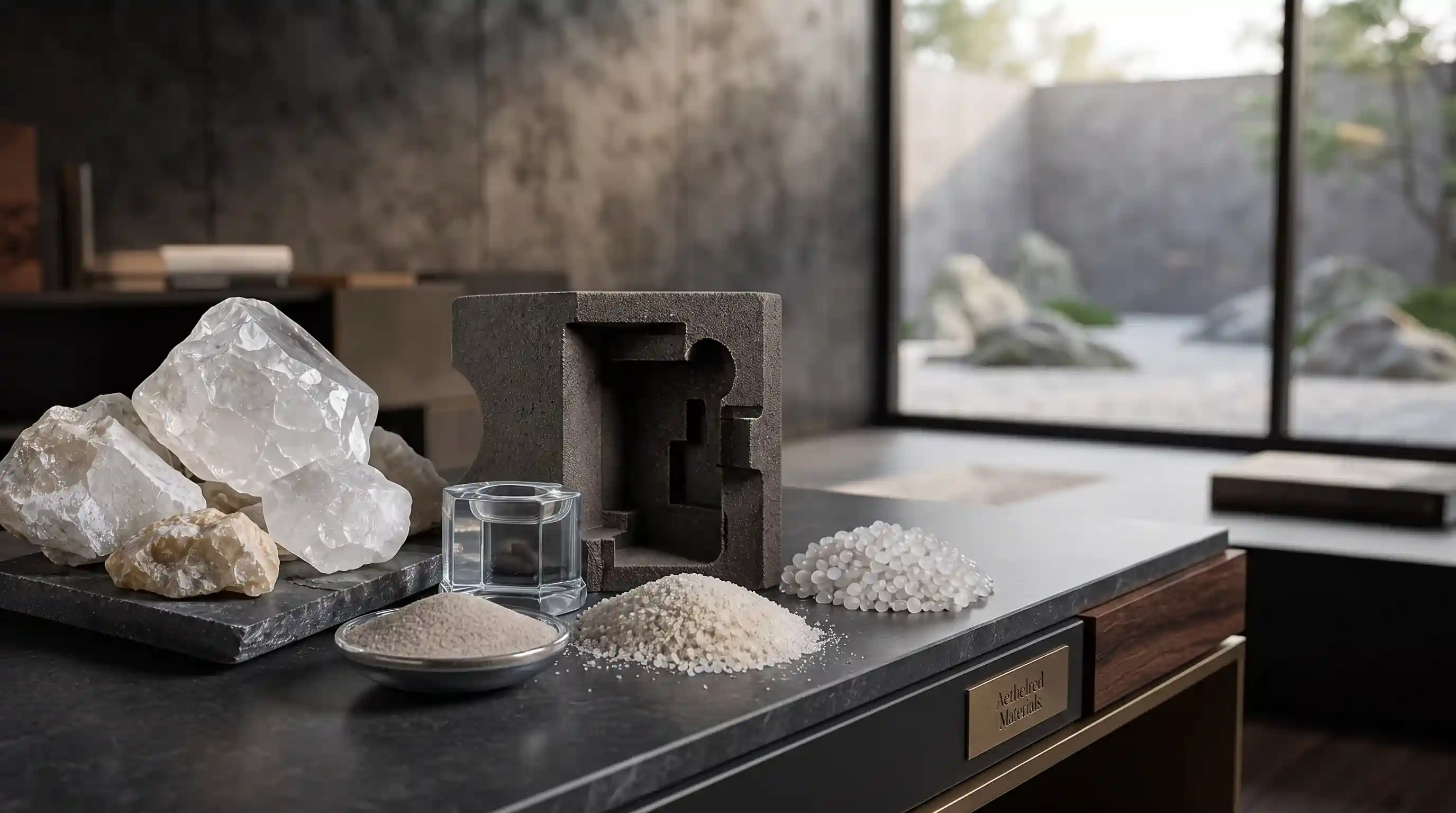
Guide to Choosing the Right Mesh Size: From 10 to 450 Mesh
Choosing the appropriate silica size is a vital step in product design and production line optimization. The first step is a proper understanding of the mesh unit and converting it into understandable values. As a reminder: the mesh number expresses the number of openings per inch of a standard sieve; therefore, 10 mesh silica contains coarser particles (about two millimeters and smaller) and 450 mesh silica contains very fine, micron-sized particles.
In the glass industry, intermediate gradations are typically used to strike a balance between melting speed, dust control, and batch homogeneity. In foundry work, the need for a combination of different sizes to build a mold with adequate permeability and a suitable surface is of the utmost importance. In ceramics, a fine size is preferred to reduce the firing temperature and improve the product surface, and in building materials, both the coarse range (as aggregate) and the fine range (as filler and pozzolanic material) are used.
To make the right choice, you must first answer the following questions:
- What does your main process require: fast melting, high reactivity, permeability, or bulk density?
- In the product manufacturing stage, is dust control and the flowability of the raw material important?
- Is your equipment (sieves, mixers, fuace, and feeding system) designed for the intended size?
- What particle size distribution (not just a single number) is desired for the final product?
Answering these questions helps you make a precise selection from the 10 to 450 mesh range. It should also be noted that shipment uniformity is as important as the size itself; large variations in the particle size distribution between different shipments can cause fluctuations in the quality of the final product and an increase in rejects. For this reason, continuous quality control and receiving gradation reports from the supplier are essential.
From a technical standpoint, common measurement methods include standard sieves (for coarser particles) and laser diffraction methods (for finer particles). Receiving a particle size distribution (PSD) report with every shipment is a professional habit in mineral purchasing; just as the article Investigating the Impact of Industrial Barite on Production Line Efficiency also points out the importance of controlling mineral specifications in the productivity of production lines.
Ultimately, choosing the right size is a multifaceted decision that must be made based on a precise understanding of the process, the equipment, and market demands. Consulting with a supplier that offers a wide range of sizes can be very helpful along this path.
Summary and Key Points for Buying Quality Silica
In this article, we examined the importance of silica particle size across various industries. From the glass industry, where faster melting and greater product homogeneity depend on particle size, to foundry work, where the permeability of the mold and the surface of the part change with the gradation; from ceramics, where finer particles help reduce the firing temperature and increase strength, to building materials, where both the coarse and fine ranges play distinct roles in the durability and strength of the product. In all of these cases, silica is not merely a raw material; it is a material whose behavior is entirely dependent on its physical characteristics.
The key points to keep in mind:
- Particle size and its distribution, alongside chemical purity, are the two main pillars of silica quality.
- The higher the mesh number, the finer the particles become, and the reactivity, melting speed, and bulk density all increase.
- Finer silica is not always better; the needs of the process, the equipment, and safety considerations must be taken into account.
- Shipment uniformity is as important as the particle size, and it must be controlled with gradation reports.
- Choosing a supplier with a wide range and transparent specifications reduces the risk of quality fluctuations.
When purchasing, be sure to ask the supplier to provide, in addition to the SiO₂ percentage and impurities, the gradation information, the mesh range, and the measurement methods. This transparency helps you optimize your process and make a better decision both economically and in terms of quality. For further reading on this topic, we recommend the article A Comprehensive Guide to Buying Quality Silica for Factories.
The Kani Sang Amiran project, by offering silica in the 10 to 450 mesh range for glass, foundry, ceramic, and building material applications, strives to cover the needs of various industries with precision and uniformity. An informed choice of raw material is the first step on the path to producing high-quality and durable products, and we hope this article has assisted you along this path.

| Question | Answer |
|---|---|
| What is silica particle size and how is it measured? | Particle size is the diameter of the silica grains, usually expressed as a range in mesh units, and is measured by methods such as standard sieves and laser diffraction. |
| What is the difference between low mesh and high mesh silica? | The higher the mesh number, the finer the particles; a low mesh indicates coarser particles and a high mesh indicates finer particles. |
| What silica size is suitable for the glass industry? | In the glass industry, intermediate sizes are typically used so that a high melting speed and batch homogeneity are maintained while dust control remains easy. |
| What effect does silica particle size have on foundry work? | Fine particles make the part surface smoother but reduce the mold permeability; therefore, a combination of different sizes yields the best result for reducing molding defects. |
| Why is fine-grained silica used in ceramics? | Finer particles have a larger surface area and are sintered at a lower temperature and in a shorter time, which helps increase the density, strength, and surface quality of the product. |
| What is the effect of silica on the strength of concrete? | Very fine silica particles act as a filler and a pozzolanic material, and by reducing porosity and producing strong compounds, they help increase the strength and durability of the concrete. |
| What does the 10 to 450 mesh range mean? | This range means the product includes a wide spectrum of particles, from coarse (about two millimeters and smaller) to very fine, micron-sized particles, and is suitable for diverse applications. |
| Is finer silica always better? | No; being excessively fine can cause increased water consumption, reduced workability, problems with material flow, and increased dust, and it should be selected based on the needs of the process. |
| How do I choose the right silica for my production line? | By determining the needs of the process (melting speed, permeability, reactivity), examining the equipment, and receiving gradation and particle size distribution reports from the supplier, you can make the right choice. |
| Where can quality silica be purchased? | The Kani Sang Amiran project offers silica in the 10 to 450 mesh range for glass, foundry, ceramic, and building material applications, and the product information is available on its product page. |
The information regarding the mesh range (10 450 mesh) and the main applications of silica in this article is derived from the product specifications of the Kani Sang Amiran project.

برچسب: Silica,Understand the Impact of Silica Particle Size on the Quality of Industrial Products,
نویسنده: رساوب آفرین