
درباره سایت
آخرین مطالب
- چگونه مشخصات فنی تالک صنعتی را بررسی کنیم؟
- Introduction to the Largest Mines for Extraction and Processing of White Barite
- دليل الاستشارة المهنية لشراء كربونات الكالسيوم
- Golden Tips for Choosing the Right Silica for Your Production Line
- Investigating the Effect of Moisture on the Final Quality of Industrial Barite
- The Role of Silica in Improving the Rheological Properties of Industrial Materials
- The Impact of Micronized White Barite Granulation on Final Product Quality
- بررسی تاثیر رطوبت بر کیفیت نهایی باریت صنعتی
- Examination of Industrial Barite Prices and Factors Affecting Its Valuation
- Review of Kaolin Application in Cement and Concrete Production Industries
امکانات وب
Introduction to Polymer Engineering and the Importance of Mineral Fillers
Polymer engineering is one of the most dynamic industries in the world today, operating with the aim of improving the mechanical, physical, and economic properties of polymeric materials. Among these, the use of fillers or mineral fillers plays a very key role in optimizing the final performance of products. Polymers alone may have limitations in strength, dimensional stability, and final cost. For this reason, engineers strive to minimize these challenges by adding appropriate mineral materials. Selecting the correct mineral filler is the most fundamental step in designing advanced polymer formulations and has a direct impact on the quality of the final product.
One of the most widely used of these mineral materials is coated calcium carbonate, which has found a special place in engineering formulations due to its unique surface characteristics. Compared to the regular type, this material is processed with a coating of fatty acids or coupling agents to create better compatibility with the polymer matrix. Focusing on the production of high-quality minerals, the Kani Sang Amiran project provides this product with precise technical specifications for various industries. A thorough understanding of this material's properties helps engineers make the best decisions in processes such as compound production and engineering parts.
In mode industrial processes, the uniform distribution of filler within the polymer matrix is of vital importance. Particle agglomeration can create weak points in the structure of the part and degrade mechanical properties. With its surface modification, coated calcium carbonate prevents particle agglomeration and facilitates their dispersion in polymer blends. This feature brings a dramatic improvement to the appearance quality and durability of manufactured parts while also optimizing production costs.
The Role of Coated Calcium Carbonate in Improving the Compounding Process
Compounding is one of the most sensitive stages in the plastics industry, where the base polymer is combined with various additives and fillers to produce granules with specific technical specifications. The use of coated calcium carbonate at this stage is very common due to improving the melt flow rate and reducing viscosity. When the polymer and filler are mixed together, the inteal friction of the system becomes important. The surface coating on the filler particles reduces the friction between the polymer chains and the particles, making the extrusion process smoother.
To better understand how this material affects the improvement of polymeric material structures, reading the article How does coated calcium carbonate increase the resistance of polymer products? is recommended, as it delves into the mechanical details of this phenomenon. By utilizing these properties, polymer engineers can increase the filler loading percentage in compounds without worrying about a sharp drop in the impact resistance or flexibility of the part. This directly leads to a reduction in the consumption of expensive base polymer and consequently reduces the final cost of the product.
Choosing the appropriate mesh in the compounding process is of utmost importance. This product is offered in a mesh range of 450 to 3500 mesh, allowing engineers to select the best granulation based on the final part thickness and the type of extrusion machinery. Precise granulation ensures that the final compound is produced with very high quality, without creating bubbles, roughness, or flow lines on the surface, and is ready for subsequent injection or extrusion stages.
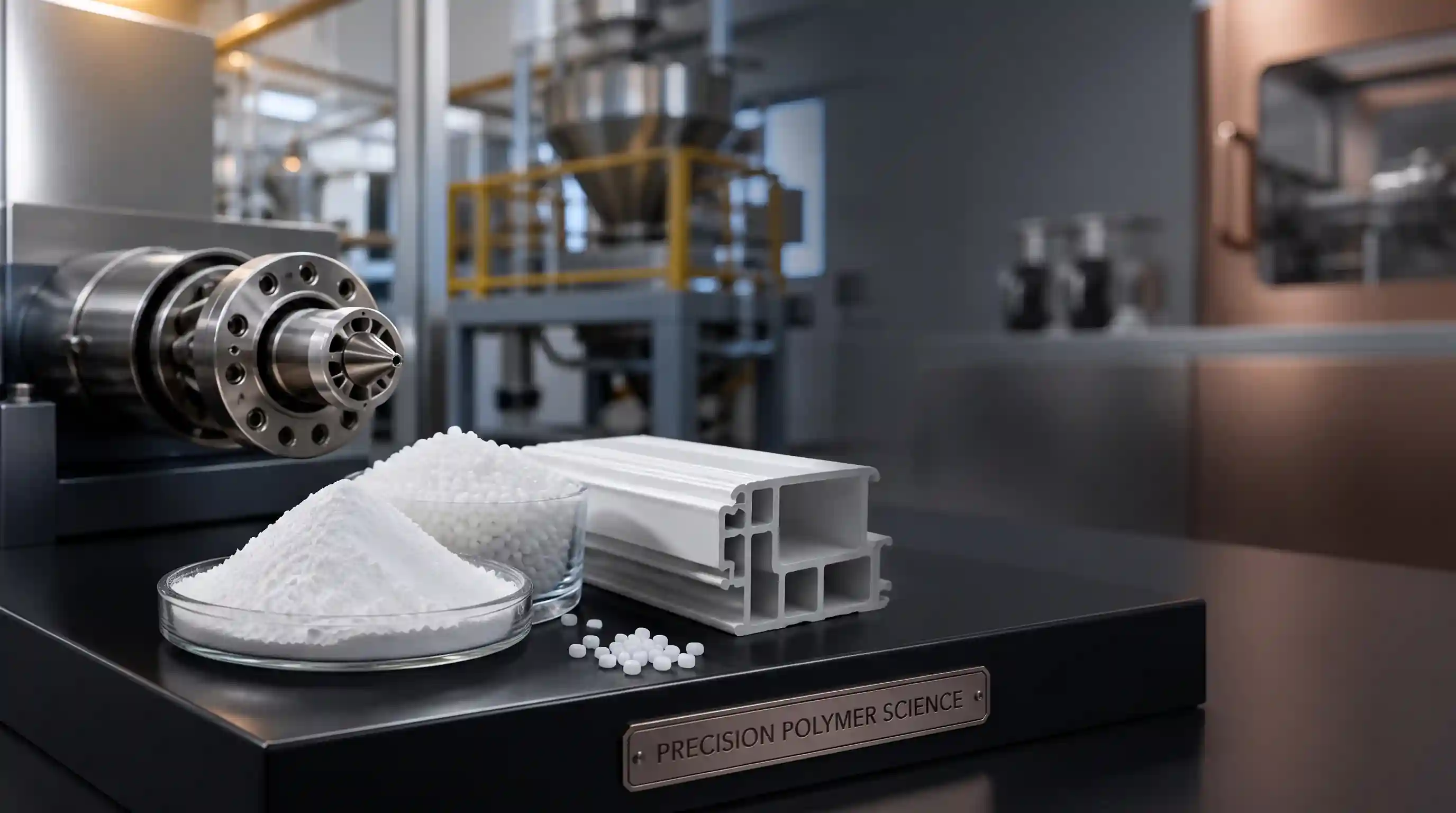
Production of High-Quality Polymer Granules with the Help of Coated Calcium Carbonate
Polymer granules are the incoming raw materials for many injection molding and blow molding units. The quality of these granules will determine the durability and stability of the final part. By adding coated calcium carbonate to granule production lines, the dimensional stability and rigidity of the granules are noticeably improved. Due to its stable chemical structure, this material minimizes dimensional changes caused by environmental heat or cold in the final part.
By supplying quality standards in the granulation process, the Kani Sang Amiran project provides manufacturers with a homogeneous product. The excellent compatibility of coated calcium carbonate with various thermoplastic polymers causes the produced granules to exhibit uniform behavior when remelted. This uniformity prevents problems such as pressure fluctuations in the injection machine and heterogeneity in the color or texture of the part.
On the other hand, there is a comprehensive review surrounding the status of this material in the industrial market, reading which gives active professionals in this field a broader perspective. In this regard, reading the Specialized guide to comparing various coated calcium carbonate types available in the market provides useful information regarding the selection of optimal options. Matching the technical characteristics of different meshes with the needs of the granule production line is considered an essential step toward enhancing the productivity of polymer factories.
Application in the Production of PVC Profiles and Construction Parts
The profile manufacturing industry and the production of rigid and soft PVC parts are among the largest consumers of mineral fillers in the world. In the production of doors and windows profiles, pipes, and gutters, mechanical properties and weather resistance are of vital importance. The use of coated calcium carbonate in these formulations causes the mineral particles to be well dispersed in the PVC matrix and distribute mechanical stresses uniformly.
The fatty acid coating on the coated calcium carbonate particles plays a very important role in preventing moisture absorption and increasing the thermal stability of the PVC compound. In the extrusion process of PVC profiles, materials are subjected to intense heat and mechanical shear. The presence of this coated filler prevents thermal degradation of the polymer and brings a glossy, smooth, and flawless surface to the profiles, which is very influential in the final appearance of the product.
To become more familiar with the practical aspects of this material in the plastics industry, you can read the comprehensive article Introduction to the application of coated calcium carbonate in the plastics industry. This article provides more details on improving the impact resistance and tensile properties of extruded parts. Choosing the appropriate mesh range from the options of 450 to 3500 mesh helps engineers implement the most optimal formulation based on the type of profile (rigid or foamed).

The Role of Coated Calcium Carbonate in the Wire and Cable Industry
The wire and cable manufacturing industry has very strict standards regarding the electrical, mechanical, and flammability properties of its products. Cable sheaths and insulations must exhibit high resistance to wear, tension, and temperature changes. Coated calcium carbonate is used as a specialized filler in the formulation of cable sheath polymer compounds (such as PVC and polyolefins) to maintain insulation properties in addition to reducing costs.
Due to the hydrophobic coating of coated calcium carbonate, moisture penetration into the cable insulation layer is significantly reduced, which prevents electrical coections and copper corrosion. By providing this high-purity mineral material, the Kani Sang Amiran project has met the need of cable manufacturers for a stable and reliable filler. The use of finer meshes (such as meshes above 1500) in thin cable jackets improves surface quality and increases product flexibility.
Additionally, the presence of coated calcium carbonate in cable compounds helps improve dispersion behavior and prevents the formation of particle aggregations that create dielectric weak points. By precisely adjusting the percentage of this filler, electrical and polymer engineers can achieve a proper balance between mechanical properties (such as elongation at break) and the economic price of the cable without compromising safety standards.
Application in Polymer Flooring and Rubber Tire Production
Polymer flooring and industrial tiles require appropriate wear resistance and rigidity due to being exposed to high foot traffic and continuous mechanical stresses. The use of coated calcium carbonate in the production of various vinyl floorings and rubber tires increases dimensional stability and resistance to point pressure. The coated particles react well with curing agents and polymer resins, creating a networked and resistant structure.
In flooring production, surface smoothness, color stability, and lack of deformation due to environmental temperature changes are key parameters. With its homogeneous distribution in the polymer matrix, coated calcium carbonate prevents warping and shrinkage of parts. The mesh range of 450 to 3500 mesh is an ideal choice for these industries so that the appropriate mesh can be utilized based on the layer type (underlayer, decorative layer, or protective layer).
By continuously supplying high-quality raw materials for the flooring industries, the Kani Sang Amiran project plays an important role in the stability of the final products' quality in the market. Utilizing the unique properties of this processed filler, formulation experts have been able to produce floorings with longer lifespans and optimized wear resistance that pass strict industrial standards.

The Importance of Selecting the Appropriate Mesh Range (450 to 3500 Mesh) in Engineering Processes
Particle size, or mesh, is one of the most important technical specifications of mineral powders in polymer engineering. The 450 to 3500 mesh range offered for coated calcium carbonate covers a wide spectrum of industrial needs. Lower meshes (such as 450 to 800) are mostly used in applications requiring high loading and general mechanical properties, while higher meshes (such as 1500 to 3500) are employed for thin films, sensitive injection-molded parts, and precision coatings.
Choosing the wrong mesh can have irreversible consequences on the production line; for example, using coarse particles in thin-walled parts causes melt fracture or a sharp drop in impact resistance. Conversely, using very fine meshes in general applications may not be economically viable. Therefore, a precise understanding of process requirements and consulting with the experts of the Kani Sang Amiran project is very helpful in selecting the appropriate mesh.
The surface coating of coated calcium carbonate is applied across all these mesh ranges to preserve hydrophobicity and compatibility with the polymer. This uniformity in coating, even in very fine meshes (3500 mesh) which have a very high specific surface area, ensures that the particles do not agglomerate and easily perform dispersion in mixer and extruder systems.
Economic and Environmental Benefits of Using Coated Calcium Carbonate
In addition to improving the technical and mechanical properties of polymer parts, the use of coated calcium carbonate brings significant economic benefits to manufacturing units. Since the price of primary polymer raw materials (virgin polymers) fluctuates greatly in global markets and is relatively expensive, replacing part of it with standard mineral fillers leads to a noticeable reduction in the final production cost. Increasing the loading percentage without a drop in quality significantly boosts factory profitability.
From an environmental perspective, the use of minerals abundant in nature, such as calcium carbonate, helps reduce industries' dependence on petroleum-derived products. The production and coating process of this material at the Kani Sang Amiran project is carried out while adhering to energy consumption optimization principles to minimize negative environmental impacts. This helps production units move in line with sustainable development standards.
Ultimately, the combination of precise engineering, selecting the appropriate mesh, and utilizing the surface-modification properties of this material provides a comprehensive solution for upgrading the country's polymer industry. Relying on the stable quality of this product, manufacturers can dramatically increase their competitiveness in domestic and foreign markets and offer products with global standards to the market.

| Question | Answer |
|---|---|
| What is coated calcium carbonate? | It is a type of calcium carbonate processed with fatty acids that has better compatibility with polymer matrices. |
| What is the mesh range of this product? | This material is supplied in a mesh range of 450 to 3500 mesh. |
| What are the main applications of this product? | Compounding, polymer granules, profiles, cables, flooring, and PVC parts. |
| Why is the coated type used? | To reduce viscosity, improve dispersion, and prevent particle agglomeration in the polymer. |
| Is this product used in granule production? | Yes, it is very suitable for improving the dimensional stability and rigidity of polymer granules. |
| What is its role in the cable manufacturing industry? | In addition to reducing costs, it creates water-repellent properties and prevents moisture penetration into the insulation. |
| How do we choose the appropriate mesh? | Selection is made from meshes 450 to 3500 based on part thickness, machinery type, and mechanical requirements. |
| Is it also used in PVC profiles? | Yes, it improves thermal stability and the surface quality of building profiles. |
| Where is the manufacturer of this product located? | Kani Sang Amiran Project — Production of Mineral Materials. |
| How can the product be obtained? | It can be ordered through the dedicated product page on the Kani Sang Amiran website. |
Specialized reference for mineral and industrial materials, Kani Sang Amiran Project.

برچسب: Coated Calcium Carbonate,Introduction to Special Applications of Coated Calcium Carbonate in Polymer Engineering,
نویسنده: رساوب آفرین